
Original version in Spanish: Extranjero que Trabaja en Argentina — Derechos, Trámites y lo que Necesitás Saber
Working in Argentina as a foreigner isn't complicated — but it has specific steps that, if omitted, create serious long-term problems. The provisional CUIL that was never unified with the definitive one. Retirement contributions that are lost due to a procedure that no one explained. The employer who believes they can fire or pay less for the worker's nationality. This section covers everything a foreigner who works or wants to work in Argentina needs to know: from immigration procedures to full labor rights, to retirement, taxes and protection against discrimination.
| Legal framework for migration | Law 25,871 and Decree 616/2010 |
| Labor legal framework | LCT — applies the same as for Argentine workers (art. 3) |
| Precarious residence | Up to 90 renewable days (Decree 366/2025) — enables you to work |
| Mercosur simplified | Temporary residence with only proof of nationality — without prior contract |
| No Mercosur | Requires employer sponsor and consular procedure |
| Provisional CUIL | It is obtained at ANSES with precarious residence — before the DNI |
| CUIL Unification | Mandatory when obtaining a DNI — at ANSES — free |
| Employment discrimination | Prohibited by Law 23.592 — nullity of the act + aggravated compensation |
| Irregular worker | You have full labor rights — the immigration violation is paid by the employer |
| POOM | 20 years of legal residence + 65 years — alternative to ordinary retirement |
| Labor Reform 2026 | Law 27,802 applies equally to foreign workers |
| Official Source | argentina.gob.ar | migraciones.gob.ar/anses.gob.ar |
| Last update | May 2026 |
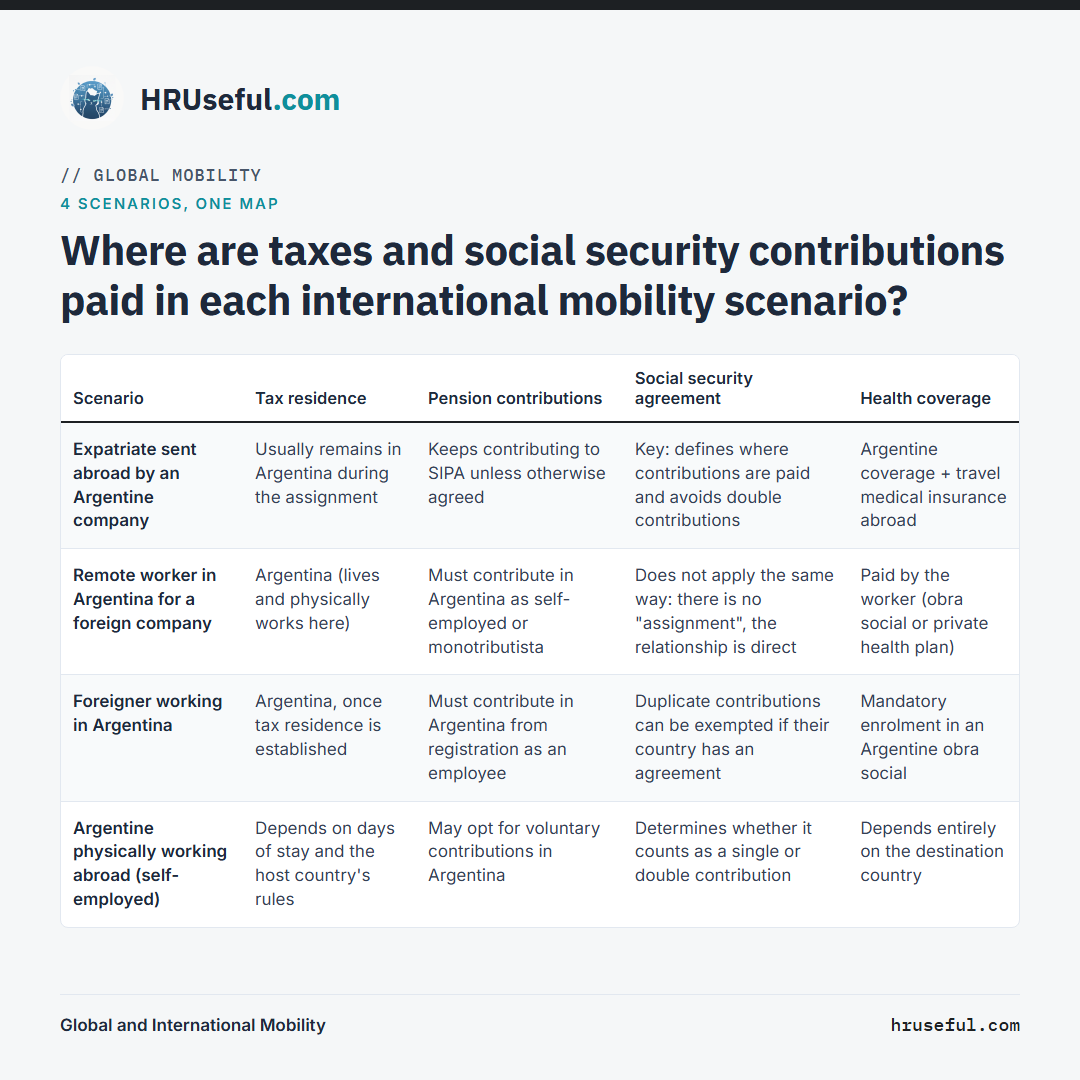
Can I avoid paying contributions in Argentina if my country of origin has a Social Security Agreement?
What happens if my country does not have a social security agreement with Argentina?
Does Argentine health insurance fund (obra social) cover my family if they came with me?
Migration Framework — Residencies and Requirements
To access the full content of this agreement you will need to register. It's free and takes less than a minute.
Register here: hruseful.com/registration/
CUIL and Registration — The Procedure You Can't Skip
To access the full content of this agreement you will need to register. It's free and takes less than a minute.
Register here: hruseful.com/registration/
Labor Rights — Equal to Any Worker's
To access the full content of this agreement you will need to register. It's free and takes less than a minute.
Register here: hruseful.com/registration/
Social Security — Retirement, Social Work and Unemployment
To access the full content of this agreement you will need to register. It's free and takes less than a minute.
Register here: hruseful.com/registration/
Legal Framework — Labor Reform 2026
To access the full content of this agreement you will need to register. It's free and takes less than a minute.
Register here: hruseful.com/registration/
Independent Work — Monotribute and CUIT for Foreigners
To access the full content of this agreement you will need to register. It's free and takes less than a minute.
Register here: hruseful.com/registration/
Taxes — Tax Residence and World Income
To access the full content of this agreement you will need to register. It's free and takes less than a minute.
Register here: hruseful.com/registration/
HRuseful Global — Migrant Workers in the Region
To access the full content of this agreement you will need to register. It's free and takes less than a minute.
Register here: hruseful.com/registration/
The information published is for guidance purposes and is based on Law 25,871, the LCT and complementary regulations in force as of May 2026. Migration and tax aspects require case-by-case analysis. Consult with a specialist before making decisions.
Now on Google Play
Your work support on your cell phone
Labor legislation in Argentina and the world, in one place and one click away. It is updated on its own with each new thing we publish.



Search for us on Google Play as “HRuseful” and “HRugame” · iPhone and computer: hruseful.com/our-app
FAQs
How does Labor Reform 2026 (Law 27,802) affect foreign workers?
In the same way as any worker in formal employment. Law 27,802 applies to all contracts governed by the LCT executed in Argentina, regardless of the worker's nationality. The changes in terms of compensation, probationary period, working hours, leave and trade union regime apply equally to foreign workers. There are no specific provisions that treat foreign workers differently in Law 27,802.
How would HRUSEful work for foreign workers in other countries in the region?
Foreign workers are one of the most vulnerable segments in any labor market — they are often unaware of their rights, do not speak the legal language of the host country and have less access to advice. In Brazil, Paraguayan, Bolivian and Venezuelan workers face barriers to accessing the Labor Code and the social security system. In Mexico, Central American workers have little information about their rights under the LFT. In Chile, the Peruvian, Venezuelan and Colombian communities have large employment information gaps. HRUSEful has the opportunity to be the platform that explains in clear language the rights of migrant workers in each jurisdiction — a market of tens of millions of people in the region that today does not have access to that information.
When should I unify the provisional CUIL with the definitive CUIL and what happens if I don't?
The unification must be requested at ANSES once the Argentine National Identity Card and the final CUIL have been obtained. If the unification is not carried out, the retirement contributions made by the employer with the provisional CUIL are dissociated from the definitive CUIL — the worker can reach retirement without being able to count years of contributions he actually made. It is one of the most frequent errors and with the most long-term consequences among foreign workers in Argentina. The procedure is free and can be done at any ANSES office.
Can an employer hire a foreigner without proper immigration documentation?
No. Law 25,871 states that hiring a foreigner in an irregular migratory situation is an offence that can result in fines for the employer. In addition, the employer who registers a worker without a valid CUIL incurs unregistered work (in black) with its consequences: registration claims, contributions and differences (the fines for unregistered work in Laws 24,013 and 25,323 were repealed by Law 27,742 in 2024, and their application to previous situations is being discussed in court). However – and this is critical – if the employer still hires the worker, the worker has full labor rights and can claim them in court.
Can an employer fire a foreign worker because of their immigration status?
No. The migratory situation is not a reason for dismissal. The employer who dismisses a foreign worker must do so in accordance with the same grounds and procedures as for any worker: justified cause with prior summary or payment of the corresponding compensation. If the dismissal is motivated by the worker's nationality or migratory status, it may constitute a discriminatory act that results in the nullity of the dismissal and aggravated compensation in accordance with Law 23.592.
Can a foreigner create a company or be a mono-taxpayer in Argentina?
Yes A foreigner with temporary or permanent residence can register as a mono-taxpayer or as a registered (autonomous) responsible person with ARCA, obtaining the corresponding CUIT. You can also set up a company (SRL, SA) in Argentina. A foreigner with only a CDI (without immigration residence) can form a company but has restrictions on being an administrator or legal representative. To work independently as a mono-taxpayer, foreigners need CUIT and regular immigration status.
Can a foreigner in Argentina claim employment discrimination?
Yes Law 23.592 on Discriminatory Acts prohibits discrimination based on national origin, ethnicity or any personal condition. In the workplace, discrimination in hiring, working conditions, promotions or dismissal on the basis of nationality results in the nullity of the discriminatory act and aggravated compensation. Argentine labor courts apply this law with broad criteria. Jurisprudence has established that refusing to hire a person because of their accent, their physical appearance associated with an ethnicity, or because they are a foreigner constitutes employment discrimination.
Can a foreigner legally work in Argentina?
Yes, as long as you have a regular immigration status. The Migration Act 25,871 establishes that foreigners with precarious, temporary or permanent residence can work in formal employment or independently in Argentina. There are no quotas or restrictions on the number of foreign workers — the only requirement is to have the immigration documentation in order. Foreigners in an irregular migratory situation cannot work legally, although if they do so they still have all the labor rights in the face of a possible complaint.
Can a foreign worker retire in Argentina?
Yes, meeting the same requirements as an Argentinian: 30 years of contributions to the SIPA and the required age (65 men, 60 women). If the foreign worker does not reach 30 years of contributions in Argentina but has contributions in their country of origin, they can total them through existing bilateral social security agreements. If there is no agreement with your country, foreign contributions are not counted and may not reach the minimum required. In that case, you can access the Universal Benefit for the Elderly (PUAM) with 20 years of contributions and 65 years of age, although with a reduced credit.
What social security contributions does a foreign worker make in Argentina?
The same as any worker in an Argentine formal employment: personal contributions to SIPA (retirement), PAMI, health insurance fund (obra social), and contribution to the National Employment Fund. The employer makes the corresponding employer contributions. Contributions are made to the Argentine system (ANSES/SIPA) regardless of the worker's nationality. If the foreign worker has already made contributions in their country of origin, bilateral social security agreements make it possible to total these periods to access retirement.
What labor rights does a foreigner working in Argentina have?
The same as any Argentine worker. Article 3 of the LCT establishes that Argentine law applies to any employment contract that is executed in national territory, regardless of the nationality of the parties. Foreign workers in formal employment have the right to: minimum wage, vacation, bonus, leave, severance pay, retirement benefits, health insurance fund (obra social), ART, and all the benefits of the CCT for their activity. Employment discrimination based on nationality or migratory status is expressly prohibited by Act No. 23,592 on Discriminatory Acts and Act No. 25,871.
What is the difference between CUIL, CUIT and CDI for a foreigner in Argentina?
They are three different keys with different functions. The CUIL identifies the worker with social security and is essential for working in a relationship of dependency. The CUIT identifies the taxpayer before ARCA (former AFIP) and is necessary for those who bill as mono-taxpayers, freelancers or companies. The CDI (Identification Code) is for foreigners without immigration residence who need to operate in the Argentine financial system (open bank accounts, buy real estate, etc.) but cannot obtain CUIT. Obtaining the wrong password for the situation causes delays and administrative complications — knowing which one is the right one is the first step in regularizing.
What is the difference between precarious, temporary and permanent residence to work in Argentina?
Precarious residence is a provisional authorization of up to 180 days (renewable) that is granted while permanent residence is being processed. It enables them to work, study and leave and re-enter the country during their term of office. Temporary residence is the main category for those who settle for a certain period (generally 1 to 2 years for Mercosur, up to 3 for non-Mercosur), renewable. It also enables you to work. Permanent residence allows you to live and work in Argentina indefinitely, without restrictions. Permanent residents have the same civil rights as Argentines, except for the right to vote.
What is the CUIL and why is it essential for foreign workers?
The CUIL (Unique Labor Identification Code) is the 11-digit number assigned by ANSES that identifies each person within the Argentine social security system. It is mandatory to work in formal employment, to receive retirement contributions and to access health insurance funds (obras sociales). Foreign workers with precarious or temporary residence can obtain a temporary CUIL before they have an Argentine national ID, allowing them to start working legally while processing the final documentation. When you obtain the DNI, ANSES automatically generates the definitive CUIL – and it is essential to request the unification of both so as not to lose the contributions made with the provisional CUIL.
What is the PUAM and when is it right for foreign workers?
The Universal Benefit for the Elderly (PUAM) is a non-contributory benefit that requires 20 years of legal residence in Argentina and 65 years of age, regardless of the years of contributions. For foreign workers who do not reach the 30 years of contributions needed for ordinary retirement, the PUAM may be an alternative. Your credit is equivalent to 80% of the minimum retirement. It is important to plan ahead to determine if it is appropriate to accumulate more contributions or access the PUAM — the decision depends on the age of entry into the Argentine system and the years of legal residence.
What health insurance fund (obra social) does a foreign worker have in Argentina?
Foreign workers in formal employment have access to the union health insurance funds (obras sociales) system just like an Argentinian worker. At the time of registration, you can choose the health insurance fund (obra social) of the union of your activity or for any health insurance fund (obra social) in the system. If you have a dependent family, you can join your family group as beneficiaries. Coverage includes health, maternity and basic PMO (Mandatory Medical Program) benefits. The right to health insurance fund (obra social) is born with employment registration — it does not require minimum seniority.
What about the taxes of a foreigner working in Argentina?
Once a foreigner acquires tax residence in Argentina (upon obtaining permanent residence or after 12 months of temporary authorization), he is covered by the Income Tax on his world income — that is, for all his income, both those obtained in Argentina and those from abroad. The assets you have abroad are also covered by the Personal Property Tax. Existing double taxation agreements can reduce the burden. A foreigner who works in Argentina but does not achieve tax residency is only taxed on his income from an Argentine source.
What procedure must a non-Mercosur foreigner do to work in Argentina?
A foreigner from outside Mercosur needs a work visa that generally requires: an employment contract with an Argentine employer, the employer's registration with the National Directorate of Migration as a sponsoring legal entity, the application for an Entry Permit for Migration, and the submission to the Argentine consulate in the country of origin. The process may take several months. The most common categories are temporary residence for dependent work and temporary residence for scientists, professionals or technicians. Migration rates vary: USD 300 for Mercosur citizens and USD 600 for non-Mercosur citizens approximately.
What advantages do Mercosur citizens have to work in Argentina?
Citizens of Mercosur countries and associated states (Brazil, Paraguay, Uruguay, Venezuela, Bolivia, Chile, Peru, Colombia, Ecuador, Guyana and Suriname) have access to a simplified residence procedure. Under the Mercosur Residence Agreement, just by proving their nationality and not having a criminal record, they can obtain temporary residence for 2 years – without the need to have a previous employment contract or sponsor. After 2 continuous years of temporary residence, they can apply for permanent residence. This is one of the most accessible migration regimes in the world for workers in the region.
Does a foreigner in an irregular migratory situation have labor rights?
Yes Although Law 25,871 prohibits hiring foreigners in an irregular situation and punishes the employer with fines, this prohibition does not reduce the rights of the immigrant worker. A foreigner who works without proper documentation has the same labor rights as any registered worker: they can claim unpaid salaries, severance pay, wage differences and unmade contributions. The employer cannot hide behind the worker's immigration irregularity to evade their obligations. The irregular migratory situation hurts the employer, not the worker.
Can a foreign worker access unemployment insurance in Argentina?
Yes, as long as you have worked in formal employment with contributions to the National Employment Fund and are dismissed without cause. The requirements are the same as for an Argentine worker: minimum 6 months of contributions in the last 3 years, having been dismissed without cause (not applicable for resignation), and having legal residence in Argentina. The amount and duration of the benefit depend on the length of time at work. It is one of the least known rights for foreign workers in Argentina.
2026 HRUseful.com — Contenido de elaboración propia basado en fuentes oficiales actualizadas a octubre 2026. Se permite la reproducción parcial o total con mención expresa de la fuente: hruseful.com. Para consultas y asesoramiento especializado visitá nuestro centro de contacto.