
Original version in Spanish: Trabajador Remoto desde Argentina para Empresa Extranjera — Derechos, Impuestos y lo que Necesitás Saber
Working from Argentina for a foreign company is today one of the most common and least legally understood employment situations. Are you an employee or independent? What taxes do you pay? Are you required to deposit dollars into the country? Do you have labor rights against a company that isn't even in Argentina? The answers aren't simple — and the consequences of being wrong are real. This section covers everything you need to know: from how to bill properly to what happens with your retirement, to payment platforms, cryptocurrencies, digital nomads and the expansion of the HRuseful model to other countries in the region.
| Billing form | Invoice type E (export) to ARCA |
| VAT exemption | Yes — exempt export of services (Law 20.631 art. 1, inc. b) |
| Export law | 5% — exempt for SMEs up to USD 600,000 per year |
| Foreign exchange settlement | Optional since April 2026 (Com. A8417 BCRA) — if you choose to settle, 20 business days from collection |
| Top not to liquidate | Eliminated since April 2026 (Com. A8417 BCRA, extends A8330) — formerly USD 36,000/year, now unlimited |
| Presumption of dependency | Deactivated by Law 27,802 when invoicing with CBU/CVU |
| Key Jurisprudence | Córdoba Court Ruling 2025 — Argentine courts competent for claims against foreign companies |
| Cryptocurrencies | CRS 2.0 signed July 2025 — ARCA detects digital assets abroad |
| Tech monotribute | Half sanction in Deputies — without active legislative status as of May 2026 |
| Official Source | arca.gob.ar/bcra.gob.ar/argentina.gob.ar |
| Last update | May 2026 |
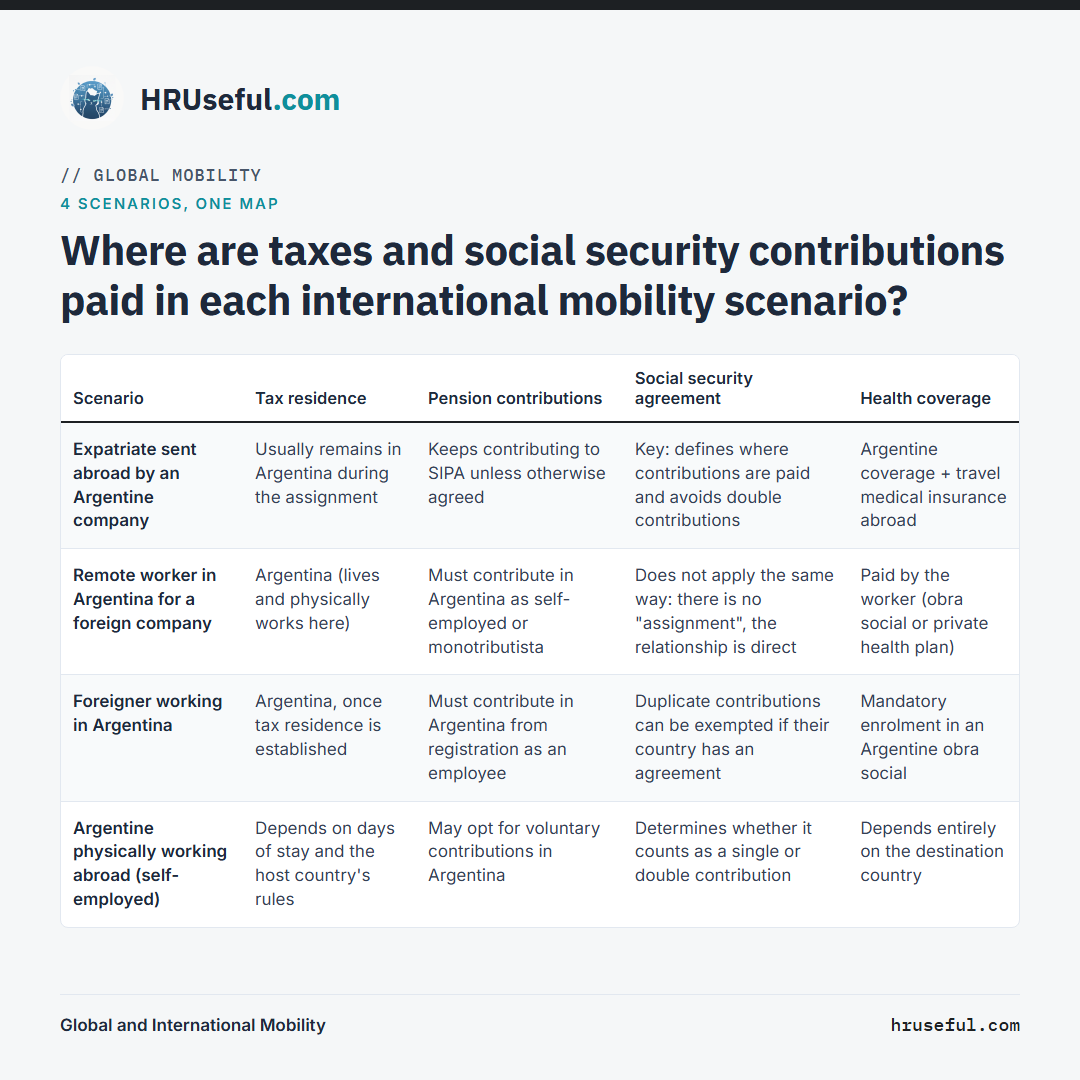
How should I bill my foreign employer if I work remotely from Argentina?
Does invoicing as a mono-taxpayer protect me from being treated as an actual employee by the foreign company?
Can I apply the concept of “independent collaborator” in Law 27,742 to my remote work?
Legal Framework — Are You an Employee or Independent?
To access the full content of this agreement you will need to register. It's free and takes less than a minute.
Register here: hruseful.com/registration/
Billing and Taxes
To access the full content of this agreement you will need to register. It's free and takes less than a minute.
Register here: hruseful.com/registration/
Foreign Exchange and BCRA — What Many Don't Know
To access the full content of this agreement you will need to register. It's free and takes less than a minute.
Register here: hruseful.com/registration/
Contributions and Retirement
To access the full content of this agreement you will need to register. It's free and takes less than a minute.
Register here: hruseful.com/registration/
Rights the Independent Doesn't Have — The Difference That Matters
To access the full content of this agreement you will need to register. It's free and takes less than a minute.
Register here: hruseful.com/registration/
Digital Nomads — Working Remotely While Traveling
To access the full content of this agreement you will need to register. It's free and takes less than a minute.
Register here: hruseful.com/registration/
Risks and Contingencies
To access the full content of this agreement you will need to register. It's free and takes less than a minute.
Register here: hruseful.com/registration/
HRuseful Global — The Coming Model
To access the full content of this agreement you will need to register. It's free and takes less than a minute.
Register here: hruseful.com/registration/
The information published is for guidance purposes and is based on regulations in force as of May 2026. Tax, exchange and pension aspects require case-by-case analysis. Consult with a specialist before making decisions.
Now on Google Play
Your work support on your cell phone
Labor legislation in Argentina and the world, in one place and one click away. It is updated on its own with each new thing we publish.


Search for us on Google Play as “HRuseful” and “HRugame” · iPhone and computer: hruseful.com/our-app
FAQs
How should an Argentinian who provides services to a foreign company bill?
You must issue a type E (export) invoice to ARCA. This invoice can be issued in foreign currency or in pesos, using the exchange rate purchased by Banco Nación the day before the issue was issued. To issue an E invoice, the worker must be registered as a mono-taxpayer or as a registered responsible person. Revenues from the export of services are exempt from VAT in Argentina. Invoice E is the document that legally supports the export of services and is essential to be able to bring foreign currency into the country.
How would HRUSEful work in Brazil for remote workers?
Brazil has the Consolidation of Labor Laws (CLT) with its 2017 reform that incorporated intermittent work, teleworking and expanded the possibilities of flexible hiring. Despite these reforms, cross-border remote work remains without clear regulation: millions of Brazilians work for companies in the United States and Europe without knowing if they have Brazilian labor rights, what contributions they must make to the INSS (social security), or how they are taxed in the Income Tax. The Superior Labor Court (TST) has disparate case law on working on platforms. HRUSEful Brazil would cover: CLT, reform 2017, cross-border teleworking, INSS, FGTS (Fundo de Garantía do Tempo de Serviço — equivalent to compensation), and the MEI (Individual Microentrepreneur — equivalent to mono-tax) regime.
How would HRUSEful work in Chile for remote workers?
Chile has the Labor Code with an ongoing pension reform that modifies the AFP (Pension Fund Administrators) system. Remote work has been regulated since 2020 by the Teleworking Act (Law 21.220). Cross-border work for foreign companies has the same gaps as in the rest of the region. HRuseful Chile would cover: Labor Code, Telework Act, AFP system and pension reform, unemployment insurance (AFC – Unemployment Fund Administrator), Fonasa/Isapres, and the Fee Bill regime for independent individuals.
How would HRUSEful work in Colombia for remote workers?
Colombia has the Substantive Labor Code (CST) and one of the most debated labor reforms in the region under way at the time of this publication. Working on digital platforms and cross-border remote work are unresolved issues in Colombian legislation. Colombia also has a complex social security system with contributions to health, pension and occupational risks that independent workers must manage on their own. In 2022, he created the Digital Nomad Visa. HRUSEful Colombia would cover: CST, platform work, pension system (average premium system vs. individual savings), Family Compensation Fund, and the particularities of the service provision contract vs. employment relationship.
How would HRUSEful work in Spain for remote workers?
Spain is the most frequent destination of the Argentine diaspora and has complex labor regulations: the Workers' Statute, the Teleworking Act (Law 10/2021), the self-employed regime (RETA), and since 2023 the Digital Nomad Visa. Argentines in Spain are often unaware of their local labor rights — especially with regard to settlement, unemployment benefits (unemployment), contributions to Spanish Social Security, and complementarity with the Argentina-Spain bilateral agreement. HRUSEful Spain would cover: Workers' Statute, sectoral collective agreements, RETA, unemployment benefit, Spanish pension system, and the Argentina-Spain bilateral social security agreement for the totalization of contributions.
How would HRUSEful work in Mexico for remote workers?
Mexico profoundly reformed the Federal Labor Law (LFT) in 2021 on two critical fronts: it incorporated teleworking as a specific modality with its own rights (equipment, connectivity, ergonomics) and eliminated outsourcing as a mechanism for labor evasion, forcing companies to register their workers directly. However, remote work for foreign companies remains in a gray area: there is no clear regime for Mexican freelancers who export services. HRuseful Mexico would cover: LFT, teleworking, post-reform outsourcing regime, IMSS (social security), Infonavit, Afore (individual capitalization retirement system), and the RIF/RESICO tax regime for independent individuals.
Does the independent remote worker have access to unemployment insurance?
No. Unemployment insurance (National Employment Fund, Law 24.013) is exclusive for dependent workers who are dismissed without cause. The independent worker, the mono-taxpayer and the self-employed do not have access to this benefit even if their income abruptly ceases. This is one of the biggest vulnerabilities of the independent remote worker: in the face of the loss of an important customer or the end of a contract, they have no state containment network. Personal financial planning with an emergency fund equivalent to several months' worth of expenses is essential for any independent remote worker.
Is the independent remote worker entitled to paid vacation, bonus and leave of absence?
No. This is one of the most important and least significant differences between the independent worker and the employee in formal employment. The freelancer or mono-taxpayer who provides services abroad does not have: paid vacation (he may not work, but he doesn't charge), bonus (SAC), paid sick leave, paid maternity leave (unless his health insurance fund (obra social) partially covers it), or unemployment insurance. The independent worker must self-finance these periods. When comparing income between formal employment and a service contract, these benefits should be considered as part of the total cost of the relationship — they generally represent an additional 30% to 40% of gross salary.
Is an Argentinian who pays from abroad obliged to deposit foreign currency into the country?
Yes. Communication A6770 of the BCRA states that exports of services must be entered into the country within 20 business days of receiving payment. This obligation applies regardless of the amount and regardless of whether the worker is a large company or an individual freelancer. Since September 2025 (Circular A8330 of the BCRA), the annual limits for not pesifying have been eliminated and the worker can keep the dollars in their Argentine bank account. Failure to meet the foreign exchange deposit deadline may result in exchange fines.
Is income from foreign services exempt from VAT in Argentina?
Yes. Exports of services are exempt from VAT in accordance with Article 1, paragraph b) of the VAT Act (Law 20,631), provided that the supply is carried out in Argentina but its actual use is carried out abroad. This covers most remote services provided to foreign companies. The exemption must be validated with an accountant in each particular case, since the tax authorities may question the qualification in specific situations.
Can there be formal employment between an Argentine worker and a foreign company?
Yes, and it's more common than you think. When an Argentine worker provides services for a foreign company with fixed hours, under direct orders, exclusively and on a continuous basis, a relationship of labor dependence regulated by the Argentine LCT can be formed, regardless of whether the contract says otherwise or whether the company is a foreign company. A ruling by the Associated Management Court of Córdoba (2025) established that Argentine courts are competent to judge these relationships and can apply local labor law. Foreign companies that hire Argentine workers under these conditions without properly registering them have significant labor and tax contingencies.
Can an Argentinian remote worker be in formal employment with a foreign company without it having a presence in Argentina?
Technically yes, but it's complex. To register an employee in Argentina, the foreign company must register with ARCA (obtain CDI or CUIT), make social security contributions, and pay the salary. This can set up a permanent establishment in Argentina with tax consequences for the company. For this reason, many foreign companies choose to hire Argentines as independent (invoice E) even though the relationship has characteristics of dependence. This practice is the international labor fraud that Argentine jurisprudence has been questioning.
Can an Argentinian remote worker keep dollars in their account without weighing them down?
Yes, since September 2025. BCRA Circular A8330 eliminated the obligation to pesify revenues from the export of services. The worker can deposit the currencies within 20 business days and keep them in dollars in their Argentine bank account. Previously, there were annual limits not to pesify (which grew from USD 12,000 to USD 36,000 before being eliminated). This is one of the most favorable changes in recent years for Argentinian remote workers.
Can an Argentinian remote worker claim labor rights against a foreign company?
Yes. Argentine labor courts have assumed jurisdiction in claims by workers who provide services from Argentina for foreign companies when the relationship has characteristics of dependency. Article 3 of the LCT states that Argentine law applies when the contract is executed on national territory. The ruling of the Court of Córdoba (2025) is a relevant precedent. The foreign company can be notified through diplomatic channels or through the mechanisms of private international law.
Can a remote worker get paid in cryptocurrency and avoid the obligation to deposit currency?
It is an area of high regulatory uncertainty. The BCRA has interpreted that the foreign exchange obligation applies to collections in foreign currency — cryptocurrencies are not technically currencies. However, in July 2025, Argentina signed the CRS 2.0 framework, which extends the automatic exchange of information to digital assets and tokenized instruments. ARCA has a growing capacity to detect foreign cryptocurrency holdings. The collection in crypto may not generate a formal exchange obligation, but it does create tax obligations (Profits and Personal Assets) that must be declared. The strategy of charging in crypto to avoid exchange controls has increasing legal risks.
What retirement contributions does an independent Argentinian remote worker make?
The mono-taxpayer makes the contributions included in their monthly payment, which include a pension component (retirement) and a health insurance fund (obra social) component. The registered manager makes contributions as a self-employed person to ANSES according to the corresponding category. In both cases, the contributions go to the Argentine system (SIPA/ANSES) regardless of whether the income comes from abroad. The critical difference with the employee in formal employment is that the independent worker provides only part of the employee — there is no employer contribution to complement it, resulting in significantly lower retirement savings in the long term.
What minimum clauses must an international services contract have to protect Argentinian workers?
A service contract with a foreign company must include: applicable law and jurisdiction (ideally Argentina), a precise description of the service (to avoid being recharacterized as formal employment), form and currency of payment, payment period and consequences of non-compliance, confidentiality, intellectual property (who owns what the worker produces), grounds for termination and minimum notice, and a dispute resolution mechanism. The absence of these clauses leaves the worker in a position of vulnerability in the face of a possible conflict with the foreign client.
What is the right to export services and when does it apply?
The provision of services carried out in Argentina whose actual use is carried out abroad are taxed with an export duty of 5% on the amount invoiced. Micro and Small Businesses registered as SMEs are only beginning to tax it on the excess of USD 600,000 per year — practically no individual freelancer reaches that threshold.
What is the Tech monotributo (simplified tax regime) and what state is it in?
The Tech Monotribute is a project that received half a sanction in Deputies but was not converted into law. It proposes a special mono-tax category for small exporters of technology and services with three categories of up to USD 10,000, USD 20,000 or USD 30,000 per year, with the possibility of collecting and keeping dollars in special accounts. If it becomes law, it would significantly simplify the situation of Argentinian tech freelancers. As of May 2026, there is no confirmed active legislative status.
What is a digital nomad and what legal complexities does it have for an Argentinian?
The digital nomad is someone who works remotely while traveling or living in different countries. For an Argentinian who adopts this lifestyle, the complexities multiply: fiscal residence (in which country do you pay taxes?) , obligation to deposit foreign currency to the BCRA (does it apply if you don't live in Argentina?) , social security agreements (in which system do you provide?) , and work visas (many countries have specific visas for digital nomads). If Argentinians spend more than 183 days in another country, they can acquire tax residence in that country and lose their Argentine residence, with consequences for profits and personal assets. Each country has its own rules — Spain, Portugal, Mexico and Colombia have digital nomad visas with different requirements.
What is a remote worker from Argentina and how is it different from a freelancer?
The remote worker from Argentina is someone who, living in the country, provides services for a company or client from abroad. You can do this in two ways: as an independent worker (freelancer, mono-taxpayer or registered manager) who bills your services as an export, or as an employee in formal employment with a foreign company that formally hires you. The difference isn't just administrative — it has completely different legal, tax and pension consequences. The way in which the relationship is structured determines what rights you have, what taxes you pay and what contributions you make.
What does Law 27,802 entail for remote workers who provide services to foreign companies?
Law 27,802 created the figure of the independent platform worker, giving a legal framework to service contracts that previously existed in a gray area. For independent remote workers, the reform disables the presumption of dependency in Article 23 LCT when the worker bills and charges through formal banking systems (CBU/CVU). However, if the relationship has characteristics of real dependency (imposed schedule, exclusivity, direct orders), whoever alleges employment can sue it in court – but now they must prove it without relying on automatic presumption.
What health insurance fund (obra social) does an Argentinian remote worker who bills abroad as a mono-taxpayer have?
The mono-taxpayer has access to health insurance fund (obra social) through the mono-tax system of health insurance funds (obras sociales) and can choose from those available. Unlike the employee in formal employment, the mono-taxpayer does not have ART (Occupational Risk Insurance). If you have an accident while working, you do not have specific employment coverage and you must resort to health insurance fund (obra social) or private insurance. For remote workers who perform tasks with a high physical or mental impact, taking out supplementary insurance is recommended.
Which countries have a digital nomad visa and how does an Argentinian access it?
Several countries created specific visas for remote workers who want to live legally in their territory without working for local companies. Spain has had the Digital Nomad Visa since 2023, which requires proof of minimum income equivalent to 200% of the Spanish minimum wage. Portugal has the D8 Visa for remote workers. Mexico does not have a specific visa but allows you to work remotely with a tourist visa for up to 180 days. Colombia has had the Digital Nomad Visa since 2022 with a minimum income requirement of USD 684 per month. For an Argentinian, access to these visas is generally simple since they do not require a local work permit — but they do create tax obligations in the host country if the stay exceeds the tax residence thresholds.
What about the Income Tax of an Argentinian remote worker?
The revenues obtained from services provided from Argentina to clients from abroad are from Argentina and are taxed by Profits. The independent worker declares them in their annual return. If you also have income from a foreign source (investments), you also declare them as world income. Double taxation agreements may reduce the burden in some cases, but for services provided to U.S. clients – without an agreement – there may be withholding at the U.S. source that is not fully creditable in Argentina.
What happens when foreign income exceeds the mono-tax ceiling?
The mono-tax has categories with annual billing caps. When income from the export of services exceeds the ceiling of the highest category of mono-taxation, the worker must switch to the general regime: register for VAT as a registered responsible person and tax Profits as a self-employed person. This change implies a greater administrative and accounting burden, a higher tax rate on net income, and self-employed contributions calculated on higher tax bases. It's one of the most critical moments in the career of a successful Argentinian freelancer and requires advance planning with an accountant.
What if a remote worker charges through Payoneer, Wise, or PayPal instead of direct bank transfer?
The use of international payment platforms such as Payoneer, Wise or PayPal does not exempt the obligation to deposit currencies into the country within 20 business days. The exchange obligation applies from the moment the payment is received, regardless of the platform used. The worker must transfer the funds from these platforms to their Argentine bank account within the deadline. Collecting and holding funds on these platforms without entering them into the Argentine banking system is an exchange default that can result in fines. This is a very common risk area among freelancers who are unaware of foreign exchange regulations.
What are the risks for foreign companies to hire Argentinian workers without registering them properly?
The risks are twofold: labor and tax. At the employment level, if the relationship has characteristics of dependency, the company may be ordered to pay compensation, wage differences, omitted contributions and fines. Argentine courts have assumed jurisdiction even when the company has no physical presence in the country. At the tax level, hiring workers in Argentina can form a permanent establishment, generating local tax obligations. These contingencies are especially relevant in international mergers and acquisitions.
2026 HRUseful.com — Contenido de elaboración propia basado en fuentes oficiales actualizadas a octubre 2026. Se permite la reproducción parcial o total con mención expresa de la fuente: hruseful.com. Para consultas y asesoramiento especializado visitá nuestro centro de contacto.