
Trabajadoras del Hogar en India — Guía Laboral Completa
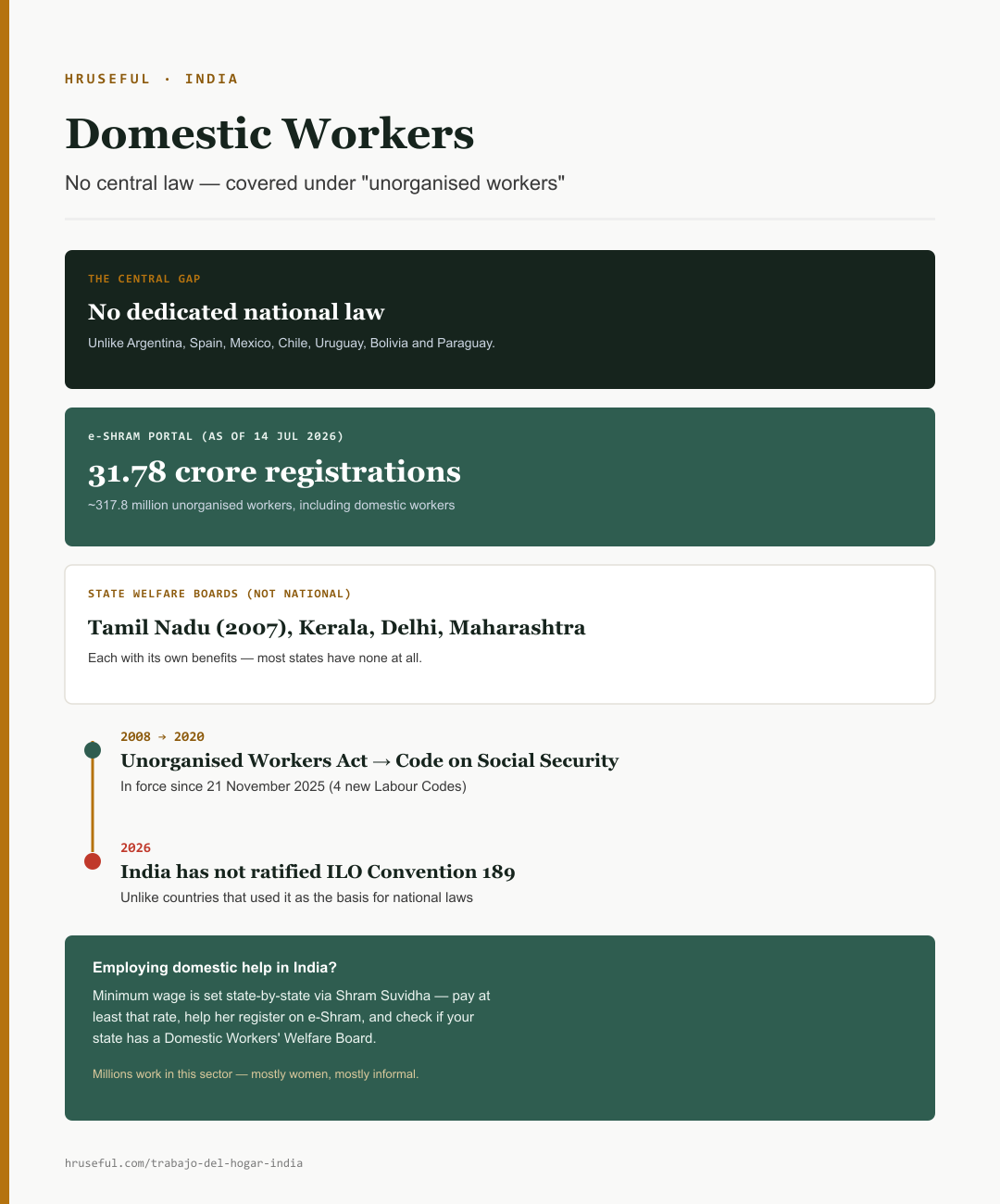
India no tiene una ley central específica de trabajo doméstico, a diferencia de Argentina, España, México, Chile, Uruguay, Bolivia o Paraguay. Esta guía explica con honestidad ese vacío, qué normas generales sí aplican (Code on Wages, Code on Social Security), el portal e-Shram, y las juntas estatales de bienestar que sí existen en algunos estados como Tamil Nadu, Kerala, Delhi y Maharashtra. Pensada tanto para quien trabaja en el sector como para quien emplea.
¿Existe en India una ley central específica de trabajo doméstico?
No. A diferencia de Argentina, España, México, Chile, Uruguay, Bolivia o Paraguay, India no tiene una ley nacional dedicada exclusivamente al trabajo doméstico — es uno de los países con mayor población de trabajadoras domésticas del mundo sin ese marco específico a nivel federal.
¿Bajo qué marco general caen entonces las trabajadoras domésticas?
Bajo el paraguas más amplio de “trabajadores no organizados” (unorganised workers), regulado primero por la Unorganised Workers’ Social Security Act de 2008 y ahora mayormente absorbido por el Code on Social Security de 2020, uno de los cuatro nuevos Códigos Laborales vigentes desde el 21 de noviembre de 2025.
¿Qué significa “trabajador no organizado” en este contexto?
Es la categoría legal para el enorme sector informal indio: trabajadores sin contrato formal, sin relación de dependencia clara con un único empleador registrado, y sin la protección automática de las leyes laborales pensadas para fábricas y empresas — el trabajo doméstico es uno de los ejemplos más grandes de esta categoría.
¿El Code on Wages de 2019 cubre a las trabajadoras domésticas?
En principio sí — el Code on Wages busca extender la protección de salario mínimo a todo tipo de empleo, incluido el doméstico — pero a 2026 las reglas (rules) de implementación específicas para este sector todavía se están terminando de definir en varios estados.
¿Por qué hay una brecha entre lo que dice la ley y lo que pasa en la práctica?
Porque el trabajo doméstico ocurre dentro de hogares privados, un espacio donde la inspección laboral tradicional casi no llega — a diferencia de una fábrica, no hay forma sencilla de que el Estado verifique de forma rutinaria si se paga el salario mínimo o si existe algún tipo de registro.
¿Qué es el portal e-Shram?
Es la base de datos nacional de trabajadores no organizados de India, lanzada en 2021, pensada para identificar y registrar a millones de trabajadores informales —incluidas las trabajadoras domésticas— y facilitarles el acceso a esquemas de bienestar del gobierno central y estatal.
¿Cuántos trabajadores están registrados en e-Shram?
Al 14 de julio de 2026, el portal superó los 31,78 crore de registros (equivalente a unos 317,8 millones de personas) — una cifra que da una idea de la escala del sector informal indio, del cual el trabajo doméstico es una parte significativa.
¿El registro en e-Shram da automáticamente derechos laborales?
No, es principalmente una herramienta de identificación y acceso a esquemas de bienestar (seguros, pensiones no contributivas, ciertos subsidios) — no reemplaza ni genera por sí solo un contrato de trabajo ni el reconocimiento de una relación de dependencia formal con un empleador específico.
¿Una trabajadora doméstica puede registrarse en e-Shram aunque trabaje para varias familias?
Sí, el registro es individual y no depende de tener un único empleador — de hecho, está pensado justamente para trabajadores con vínculos laborales múltiples, informales o cambiantes, como es habitual en este sector.
¿Qué son las Domestic Workers’ Welfare Boards?
Son organismos creados por gobiernos estatales específicos —no por una ley nacional— para brindar cobertura de bienestar (seguro de salud, pensión, ayuda educativa para los hijos, mecanismos de reclamo) a las trabajadoras domésticas registradas en ese estado en particular.
¿Qué estados tienen una junta de este tipo?
Entre otros, Tamil Nadu (pionera, creada en 2007), Kerala, Delhi y Maharashtra — cada una con su propio esquema de beneficios, requisitos de registro y financiamiento, sin un modelo único nacional.
¿Qué cubre típicamente la junta de Tamil Nadu?
Como pionera del modelo, ofrece asistencia económica en situaciones como el parto, accidentes y matrimonio de la trabajadora o de sus hijos, además de mecanismos de resolución de conflictos con empleadores — un esquema que sirvió de referencia para otros estados.
¿Qué pasa si una trabajadora doméstica vive en un estado sin junta de bienestar propia?
Depende principalmente de la cobertura general que puedan darle el e-Shram y los esquemas nacionales del Code on Social Security, sin el nivel adicional de protección estatal específica que sí tienen sus pares en Tamil Nadu, Kerala, Delhi o Maharashtra — una desigualdad real entre estados.
¿Cómo se financian estas juntas estatales?
Varían según el estado, combinando presupuesto público estatal, en algunos casos pequeñas contribuciones de empleadores registrados, y fondos específicos asignados para programas de bienestar social del gobierno estatal correspondiente.
¿Existe un salario mínimo nacional único para el trabajo doméstico en India?
No de forma unificada — el salario mínimo en India se fija principalmente a nivel estatal, y varía significativamente según el estado, la zona (urbana o rural) y, en algunos casos, la categoría de habilidad de la tarea.
¿Cómo puede una trabajadora o un empleador consultar el salario mínimo vigente en su estado?
A través del portal unificado Shram Suvidha del Ministerio de Trabajo, que permite buscar las tasas de salario mínimo vigentes según el estado y la categoría de empleo correspondiente.
¿Hubo actualizaciones importantes de salario mínimo en 2026?
Sí, varios estados actualizaron sus tasas de forma significativa: Uttar Pradesh subió un 21%, Haryana un 35%, y Karnataka realizó una revisión importante en mayo de 2026 que reseteó las tasas en todas las zonas y niveles de habilidad.
¿El salario mínimo estatal aplica automáticamente al trabajo doméstico?
Depende de si el estado incluyó explícitamente al trabajo doméstico dentro de las categorías de empleo cubiertas por su notificación de salario mínimo — no todos los estados lo hicieron de forma clara e inequívoca, lo que genera zonas grises reales.
¿Qué debería hacer una familia que emplea a una trabajadora doméstica para actuar de forma responsable?
Pagar como mínimo la tasa de salario mínimo estatal vigente para la categoría correspondiente, ayudar a la trabajadora a registrarse en e-Shram si no lo está, y verificar si el estado cuenta con una junta de bienestar a la que pueda afiliarse.
¿Existe alguna obligación formal de “dar de alta” a una trabajadora doméstica ante alguna autoridad?
No existe un trámite único y obligatorio a nivel nacional como en otros países de esta guía — el registro más cercano disponible hoy es el voluntario en e-Shram (por parte de la trabajadora) y, donde exista, la afiliación a la junta estatal de bienestar correspondiente.
¿Qué riesgo legal corre un empleador que paga por debajo del salario mínimo estatal?
Se expone a sanciones bajo el Code on Wages si la autoridad laboral estatal detecta el incumplimiento, aunque la fiscalización efectiva dentro de domicilios particulares es en la práctica mucho más débil que en un entorno de fábrica o empresa.
¿El empleador puede deducir el costo de la comida o el alojamiento del salario de una trabajadora que vive en la casa?
No existe una regla nacional uniforme y detallada sobre esto para el trabajo doméstico específicamente — conviene pactarlo con claridad por escrito y, ante la duda, no reducir el salario en efectivo por debajo del mínimo estatal vigente.
¿Existe un límite de jornada específico para el trabajo doméstico?
No hay una regla nacional única y detallada como en otros sectores — el Occupational Safety, Health and Working Conditions Code fija principios generales de jornada razonable, pero su aplicación práctica al trabajo doméstico dentro de hogares particulares todavía es limitada.
¿Una trabajadora doméstica “vive adentro” (live-in) tiene descanso garantizado?
No existe una norma nacional detallada equivalente a la de otros países de esta guía sobre descanso mínimo diario o semanal para esta modalidad específica — es un área donde las organizaciones de trabajadoras domésticas vienen reclamando mayor claridad legal.
¿Puede trabajar para varias familias distintas en un mismo día?
Sí, es una modalidad muy común en India (trabajar por horas para distintos hogares), y no existe una restricción legal específica que lo impida — cada relación con cada familia es, en la práctica, independiente.
¿Qué tan grande es el sector del trabajo doméstico en India?
Es uno de los sectores de empleo informal más grandes del país, con estimaciones que ubican a millones de personas —mayoritariamente mujeres— trabajando en esta actividad, aunque las cifras exactas varían según la fuente, precisamente por la naturaleza informal del sector.
¿Qué organizaciones defienden los derechos de las trabajadoras domésticas en India?
Existen sindicatos y organizaciones de la sociedad civil activos en distintos estados que impulsan la extensión de derechos, la creación de juntas de bienestar donde no existen, y la ratificación por parte de India del Convenio 189 de la OIT sobre trabajo doméstico.
¿India ratificó el Convenio 189 de la OIT sobre trabajadoras domésticas?
No, India todavía no ratificó ese convenio internacional específico, a diferencia de otros países que sí lo hicieron y que en muchos casos usaron esa ratificación como base para sancionar sus propias leyes nacionales de trabajo doméstico.
¿Qué puede hacer una trabajadora doméstica si su empleador no le paga lo acordado?
Puede acudir a la junta de bienestar estatal si existe en su estado, presentar una queja ante la autoridad laboral estatal correspondiente, o buscar apoyo de organizaciones sindicales y de la sociedad civil especializadas en este sector.
¿Muchas trabajadoras domésticas en India migran desde otros estados?
Sí, es un patrón muy extendido: mujeres de estados como Jharkhand, Odisha, Bengala Occidental o del noreste de India migran a las grandes ciudades (Delhi, Mumbai, Bangalore) para trabajar en el servicio doméstico, muchas veces a través de agencias de colocación.
¿Las agencias de colocación de trabajadoras domésticas están reguladas?
La regulación varía mucho según el estado, y en la práctica muchas agencias operan con escasa supervisión — es un área donde han surgido preocupaciones documentadas sobre condiciones de reclutamiento poco transparentes y, en los casos más graves, riesgo de explotación.
¿Existe alguna protección específica para trabajadoras domésticas menores de edad?
Sí, el trabajo doméstico está incluido entre las ocupaciones prohibidas para menores de 14 años bajo la Child Labour (Prohibition and Regulation) Act, y sujeto a restricciones adicionales para adolescentes de 14 a 18 años bajo las normas generales de trabajo infantil y adolescente.
¿Una trabajadora doméstica puede acceder a algún esquema de seguro de salud del gobierno?
Sí, a través de su registro en e-Shram puede acceder a ciertos esquemas nacionales de seguro de salud para trabajadores no organizados, además de los esquemas de salud pública general disponibles para toda la población.
¿Qué pasa si sufre un accidente mientras trabaja?
Sin una cobertura de accidentes de trabajo específica y obligatoria para el sector (a diferencia de lo que exige el Code on Social Security para trabajadores formales registrados en EPF/ESI), depende principalmente de la atención médica pública general y de cualquier esquema de bienestar estatal al que esté afiliada.
¿El Code on Social Security prevé beneficios de maternidad para trabajadoras domésticas?
El Code contempla en principio la extensión de beneficios de maternidad a trabajadoras no organizadas a través de esquemas de bienestar estatales financiados por el gobierno, aunque la implementación efectiva y uniforme todavía está en desarrollo en distintos estados a 2026.
¿Es lo mismo una trabajadora doméstica que una niñera contratada a través de una agencia formal de cuidado infantil premium?
No necesariamente — algunas agencias urbanas modernas ofrecen contratos más formales con mejores condiciones para roles de cuidado especializado, pero la gran mayoría del trabajo doméstico en India sigue ocurriendo por fuera de ese circuito formal, bajo arreglos informales directos con la familia.
¿Un trabajador de limpieza contratado a través de una empresa de facility management tiene el mismo vacío legal?
No, esa relación laboral es con la empresa formal que lo contrata, no con cada hogar donde presta servicio — esas empresas sí están sujetas a las obligaciones generales de los Códigos Laborales como cualquier empleador formal registrado.
¿El cuidado de un adulto mayor o de una persona con discapacidad dentro del hogar se considera trabajo doméstico?
Sí, cuando se presta directamente para una familia dentro de su domicilio, cae dentro de la misma categoría general de trabajo doméstico no organizado, con el mismo vacío de regulación central específica.
¿Qué documentación conviene tener aunque no exista obligación legal estricta de contrato escrito?
Un acuerdo simple por escrito (aunque sea informal) con las tareas, el horario, el pago acordado y la frecuencia de pago ayuda a prevenir malentendidos y sirve como referencia si más adelante surge un conflicto o una consulta ante una junta de bienestar.
¿Qué pasa si la trabajadora deja el empleo sin previo aviso?
Al no existir un régimen legal detallado de preaviso para este sector específico, las consecuencias dependen de lo que hayan acordado verbalmente las partes — no hay una sanción legal estandarizada como en una relación laboral formal registrada.
¿Un empleador puede retener el pago de un mes si sospecha que la trabajadora robó algo?
No es una práctica legalmente aconsejable ni segura — ante una sospecha de este tipo, corresponde acudir a las autoridades correspondientes en lugar de tomar la justicia por mano propia reteniendo un salario ya devengado por trabajo efectivamente realizado.
¿Existen plataformas digitales para contratar trabajo doméstico de forma más formal en India?
Sí, han surgido plataformas urbanas (por ejemplo, para limpieza por horas o servicios de cocina) que operan con un modelo más estructurado de pago y calificación — aunque la relación laboral de fondo de las personas que prestan el servicio a través de esas apps puede caer, a su vez, dentro del debate sobre gig/platform work.
¿Hay algún proyecto de ley central específico de trabajo doméstico en danza en India?
Existen borradores y propuestas de política nacional de trabajo doméstico que circularon en distintos momentos, impulsados por organizaciones sindicales y algunos legisladores, pero a 2026 ninguno se cristalizó todavía en una ley central aprobada y vigente.
¿Qué modelo de otros países se menciona como referencia en el debate indio?
Se citan con frecuencia los Domestic Workers’ Welfare Boards estatales ya existentes (como el de Tamil Nadu) como un posible punto de partida para un esquema nacional, además de comparaciones con el Convenio 189 de la OIT y las leyes específicas de países como Sudáfrica o Uruguay.
¿Qué presiona hoy para que India avance hacia una ley nacional?
El tamaño mismo del sector, la creciente visibilidad del tema en medios y organizaciones internacionales, la implementación gradual de los nuevos Códigos Laborales que ya mencionan a los trabajadores no organizados, y la presión sostenida de sindicatos del sector durante más de dos décadas.
¿Por qué la protección real varía tanto de un estado indio a otro?
Porque India es una federación donde el trabajo es materia concurrente (tanto el gobierno central como los estados legislan), y en ausencia de una ley central específica de trabajo doméstico, cada estado decidió —o no— avanzar por su cuenta con juntas de bienestar y notificaciones de salario mínimo propias.
¿Qué estado se considera más avanzado en protección al trabajo doméstico?
Tamil Nadu es citado consistentemente como el más avanzado, por ser pionero desde 2007 con su junta de bienestar y por mantener un esquema de beneficios relativamente robusto en comparación con la mayoría de los demás estados.
¿Qué puede hacer una trabajadora doméstica que se muda de un estado con junta de bienestar a otro sin ella?
Pierde el acceso a los beneficios específicos de esa junta estatal, aunque conserva su registro en e-Shram, que es de alcance nacional y no depende del estado de residencia — conviene actualizar los datos de domicilio en el portal al mudarse.
¿Dónde se puede registrar una trabajadora doméstica en e-Shram?
A través del portal oficial eshram.gov.in, con su número de Aadhaar y un teléfono móvil vinculado — el registro es gratuito y puede hacerse también en Common Service Centres (CSC) con ayuda presencial.
¿Dónde se puede consultar el salario mínimo vigente para trabajo doméstico en un estado específico?
A través del portal unificado Shram Suvidha del Ministerio de Trabajo y Empleo, que centraliza las notificaciones de salario mínimo estatales vigentes por categoría de empleo.
e-Shram — Portal Nacional de Trabajadores No Organizados
Shram Suvidha — Consulta de Salario Mínimo Estatal
Trabajadores de Plataformas — India
Domestic Workers in India — Complete Labour Guide
India has no central law specific to domestic work, unlike Argentina, Spain, Mexico, Chile, Uruguay, Bolivia or Paraguay. This guide honestly explains that gap, which general rules do apply (the Code on Wages, the Code on Social Security), the e-Shram portal, and the state-level welfare boards that do exist in states like Tamil Nadu, Kerala, Delhi and Maharashtra. Written for both workers in the sector and employers.
Does India have a specific central law on domestic work?
No. Unlike Argentina, Spain, Mexico, Chile, Uruguay, Bolivia or Paraguay, India has no national law dedicated exclusively to domestic work — it is one of the countries with the largest population of domestic workers in the world without that specific framework at the federal level.
Under what broader framework do domestic workers fall then?
Under the wider umbrella of “unorganised workers,” first regulated by the Unorganised Workers’ Social Security Act of 2008 and now largely absorbed into the Code on Social Security, 2020, one of the four new Labour Codes in force since 21 November 2025.
What does “unorganised worker” mean in this context?
It is the legal category for India’s enormous informal sector: workers without a formal contract, without a clear dependent relationship with a single registered employer, and without the automatic protection of labour laws designed for factories and companies — domestic work is one of the largest examples of this category.
Does the Code on Wages, 2019 cover domestic workers?
In principle yes — the Code on Wages seeks to extend minimum wage protection to every type of employment, including domestic work — but as of 2026 the implementation rules specific to this sector are still being finalised in several states.
Why is there a gap between what the law says and what happens in practice?
Because domestic work takes place inside private homes, a space traditional labour inspection almost never reaches — unlike a factory, there is no simple way for the state to routinely verify whether minimum wage is being paid or whether any form of registration exists.
What is the e-Shram portal?
It is India’s national database of unorganised workers, launched in 2021, designed to identify and register millions of informal workers — including domestic workers — and give them access to central and state government welfare schemes.
How many workers are registered on e-Shram?
As of 14 July 2026, the portal crossed 31.78 crore registrations (roughly 317.8 million people) — a figure that gives a sense of the scale of India’s informal sector, of which domestic work is a significant part.
Does registering on e-Shram automatically grant labour rights?
No, it is primarily an identification tool and a gateway to welfare schemes (insurance, non-contributory pensions, certain subsidies) — it does not by itself replace or create an employment contract, nor does it establish formal recognition of a dependent relationship with a specific employer.
Can a domestic worker register on e-Shram even if she works for several families?
Yes, registration is individual and does not depend on having a single employer — in fact, it is specifically designed for workers with multiple, informal, or changing employment ties, as is common in this sector.
What are Domestic Workers’ Welfare Boards?
They are bodies created by specific state governments — not by a national law — to provide welfare coverage (health insurance, pension, educational assistance for children, grievance mechanisms) to domestic workers registered in that particular state.
Which states have a board of this kind?
Among others, Tamil Nadu (a pioneer, established in 2007), Kerala, Delhi and Maharashtra — each with its own scheme of benefits, registration requirements and funding, with no single national model.
What does the Tamil Nadu board typically cover?
As the pioneer of the model, it offers financial assistance for situations such as childbirth, accidents and marriage of the worker or her children, in addition to dispute-resolution mechanisms with employers — a scheme that served as a reference for other states.
What happens if a domestic worker lives in a state without its own welfare board?
She mainly depends on the general coverage that e-Shram and the national Code on Social Security schemes can provide, without the additional level of state-specific protection that her counterparts in Tamil Nadu, Kerala, Delhi or Maharashtra have — a real inequality between states.
How are these state boards funded?
Funding varies by state, combining state public budget, in some cases small contributions from registered employers, and specific funds allocated for social welfare programmes by the corresponding state government.
Is there a single national minimum wage for domestic work in India?
Not in a unified way — minimum wage in India is set mainly at the state level, and varies significantly by state, zone (urban or rural) and, in some cases, the skill category of the task.
How can a worker or employer check the minimum wage in force in their state?
Through the Ministry of Labour’s unified Shram Suvidha portal, which allows searching for current minimum wage rates by state and corresponding employment category.
Were there major minimum wage updates in 2026?
Yes, several states significantly updated their rates: Uttar Pradesh raised rates by 21%, Haryana by 35%, and Karnataka carried out a major revision in May 2026 that reset rates across all zones and skill tiers.
Does the state minimum wage automatically apply to domestic work?
It depends on whether the state explicitly included domestic work among the employment categories covered by its minimum wage notification — not every state did so clearly and unambiguously, which creates real grey areas.
What should a family that employs a domestic worker do to act responsibly?
Pay at least the applicable state minimum wage rate for the corresponding category, help the worker register on e-Shram if she is not already registered, and check whether the state has a welfare board she can join.
Is there any formal obligation to “register” a domestic worker with any authority?
There is no single mandatory national procedure as in other countries covered in this guide — the closest option available today is voluntary registration on e-Shram (by the worker) and, where it exists, affiliation with the corresponding state welfare board.
What legal risk does an employer face for paying below the state minimum wage?
They are exposed to penalties under the Code on Wages if the state labour authority detects the violation, although effective enforcement inside private homes is, in practice, much weaker than in a factory or company setting.
Can an employer deduct food or housing costs from the wage of a live-in worker?
There is no uniform, detailed national rule on this specifically for domestic work — it is best to agree on it clearly in writing and, when in doubt, not to reduce the cash wage below the applicable state minimum.
Is there a specific working-hours limit for domestic work?
There is no single detailed national rule as in other sectors — the Occupational Safety, Health and Working Conditions Code sets general principles of reasonable working hours, but its practical application to domestic work inside private homes remains limited.
Does a live-in domestic worker have guaranteed rest?
There is no detailed national standard equivalent to that of other countries in this guide regarding minimum daily or weekly rest for this specific arrangement — this is an area where domestic workers’ organisations have long demanded greater legal clarity.
Can she work for several different families on the same day?
Yes, it is a very common arrangement in India (working by the hour for different households), and there is no specific legal restriction preventing it — each relationship with each family is, in practice, independent.
How big is the domestic work sector in India?
It is one of the country’s largest informal employment sectors, with estimates placing millions of people — mostly women — working in this activity, although exact figures vary by source, precisely because of the sector’s informal nature.
What organisations defend domestic workers’ rights in India?
There are unions and civil society organisations active in various states pushing for the extension of rights, the creation of welfare boards where they do not exist, and India’s ratification of ILO Convention 189 on domestic work.
Has India ratified ILO Convention 189 on domestic workers?
No, India has not yet ratified that specific international convention, unlike other countries that did and, in many cases, used that ratification as the basis for enacting their own national domestic work laws.
What can a domestic worker do if her employer does not pay what was agreed?
She can approach the state welfare board if one exists in her state, file a complaint with the relevant state labour authority, or seek support from unions and civil society organisations specialised in this sector.
Do many domestic workers in India migrate from other states?
Yes, it is a very widespread pattern: women from states such as Jharkhand, Odisha, West Bengal or India’s northeast migrate to big cities (Delhi, Mumbai, Bangalore) to work in domestic service, often through placement agencies.
Are domestic worker placement agencies regulated?
Regulation varies widely by state, and in practice many agencies operate with little oversight — this is an area where documented concerns have emerged about opaque recruitment conditions and, in the most serious cases, the risk of exploitation.
Is there any specific protection for underage domestic workers?
Yes, domestic work is included among the occupations prohibited for children under 14 under the Child Labour (Prohibition and Regulation) Act, and subject to additional restrictions for adolescents aged 14 to 18 under general child and adolescent labour rules.
Can a domestic worker access any government health insurance scheme?
Yes, through her e-Shram registration she can access certain national health insurance schemes for unorganised workers, in addition to the general public health schemes available to the population at large.
What happens if she is injured while working?
Without specific, mandatory work-injury coverage for the sector (unlike what the Code on Social Security requires for formal workers registered under EPF/ESI), she mainly depends on general public healthcare and any state welfare scheme she may be affiliated with.
Does the Code on Social Security provide for maternity benefits for domestic workers?
The Code in principle contemplates extending maternity benefits to unorganised workers through government-funded state welfare schemes, although effective and uniform implementation is still developing across different states as of 2026.
Is a domestic worker the same as a nanny hired through a formal premium childcare agency?
Not necessarily — some modern urban agencies offer more formal contracts with better conditions for specialised care roles, but the vast majority of domestic work in India still takes place outside that formal circuit, under informal arrangements made directly with the family.
Does a cleaner hired through a facility management company face the same legal gap?
No, that employment relationship is with the formal company that hires them, not with each household where they provide the service — such companies are subject to the general obligations of the Labour Codes like any registered formal employer.
Is caring for an elderly person or a person with a disability inside the home considered domestic work?
Yes, when it is provided directly for a family inside their home, it falls within the same general category of unorganised domestic work, with the same gap in specific central regulation.
What documentation is worth keeping even without a strict legal requirement for a written contract?
A simple written agreement (even if informal) covering tasks, schedule, agreed pay and payment frequency helps prevent misunderstandings and serves as a reference if a dispute or a welfare board inquiry arises later.
What happens if the worker leaves the job without notice?
Since there is no detailed legal notice regime for this specific sector, the consequences depend on what the parties verbally agreed — there is no standardised legal penalty as in a formal registered employment relationship.
Can an employer withhold a month’s pay if they suspect the worker stole something?
This is not a legally advisable or safe practice — if such a suspicion arises, the proper course is to approach the relevant authorities rather than take matters into one’s own hands by withholding wages already earned for work actually performed.
Are there digital platforms for hiring domestic work more formally in India?
Yes, urban platforms have emerged (for example, for hourly cleaning or cooking services) that operate with a more structured payment and rating model — although the underlying employment relationship of the people providing the service through those apps can, in turn, fall within the gig/platform work debate.
Is there a specific central bill on domestic work moving through India’s Parliament?
Drafts and proposals for a national domestic work policy have circulated at various times, pushed by unions and some legislators, but as of 2026 none has yet crystallised into an approved and enforceable central law.
What model from other countries is cited as a reference in India’s debate?
The already-existing state Domestic Workers’ Welfare Boards (such as Tamil Nadu’s) are frequently cited as a possible starting point for a national scheme, alongside comparisons with ILO Convention 189 and the specific laws of countries such as South Africa or Uruguay.
What is pushing India today toward a national law?
The sheer size of the sector, growing visibility of the issue in media and international organisations, the gradual implementation of the new Labour Codes that already mention unorganised workers, and sustained pressure from sector unions over more than two decades.
Why does real protection vary so much from one Indian state to another?
Because India is a federation where labour is a concurrent subject (both the central government and states can legislate), and in the absence of a specific central domestic work law, each state decided — or not — to move forward on its own with welfare boards and its own minimum wage notifications.
Which state is considered the most advanced in protecting domestic work?
Tamil Nadu is consistently cited as the most advanced, having pioneered its welfare board since 2007 and maintaining a relatively robust benefits scheme compared with most other states.
What can a domestic worker do if she moves from a state with a welfare board to one without one?
She loses access to that state board’s specific benefits, although she keeps her e-Shram registration, which is nationwide and does not depend on state of residence — it is worth updating her address details on the portal after moving.
Where can a domestic worker register on e-Shram?
Through the official portal eshram.gov.in, using her Aadhaar number and a linked mobile phone — registration is free and can also be done in person at Common Service Centres (CSCs) with assistance.
Where can you check the current minimum wage for domestic work in a specific state?
Through the Ministry of Labour and Employment’s unified Shram Suvidha portal, which centralises current state minimum wage notifications by employment category.
e-Shram — National Database of Unorganised Workers
Shram Suvidha — State Minimum Wage Search
Platform Workers — India
भारत में घरेलू कामगार — संपूर्ण श्रम गाइड
अर्जेंटीना, स्पेन, मेक्सिको, चिली, उरुग्वे, बोलीविया या पैराग्वे के विपरीत, भारत में घरेलू कार्य के लिए कोई विशेष केंद्रीय कानून नहीं है। यह गाइड इस कमी को ईमानदारी से समझाती है, कौन-से सामान्य नियम लागू होते हैं (Code on Wages, Code on Social Security), e-Shram पोर्टल, और तमिलनाडु, केरल, दिल्ली और महाराष्ट्र जैसे कुछ राज्यों में मौजूद कल्याण बोर्ड। यह गाइड इस क्षेत्र में काम करने वाले और नियोक्ता, दोनों के लिए है।
क्या भारत में घरेलू कार्य के लिए कोई विशेष केंद्रीय कानून है?
नहीं। अर्जेंटीना, स्पेन, मेक्सिको, चिली, उरुग्वे, बोलीविया या पैराग्वे के विपरीत, भारत में विशेष रूप से घरेलू कार्य के लिए कोई राष्ट्रीय कानून नहीं है — भारत दुनिया के उन देशों में से एक है जहां घरेलू कामगारों की सबसे बड़ी आबादी है, फिर भी संघीय स्तर पर यह विशेष ढांचा मौजूद नहीं है।
तो घरेलू कामगार किस व्यापक ढांचे के अंतर्गत आते हैं?
“असंगठित कामगार” (unorganised workers) की व्यापक श्रेणी के अंतर्गत, जिसे पहले Unorganised Workers’ Social Security Act, 2008 द्वारा नियंत्रित किया गया था और अब मुख्यतः Code on Social Security, 2020 में समाहित कर दिया गया है — यह चार नए श्रम संहिताओं में से एक है, जो 21 नवंबर 2025 से लागू हैं।
इस संदर्भ में “असंगठित कामगार” का क्या अर्थ है?
यह भारत के विशाल अनौपचारिक क्षेत्र के लिए कानूनी श्रेणी है: बिना औपचारिक अनुबंध, बिना किसी एक पंजीकृत नियोक्ता के साथ स्पष्ट आश्रित संबंध, और फैक्ट्रियों तथा कंपनियों के लिए बनाए गए श्रम कानूनों की स्वतः सुरक्षा के बिना काम करने वाले कामगार — घरेलू कार्य इस श्रेणी का सबसे बड़ा उदाहरण है।
क्या Code on Wages, 2019 घरेलू कामगारों को कवर करता है?
सिद्धांत रूप में हां — Code on Wages का उद्देश्य हर प्रकार के रोजगार, जिसमें घरेलू कार्य भी शामिल है, तक न्यूनतम वेतन संरक्षण का विस्तार करना है — लेकिन 2026 तक इस क्षेत्र के लिए विशेष कार्यान्वयन नियम (rules) कई राज्यों में अभी अंतिम रूप लिए जा रहे हैं।
कानून जो कहता है और व्यवहार में जो होता है, उसमें अंतर क्यों है?
क्योंकि घरेलू कार्य निजी घरों के भीतर होता है, एक ऐसी जगह जहां पारंपरिक श्रम निरीक्षण लगभग नहीं पहुंच पाता — किसी फैक्ट्री के विपरीत, राज्य के पास यह नियमित रूप से जांचने का कोई सरल तरीका नहीं है कि न्यूनतम वेतन दिया जा रहा है या कोई पंजीकरण मौजूद है।
e-Shram पोर्टल क्या है?
यह भारत के असंगठित कामगारों का राष्ट्रीय डेटाबेस है, जिसे 2021 में शुरू किया गया — इसका उद्देश्य लाखों अनौपचारिक कामगारों, जिनमें घरेलू कामगार भी शामिल हैं, की पहचान करना और उन्हें केंद्र व राज्य सरकार की कल्याण योजनाओं तक पहुंच दिलाना है।
e-Shram पर कितने कामगार पंजीकृत हैं?
14 जुलाई 2026 तक, पोर्टल पर 31.78 करोड़ पंजीकरण (लगभग 31.78 करोड़ लोग) पार हो चुके थे — यह आंकड़ा भारत के अनौपचारिक क्षेत्र के पैमाने का अंदाजा देता है, जिसका घरेलू कार्य एक महत्वपूर्ण हिस्सा है।
क्या e-Shram पर पंजीकरण से स्वतः श्रम अधिकार मिल जाते हैं?
नहीं, यह मुख्यतः पहचान और कल्याण योजनाओं (बीमा, गैर-अंशदायी पेंशन, कुछ सब्सिडी) तक पहुंच का एक साधन है — यह अपने आप में न तो रोजगार अनुबंध की जगह लेता है और न ही किसी विशेष नियोक्ता के साथ औपचारिक आश्रित संबंध की मान्यता उत्पन्न करता है।
क्या एक घरेलू कामगार e-Shram पर पंजीकरण करा सकती है भले ही वह कई परिवारों के लिए काम करती हो?
हां, पंजीकरण व्यक्तिगत होता है और एक ही नियोक्ता होने पर निर्भर नहीं करता — दरअसल, यह विशेष रूप से उन कामगारों के लिए बनाया गया है जिनके कई, अनौपचारिक या बदलते रोजगार संबंध होते हैं, जैसा कि इस क्षेत्र में आम बात है।
Domestic Workers’ Welfare Boards क्या हैं?
ये विशिष्ट राज्य सरकारों द्वारा बनाई गई संस्थाएं हैं — किसी राष्ट्रीय कानून द्वारा नहीं — जो उस विशेष राज्य में पंजीकृत घरेलू कामगारों को कल्याण कवरेज (स्वास्थ्य बीमा, पेंशन, बच्चों के लिए शैक्षणिक सहायता, शिकायत निवारण तंत्र) प्रदान करती हैं।
किन राज्यों में इस तरह का बोर्ड है?
अन्य के अलावा, तमिलनाडु (अग्रणी, 2007 में स्थापित), केरल, दिल्ली और महाराष्ट्र — हर एक का अपना लाभ योजना, पंजीकरण आवश्यकताएं और वित्तपोषण, बिना किसी एक राष्ट्रीय मॉडल के।
तमिलनाडु बोर्ड सामान्यतः क्या कवर करता है?
इस मॉडल के अग्रणी के रूप में, यह कामगार या उसके बच्चों के प्रसव, दुर्घटना और विवाह जैसी स्थितियों में आर्थिक सहायता प्रदान करता है, साथ ही नियोक्ताओं के साथ विवाद समाधान तंत्र भी — यह योजना अन्य राज्यों के लिए संदर्भ बनी।
अगर कोई घरेलू कामगार ऐसे राज्य में रहती है जहां अपना कल्याण बोर्ड नहीं है, तो क्या होगा?
वह मुख्यतः e-Shram और Code on Social Security की राष्ट्रीय योजनाओं की सामान्य कवरेज पर निर्भर रहती है, बिना उस अतिरिक्त राज्य-विशिष्ट सुरक्षा के जो तमिलनाडु, केरल, दिल्ली या महाराष्ट्र में उसके समकक्षों को मिलती है — राज्यों के बीच एक वास्तविक असमानता।
ये राज्य बोर्ड कैसे वित्तपोषित होते हैं?
यह राज्य के अनुसार अलग-अलग होता है, जिसमें राज्य सार्वजनिक बजट, कुछ मामलों में पंजीकृत नियोक्ताओं का छोटा योगदान, और संबंधित राज्य सरकार द्वारा सामाजिक कल्याण कार्यक्रमों के लिए आवंटित विशिष्ट निधि शामिल होती है।
क्या भारत में घरेलू कार्य के लिए एक एकल राष्ट्रीय न्यूनतम वेतन है?
एकीकृत रूप से नहीं — भारत में न्यूनतम वेतन मुख्यतः राज्य स्तर पर तय होता है, और राज्य, क्षेत्र (शहरी या ग्रामीण) और कुछ मामलों में कार्य की कौशल श्रेणी के अनुसार काफी भिन्न होता है।
एक कामगार या नियोक्ता अपने राज्य में लागू न्यूनतम वेतन कैसे जांच सकता है?
श्रम मंत्रालय के एकीकृत Shram Suvidha पोर्टल के माध्यम से, जो राज्य और संबंधित रोजगार श्रेणी के अनुसार लागू न्यूनतम वेतन दरों को खोजने की सुविधा देता है।
क्या 2026 में न्यूनतम वेतन में महत्वपूर्ण बदलाव हुए?
हां, कई राज्यों ने अपनी दरों में महत्वपूर्ण वृद्धि की: उत्तर प्रदेश ने 21% की वृद्धि की, हरियाणा ने 35% की, और कर्नाटक ने मई 2026 में एक बड़ा संशोधन किया जिसने सभी क्षेत्रों और कौशल स्तरों में दरों को नए सिरे से तय किया।
क्या राज्य न्यूनतम वेतन स्वतः घरेलू कार्य पर लागू होता है?
यह इस पर निर्भर करता है कि राज्य ने अपनी न्यूनतम वेतन अधिसूचना में घरेलू कार्य को स्पष्ट रूप से शामिल किया है या नहीं — हर राज्य ने इसे स्पष्ट और असंदिग्ध रूप से नहीं किया, जिससे वास्तविक अस्पष्ट क्षेत्र बनते हैं।
घरेलू कामगार को नियुक्त करने वाले परिवार को जिम्मेदारी से कार्य करने के लिए क्या करना चाहिए?
संबंधित श्रेणी के लिए लागू राज्य न्यूनतम वेतन दर से कम भुगतान न करें, यदि कामगार पंजीकृत नहीं है तो उसे e-Shram पर पंजीकरण कराने में मदद करें, और जांचें कि क्या राज्य में कोई कल्याण बोर्ड है जिसमें वह शामिल हो सकती है।
क्या किसी प्राधिकरण के पास घरेलू कामगार को “पंजीकृत” करने का कोई औपचारिक दायित्व है?
इस गाइड के अन्य देशों की तरह कोई एकल अनिवार्य राष्ट्रीय प्रक्रिया मौजूद नहीं है — आज उपलब्ध निकटतम विकल्प है e-Shram पर स्वैच्छिक पंजीकरण (कामगार द्वारा) और, जहां मौजूद हो, संबंधित राज्य कल्याण बोर्ड की सदस्यता।
राज्य न्यूनतम वेतन से कम भुगतान करने वाले नियोक्ता को क्या कानूनी जोखिम है?
यदि राज्य श्रम प्राधिकरण उल्लंघन का पता लगाता है तो वह Code on Wages के तहत दंड के लिए उजागर होता है, हालांकि निजी घरों के भीतर प्रभावी प्रवर्तन व्यवहार में किसी फैक्ट्री या कंपनी की तुलना में कहीं कमजोर है।
क्या नियोक्ता घर में रहने वाली कामगार के वेतन से भोजन या आवास की लागत काट सकता है?
घरेलू कार्य के लिए विशेष रूप से इस पर कोई समान, विस्तृत राष्ट्रीय नियम नहीं है — इसे लिखित रूप में स्पष्ट रूप से तय करना बेहतर है, और संदेह की स्थिति में, नकद वेतन को लागू राज्य न्यूनतम से कम न करें।
क्या घरेलू कार्य के लिए कोई विशेष कार्य-समय सीमा है?
अन्य क्षेत्रों की तरह कोई एकल विस्तृत राष्ट्रीय नियम नहीं है — Occupational Safety, Health and Working Conditions Code उचित कार्य समय के सामान्य सिद्धांत तय करता है, लेकिन निजी घरों के भीतर घरेलू कार्य पर इसका व्यावहारिक प्रयोग अभी सीमित है।
क्या “लिव-इन” (घर में रहने वाली) घरेलू कामगार को गारंटीशुदा आराम मिलता है?
इस विशेष व्यवस्था के लिए न्यूनतम दैनिक या साप्ताहिक आराम पर इस गाइड के अन्य देशों के समकक्ष कोई विस्तृत राष्ट्रीय मानक मौजूद नहीं है — यह एक ऐसा क्षेत्र है जहां घरेलू कामगार संगठन लंबे समय से अधिक कानूनी स्पष्टता की मांग कर रहे हैं।
क्या वह एक ही दिन में कई अलग-अलग परिवारों के लिए काम कर सकती है?
हां, यह भारत में एक बहुत ही आम व्यवस्था है (अलग-अलग घरों के लिए घंटे के हिसाब से काम करना), और इसे रोकने वाला कोई विशेष कानूनी प्रतिबंध नहीं है — हर परिवार के साथ संबंध व्यवहार में स्वतंत्र होता है।
भारत में घरेलू कार्य क्षेत्र कितना बड़ा है?
यह देश के सबसे बड़े अनौपचारिक रोजगार क्षेत्रों में से एक है, अनुमानों के अनुसार लाखों लोग — ज्यादातर महिलाएं — इस गतिविधि में काम करते हैं, हालांकि क्षेत्र की अनौपचारिक प्रकृति के कारण सटीक आंकड़े स्रोत के अनुसार भिन्न होते हैं।
भारत में घरेलू कामगारों के अधिकारों की रक्षा कौन-सी संस्थाएं करती हैं?
विभिन्न राज्यों में सक्रिय ट्रेड यूनियन और नागरिक समाज संगठन मौजूद हैं जो अधिकारों के विस्तार, जहां कल्याण बोर्ड नहीं हैं वहां उन्हें बनाने, और घरेलू कार्य पर ILO कन्वेंशन 189 के भारत द्वारा अनुसमर्थन को बढ़ावा देते हैं।
क्या भारत ने घरेलू कामगारों पर ILO कन्वेंशन 189 का अनुसमर्थन किया है?
नहीं, भारत ने अभी तक उस विशेष अंतरराष्ट्रीय कन्वेंशन का अनुसमर्थन नहीं किया है, जबकि अन्य देशों ने ऐसा किया और कई मामलों में उस अनुसमर्थन को अपने राष्ट्रीय घरेलू कार्य कानून बनाने का आधार बनाया।
अगर नियोक्ता सहमत राशि का भुगतान नहीं करता तो घरेलू कामगार क्या कर सकती है?
वह अपने राज्य में मौजूद कल्याण बोर्ड से संपर्क कर सकती है, संबंधित राज्य श्रम प्राधिकरण के पास शिकायत दर्ज कर सकती है, या इस क्षेत्र में विशेषज्ञ ट्रेड यूनियन और नागरिक समाज संगठनों से सहायता ले सकती है।
क्या भारत में कई घरेलू कामगार अन्य राज्यों से प्रवास करते हैं?
हां, यह एक बहुत व्यापक पैटर्न है: झारखंड, ओडिशा, पश्चिम बंगाल या पूर्वोत्तर भारत जैसे राज्यों की महिलाएं बड़े शहरों (दिल्ली, मुंबई, बेंगलुरु) में घरेलू सेवा में काम करने के लिए प्रवास करती हैं, अक्सर प्लेसमेंट एजेंसियों के माध्यम से।
क्या घरेलू कामगार प्लेसमेंट एजेंसियां विनियमित हैं?
विनियमन राज्य के अनुसार बहुत भिन्न होता है, और व्यवहार में कई एजेंसियां बहुत कम निगरानी के साथ काम करती हैं — यह एक ऐसा क्षेत्र है जहां अपारदर्शी भर्ती परिस्थितियों और, सबसे गंभीर मामलों में, शोषण के जोखिम के बारे में दस्तावेजी चिंताएं सामने आई हैं।
क्या नाबालिग घरेलू कामगारों के लिए कोई विशेष सुरक्षा है?
हां, घरेलू कार्य को Child Labour (Prohibition and Regulation) Act के तहत 14 वर्ष से कम उम्र के बच्चों के लिए निषिद्ध व्यवसायों में शामिल किया गया है, और 14 से 18 वर्ष के किशोरों के लिए सामान्य बाल एवं किशोर श्रम नियमों के तहत अतिरिक्त प्रतिबंध लागू होते हैं।
क्या एक घरेलू कामगार किसी सरकारी स्वास्थ्य बीमा योजना तक पहुंच सकती है?
हां, अपने e-Shram पंजीकरण के माध्यम से वह असंगठित कामगारों के लिए कुछ राष्ट्रीय स्वास्थ्य बीमा योजनाओं तक पहुंच सकती है, साथ ही पूरी जनसंख्या के लिए उपलब्ध सामान्य सार्वजनिक स्वास्थ्य योजनाओं तक भी।
अगर काम के दौरान वह दुर्घटनाग्रस्त हो जाए तो क्या होगा?
इस क्षेत्र के लिए विशेष और अनिवार्य कार्य-दुर्घटना कवरेज के बिना (जैसा कि Code on Social Security EPF/ESI में पंजीकृत औपचारिक कामगारों के लिए अपेक्षा करता है), वह मुख्यतः सामान्य सार्वजनिक चिकित्सा देखभाल और किसी भी राज्य कल्याण योजना पर निर्भर रहती है जिससे वह जुड़ी हो सकती है।
क्या Code on Social Security घरेलू कामगारों के लिए मातृत्व लाभ प्रदान करता है?
यह Code सिद्धांत रूप में सरकार द्वारा वित्तपोषित राज्य कल्याण योजनाओं के माध्यम से असंगठित कामगारों तक मातृत्व लाभ का विस्तार करने की परिकल्पना करता है, हालांकि प्रभावी और समान कार्यान्वयन 2026 तक विभिन्न राज्यों में अभी विकसित हो रहा है।
क्या एक घरेलू कामगार और एक औपचारिक प्रीमियम चाइल्डकेयर एजेंसी के माध्यम से नियुक्त नैनी एक ही बात है?
जरूरी नहीं — कुछ आधुनिक शहरी एजेंसियां विशेष देखभाल भूमिकाओं के लिए बेहतर शर्तों के साथ अधिक औपचारिक अनुबंध प्रदान करती हैं, लेकिन भारत में अधिकांश घरेलू कार्य अभी भी उस औपचारिक दायरे के बाहर, परिवार के साथ सीधे अनौपचारिक व्यवस्थाओं के तहत होता है।
क्या facility management कंपनी के माध्यम से नियुक्त सफाई कर्मचारी को वही कानूनी कमी झेलनी पड़ती है?
नहीं, वह रोजगार संबंध उसे नियुक्त करने वाली औपचारिक कंपनी के साथ है, न कि हर उस घर के साथ जहां वह सेवा देता है — ऐसी कंपनियां किसी भी पंजीकृत औपचारिक नियोक्ता की तरह श्रम संहिताओं के सामान्य दायित्वों के अधीन होती हैं।
क्या घर के भीतर किसी बुजुर्ग या दिव्यांग व्यक्ति की देखभाल को घरेलू कार्य माना जाता है?
हां, जब यह सीधे किसी परिवार के लिए उनके घर के भीतर प्रदान की जाती है, तो यह असंगठित घरेलू कार्य की उसी सामान्य श्रेणी में आती है, जिसमें विशेष केंद्रीय विनियमन की वही कमी है।
लिखित अनुबंध की सख्त कानूनी बाध्यता न होने पर भी कौन-सा दस्तावेज रखना उचित है?
कार्यों, समय-सारणी, सहमत भुगतान और भुगतान की आवृत्ति के साथ एक साधारण लिखित समझौता (भले ही अनौपचारिक हो) गलतफहमियों को रोकने में मदद करता है और बाद में किसी विवाद या कल्याण बोर्ड की जांच में संदर्भ के रूप में काम करता है।
अगर कामगार बिना पूर्व सूचना के नौकरी छोड़ दे तो क्या होगा?
इस विशेष क्षेत्र के लिए कोई विस्तृत कानूनी सूचना व्यवस्था न होने के कारण, परिणाम इस बात पर निर्भर करते हैं कि पक्षों ने मौखिक रूप से क्या तय किया था — किसी औपचारिक पंजीकृत रोजगार संबंध की तरह कोई मानकीकृत कानूनी दंड नहीं है।
क्या नियोक्ता संदेह होने पर कि कामगार ने कुछ चुराया है, एक महीने का भुगतान रोक सकता है?
यह कानूनी रूप से सलाह योग्य या सुरक्षित प्रथा नहीं है — इस तरह के संदेह की स्थिति में, वास्तव में किए गए काम के लिए पहले से अर्जित वेतन रोककर स्वयं न्याय करने के बजाय संबंधित प्राधिकरणों से संपर्क करना उचित है।
क्या भारत में घरेलू कार्य को अधिक औपचारिक रूप से नियुक्त करने के लिए डिजिटल प्लेटफॉर्म मौजूद हैं?
हां, शहरी प्लेटफॉर्म सामने आए हैं (उदाहरण के लिए, घंटे के हिसाब से सफाई या खाना पकाने की सेवाओं के लिए) जो भुगतान और रेटिंग के अधिक संरचित मॉडल के साथ काम करते हैं — हालांकि इन ऐप्स के माध्यम से सेवा देने वाले लोगों का मूल रोजगार संबंध, बदले में, गिग/प्लेटफॉर्म वर्क की बहस के अंतर्गत आ सकता है।
क्या भारत में घरेलू कार्य पर कोई विशेष केंद्रीय विधेयक विचाराधीन है?
ट्रेड यूनियनों और कुछ सांसदों द्वारा प्रेरित, विभिन्न समय पर राष्ट्रीय घरेलू कार्य नीति के मसौदे और प्रस्ताव सामने आए हैं, लेकिन 2026 तक कोई भी अभी तक स्वीकृत और लागू केंद्रीय कानून का रूप नहीं ले पाया है।
भारतीय बहस में अन्य देशों के किस मॉडल का संदर्भ दिया जाता है?
पहले से मौजूद राज्य Domestic Workers’ Welfare Boards (जैसे तमिलनाडु का) को अक्सर एक राष्ट्रीय योजना के संभावित शुरुआती बिंदु के रूप में उद्धृत किया जाता है, साथ ही ILO कन्वेंशन 189 और दक्षिण अफ्रीका या उरुग्वे जैसे देशों के विशेष कानूनों से तुलना की जाती है।
आज भारत को राष्ट्रीय कानून की ओर बढ़ने के लिए क्या दबाव डाल रहा है?
क्षेत्र का विशाल आकार, मीडिया और अंतरराष्ट्रीय संगठनों में इस मुद्दे की बढ़ती दृश्यता, नए श्रम संहिताओं का क्रमिक कार्यान्वयन जो पहले से ही असंगठित कामगारों का उल्लेख करते हैं, और दो दशकों से अधिक समय से क्षेत्र के ट्रेड यूनियनों का निरंतर दबाव।
एक भारतीय राज्य से दूसरे में वास्तविक सुरक्षा इतनी भिन्न क्यों है?
क्योंकि भारत एक संघ है जहां श्रम समवर्ती सूची का विषय है (केंद्र सरकार और राज्य दोनों कानून बना सकते हैं), और घरेलू कार्य पर विशेष केंद्रीय कानून के अभाव में, हर राज्य ने अपने कल्याण बोर्ड और अपनी न्यूनतम वेतन अधिसूचनाओं के साथ आगे बढ़ने का फैसला किया — या नहीं किया।
घरेलू कार्य की सुरक्षा में किस राज्य को सबसे उन्नत माना जाता है?
तमिलनाडु को लगातार सबसे उन्नत माना जाता है, क्योंकि उसने 2007 से अपने कल्याण बोर्ड के साथ अग्रणी भूमिका निभाई और अधिकांश अन्य राज्यों की तुलना में अपेक्षाकृत मजबूत लाभ योजना बनाए रखी है।
अगर कोई घरेलू कामगार कल्याण बोर्ड वाले राज्य से बिना बोर्ड वाले राज्य में चली जाए तो क्या होगा?
वह उस राज्य बोर्ड के विशेष लाभों तक पहुंच खो देती है, हालांकि वह अपना e-Shram पंजीकरण बनाए रखती है, जो राष्ट्रव्यापी है और निवास के राज्य पर निर्भर नहीं करता — स्थानांतरण के बाद पोर्टल पर पते का विवरण अपडेट करना उचित है।
घरेलू कामगार e-Shram पर कहां पंजीकरण करा सकती है?
आधिकारिक पोर्टल eshram.gov.in के माध्यम से, अपने Aadhaar नंबर और एक लिंक्ड मोबाइल फोन के साथ — पंजीकरण निःशुल्क है और Common Service Centres (CSC) पर व्यक्तिगत सहायता से भी किया जा सकता है।
किसी विशेष राज्य में घरेलू कार्य के लिए लागू न्यूनतम वेतन कहां देखा जा सकता है?
श्रम एवं रोजगार मंत्रालय के एकीकृत Shram Suvidha पोर्टल के माध्यम से, जो रोजगार श्रेणी के अनुसार लागू राज्य न्यूनतम वेतन अधिसूचनाओं को केंद्रीकृत करता है।
e-Shram — असंगठित कामगारों का राष्ट्रीय पोर्टल
Shram Suvidha — राज्य न्यूनतम वेतन खोज
प्लेटफॉर्म कामगार — भारत
// Seguí recorriendo HRUseful · Keep exploring
- HRU India: todas las guías del país
- Empresa y Empleo Privado
- Empleo Público
- Autónomos e Independientes
- Sindicatos y Gremios
- Expatriados en India: Guía Laboral, Fiscal y Migratoria (ES / EN / हिन्दी)
- Workplace Harassment: POSH Act
- Trabajadores de Plataformas
- Remote Work and Labour Codes
- Legislación comparada: India y Argentina
- Casas particulares en Argentina (Ley 26.844)
- Legislación Laboral Comparada: todas las piezas
- Podcast HRUseful
- Todos los países en el mapa del sitio
Now on Google Play
Labour-law support on your phone
Employment law of the world, in one place and one tap away. It updates itself with every new piece we publish.



Search Google Play for “HRUseful” and “HRUGame” · iPhone and desktop: hruseful.com/nuestra-app