
Gig y Platform Workers en India — Guía Laboral Completa
India cuenta con un marco nacional reciente (Code on Social Security, 2020, vigente desde el 21 de noviembre de 2025) que por primera vez define legalmente a los “gig workers” y “platform workers”, más tres leyes estatales pioneras (Rajasthan, Bihar, Karnataka) que van más allá. Esta guía cubre ambos niveles, pensada tanto para quien trabaja en plataformas como para quien gestiona una flota o un grupo de conductores/repartidores.
¿Existe en India un marco legal específico para trabajadores de plataformas digitales?
Sí, y es reciente: el Code on Social Security de 2020, uno de los cuatro nuevos Labour Codes de India, entró en vigencia el 21 de noviembre de 2025 y por primera vez define legalmente las figuras de “gig worker”, “platform worker” y “aggregator” a nivel nacional.
¿Cómo define la ley a un “gig worker”?
Como una persona que realiza trabajo o participa en un arreglo de trabajo por fuera de la relación empleador-empleado tradicional, y que obtiene ingresos a partir de esas actividades — una definición amplia que cubre tanto a quien trabaja a través de una plataforma como a otras formas de trabajo por proyecto.
¿Qué es un “aggregator” según la ley?
Es un intermediario digital que conecta a un comprador o usuario de un servicio con un vendedor o prestador de ese servicio — la definición incluye a cualquier entidad que coordine con uno o más agregadores para prestar servicios, cubriendo así modelos de subcontratación entre plataformas.
¿Los cuatro Labour Codes reemplazan leyes laborales anteriores?
Sí, consolidan y reemplazan 29 leyes laborales centrales previas, algunas de más de 70 años de antigüedad — el Code on Wages, el Industrial Relations Code, el Code on Social Security y el Occupational Safety, Health and Working Conditions Code.
¿Por qué se sigue hablando de implementación en 2026 si los Códigos ya están vigentes desde noviembre de 2025?
Porque muchas de las reglas (rules) de implementación específicas a nivel estatal todavía se están finalizando — la ley marco es nacional, pero buena parte de su aplicación práctica depende de reglamentación adicional que cada estado debe completar.
¿Los agregadores deben aportar económicamente a la seguridad social de sus trabajadores?
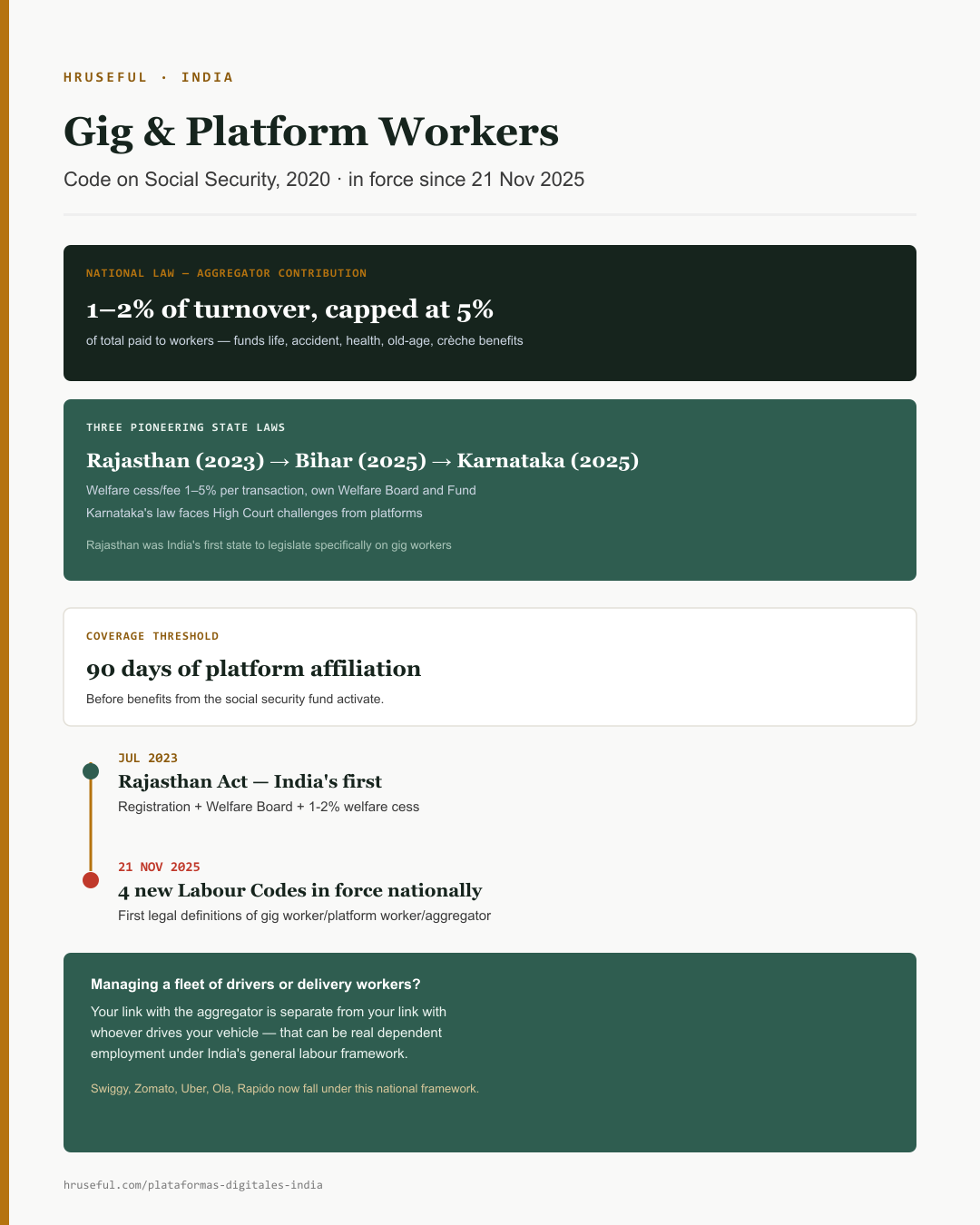
Sí, es una de las obligaciones centrales del Code on Social Security: los agregadores deben aportar entre el 1% y el 2% de su facturación anual (turnover) a un fondo de seguridad social para gig y platform workers.
¿Hay algún tope a ese aporte?
Sí, el aporte del agregador no puede superar el 5% del monto total pagado a los gig y platform workers — un límite pensado para no imponer una carga desproporcionada sobre las plataformas más pequeñas o con márgenes ajustados.
¿Qué beneficios financia ese fondo de seguridad social?
Cubre seguro de vida y discapacidad, seguro de accidentes, beneficios de salud y maternidad, protección para la vejez, y servicios de guardería — un paquete amplio pensado específicamente para las necesidades de este tipo de trabajador.
¿Cualquier trabajador de plataforma accede a estos beneficios desde el primer día?
No, la cobertura generalmente se activa después de que el trabajador acumula un mínimo de 90 días de afiliación o actividad en la plataforma — un umbral pensado para dar cierta estabilidad al sistema sin excluir a quienes recién empiezan.
¿Quién administra este fondo de seguridad social a nivel nacional?
Se gestiona dentro del marco general de la seguridad social que administra el gobierno central bajo el Code on Social Security, aunque la implementación operativa involucra también a los gobiernos estatales.
¿Qué estado fue el primero en India en legislar específicamente sobre gig workers?
Rajasthan, con la Rajasthan Platform-Based Gig Workers (Registration and Welfare) Act, aprobada en julio de 2023 — la primera ley estatal específica de este tipo en todo el país.
¿Qué establece la ley de Rajasthan?
Exige el registro obligatorio tanto de los gig workers como de los agregadores, crea una Junta de Bienestar (Welfare Board) específica, y establece un Fondo de Seguridad Social y Bienestar financiado por un “welfare cess” (gravamen) del 1% al 2% sobre cada transacción, además de aportes del gobierno estatal.
¿Qué es exactamente el “Platform-Based Gig Workers Welfare Cess” de Rajasthan?
Es un gravamen específico que se cobra a los agregadores, calculado como un porcentaje de cada transacción realizada en la plataforma, y que se recauda y deposita directamente en el fondo de bienestar estatal.
¿Qué otros estados siguieron el ejemplo de Rajasthan?
Bihar, con la Bihar Gig and Platform Based Workers (Registration, Social Security and Welfare) Act de 2025, y Karnataka, que se convirtió en el tercer estado con una ley específica para este sector en 2025.
¿Qué establece la ley de Karnataka?
La Karnataka Platform Based Gig Workers (Social Security and Welfare) Bill/Ordinance de 2025, introducida en la Asamblea Legislativa el 12 de agosto de 2025, reemplazando una ordenanza previa — establece registro obligatorio y un fondo de bienestar financiado por los agregadores.
¿Cuánto deben aportar los agregadores bajo la ley de Karnataka?
Un “welfare fee” de entre el 1% y el 5% del pago realizado al gig worker en cada transacción, con el porcentaje exacto determinado según distintas categorías de agregador que fija el gobierno estatal.
¿La ley de Karnataka generó controversia?
Sí, ha sido objeto de cuestionamientos legales por parte de algunas plataformas, incluyendo instancias ante la Corte Superior de Karnataka — un ejemplo de la tensión activa entre estos nuevos marcos regulatorios estatales y los intereses de las empresas de plataformas.
¿Qué pasa en los estados que todavía no tienen una ley específica como la de Rajasthan, Bihar o Karnataka?
Se aplica únicamente el marco nacional del Code on Social Security 2020, sin el nivel adicional de protección y financiamiento específico que sí existe en esos tres estados pioneros — otra desigualdad real entre estados, similar a la que ocurre con el trabajo doméstico.
¿Qué pasa si una persona posee varios vehículos y contrata a otros conductores para operarlos en las plataformas en India?
Esa relación entre el dueño de los vehículos y los conductores que contrata es un vínculo aparte de la relación entre esos conductores y la plataforma digital — si el dueño de la flota fija turnos, exige metas y retiene una parte fija de lo generado, ese vínculo puede calificar como una relación de trabajo dependiente bajo el marco laboral general de India, con obligaciones patronales propias.
¿El Code on Social Security regula también a quien gestiona una flota de conductores?
No de forma directa — el Code se enfoca en el vínculo entre el gig/platform worker y el agregador. La relación entre un dueño de flota y las personas que operan sus vehículos se sigue rigiendo por las reglas laborales generales sobre subordinación.
¿Qué riesgo legal corre quien gestiona una flota sin registrar formalmente a sus conductores?
Se expone a que las autoridades laborales determinen la existencia de una relación de dependencia real con efecto retroactivo, generando obligaciones de pago de beneficios y contribuciones que no se habían cumplido durante todo el período no registrado.
¿Cómo se diferencia a un conductor independiente de uno que trabaja para un dueño de flota en India?
El criterio central sigue siendo la subordinación real: si el conductor decide libremente sus horarios y se queda con la totalidad de lo que gana en la plataforma, es un vínculo directo con el agregador; si recibe un vehículo ajeno, cumple turnos fijados por un tercero y entrega una parte fija de sus ingresos, existen elementos de subordinación frente al dueño de la flota.
¿Cómo se registra un gig worker en Rajasthan, Bihar o Karnataka?
A través del proceso de registro específico que cada Welfare Board estatal estableció, generalmente vinculado al número de identificación del trabajador y a la información que la plataforma debe reportar sobre las personas que operan a través de ella.
¿El registro estatal reemplaza al registro en e-Shram?
No, son complementarios — e-Shram es el registro nacional general para trabajadores no organizados, mientras que el registro estatal específico (donde existe) da acceso a los beneficios adicionales de esa ley particular, como el fondo financiado por el welfare cess.
¿Un gig worker puede estar registrado en más de un estado?
Depende de dónde presta efectivamente el servicio — si trabaja en distintos estados con leyes propias, conviene verificar los requisitos de registro específicos de cada uno para no perder acceso a beneficios.
¿Un gig worker debe pagar impuestos sobre sus ingresos en India?
Sí, como cualquier persona con ingresos, está sujeto al régimen general del impuesto a la renta indio (Income Tax), con las reglas de presentación y eventuales deducciones que correspondan según su nivel de ingresos.
¿Existe algún régimen tributario simplificado para trabajadores de plataformas de bajos ingresos?
India cuenta con esquemas de tributación presuntiva (presumptive taxation) para pequeños contribuyentes que, según la actividad y el nivel de ingresos, pueden aplicar a algunos gig workers — conviene evaluar la situación particular con un contador.
¿Los aportes que hace el agregador al fondo de seguridad social salen del bolsillo del trabajador?
No, es una obligación que recae directamente sobre el agregador, calculada sobre su facturación o sobre los pagos realizados a los trabajadores — no es un descuento del ingreso del gig worker.
¿Un gig worker puede trabajar para varias plataformas al mismo tiempo en India?
Sí, la multi-conexión (trabajar simultáneamente para varias aplicaciones distintas) es una práctica habitual y no está prohibida por el marco legal nacional ni por las leyes estatales existentes.
¿Qué pasa si una plataforma bloquea la cuenta de un trabajador sin explicación?
El marco legal nacional no exige todavía mecanismos de reclamo detallados equivalentes a los de leyes como la argentina o la chilena — los trabajadores dependen principalmente de los canales internos de cada plataforma y, donde exista, del respaldo de la Welfare Board estatal correspondiente.
¿Las propinas le pertenecen 100% al trabajador en India?
En general sí, aunque no existe todavía una regla nacional explícita y uniforme sobre esto — la práctica depende en gran medida de las políticas internas de cada plataforma.
¿Qué pasa si un gig worker sufre un accidente mientras trabaja?
Si está afiliado al fondo de seguridad social (tras cumplir el umbral de 90 días donde aplique, o bajo el esquema estatal correspondiente), puede acceder a la cobertura de accidentes prevista — de lo contrario, depende de la atención médica pública general.
¿Qué documentos se necesitan para registrarse como repartidor o conductor de plataformas en India?
Documento de identidad (a menudo vinculado al Aadhaar), en el caso de conductores la licencia de conducir correspondiente y la documentación del vehículo en regla, y una cuenta bancaria o instrumento de pago digital para recibir los pagos.
¿Se necesita una licencia comercial especial para operar como conductor de transporte de pasajeros?
Sí, además de la licencia de conducir personal, en muchos estados se requiere un permiso comercial específico para transporte remunerado de pasajeros, regulado por la normativa de tránsito estatal correspondiente, independiente del Code on Social Security.
¿Un menor de edad puede trabajar como repartidor de plataformas en India?
No, las normas generales de trabajo infantil y adolescente de India aplican también a este sector — la mayoría de las plataformas exige directamente mayoría de edad para registrarse, dados además los requisitos de licencia de conducir en muchos casos.
¿Un trabajador migrante interno (de otro estado) puede registrarse como gig worker en cualquier estado?
Sí, no existe una restricción basada en el estado de origen — de hecho, una parte significativa de la fuerza laboral de plataformas de reparto en las grandes ciudades indias está compuesta por migrantes internos de otros estados.
¿Cómo se compara el modelo indio con el argentino o el chileno?
Es un modelo intermedio distinto: no presume independencia pura como Argentina, ni impone un piso de derechos laborales completo como Chile — crea una categoría específica de “gig/platform worker” con un fondo de seguridad social financiado por un porcentaje de la facturación de la plataforma, un enfoque propio.
¿Qué hace único al modelo indio frente a otros países que ya regularon este sector?
La combinación de un marco nacional (Code on Social Security) con leyes estatales adicionales y más ambiciosas en algunos estados (Rajasthan, Bihar, Karnataka) — un federalismo regulatorio que no tiene un equivalente exacto en los demás países de esta guía.
¿Otros estados indios podrían seguir el ejemplo de Rajasthan, Bihar y Karnataka?
Es probable — el hecho de que tres estados ya legislaron de forma independiente sugiere una tendencia que otros estados con alta concentración de trabajadores de plataformas podrían replicar en los próximos años.
¿Cuántas personas trabajan como gig o platform workers en India?
Es un sector de gran escala y en crecimiento sostenido — India es uno de los mercados de economía de plataformas más grandes del mundo, con proyecciones oficiales que anticipan un crecimiento significativo del número de trabajadores hacia el final de la década.
¿Qué plataformas operan en el sector de reparto y transporte en India?
Empresas como Swiggy, Zomato, Uber, Ola, Rapido y otras operan a gran escala en las principales ciudades indias, cada una sujeta ahora al marco nacional del Code on Social Security y, en Rajasthan, Bihar y Karnataka, también a la ley estatal correspondiente.
¿Qué organizaciones defienden los derechos de los gig workers en India?
Existen sindicatos y colectivos de trabajadores de plataformas activos en distintas ciudades, que impulsaron buena parte de la presión que llevó tanto al Code on Social Security nacional como a las leyes estatales pioneras de Rajasthan, Bihar y Karnataka.
¿Quién fiscaliza que los agregadores cumplan con sus aportes al fondo de seguridad social?
A nivel nacional, las autoridades laborales del gobierno central bajo el Code on Social Security; a nivel estatal, las Welfare Boards específicas de Rajasthan, Bihar y Karnataka tienen facultades propias de fiscalización sobre el welfare cess o welfare fee correspondiente.
¿Qué pasa si un agregador no realiza los aportes obligatorios?
Queda expuesto a sanciones bajo el marco legal correspondiente (nacional o estatal, según el caso), y a la exigencia de regularizar retroactivamente los aportes adeudados al fondo de seguridad social.
¿Existen sentencias judiciales relevantes sobre este tema en India?
Sí, la ley de Karnataka en particular fue objeto de cuestionamientos ante la Corte Superior de ese estado por parte de algunas plataformas — un desarrollo judicial en curso que conviene seguir de cerca a medida que avanza.
¿Un repartidor contratado directamente por un restaurante (sin pasar por una app) tiene el mismo marco legal?
No, esa persona sería en principio un empleado directo del restaurante bajo las reglas generales del Code on Wages y el Code on Social Security como trabajador dependiente tradicional, no como gig/platform worker bajo el régimen específico de agregadores.
¿Un profesional independiente que ofrece servicios de consultoría a través de una plataforma digital cae en la misma categoría?
Puede caer dentro de la definición amplia de “gig worker” del Code on Social Security si trabaja fuera de una relación empleador-empleado tradicional a través de una plataforma, aunque las leyes estatales de Rajasthan, Bihar y Karnataka se enfocaron específicamente en movilidad y delivery.
¿Qué se espera que cambie en los próximos años en la regulación de gig workers en India?
La finalización de las reglas de implementación pendientes del Code on Social Security a nivel estatal, la posible expansión del modelo de Rajasthan/Bihar/Karnataka a otros estados, y la evolución de los cuestionamientos judiciales en curso sobre la ley de Karnataka.
¿Qué puede hacer un gig worker para protegerse mientras el marco sigue evolucionando?
Verificar si su estado tiene una ley específica y registrarse ante la Welfare Board correspondiente si existe, mantener registros propios de sus ingresos y horas trabajadas, y verificar directamente con la plataforma cómo se están aplicando los aportes al fondo de seguridad social.
¿Dónde se puede consultar más información oficial sobre el Code on Social Security y los gig workers?
A través del sitio del Ministerio de Trabajo y Empleo de India (labour.gov.in) y, para Rajasthan específicamente, del portal de su Welfare Board estatal para gig workers.
Ministerio de Trabajo y Empleo de India
PRS India — Karnataka Platform Based Gig Workers Bill 2025
Trabajadoras del Hogar — India
Gig and Platform Workers in India — Complete Labour Guide
India has a recent national framework (the Code on Social Security, 2020, in force since 21 November 2025) that for the first time legally defines “gig workers” and “platform workers,” plus three pioneering state laws (Rajasthan, Bihar, Karnataka) that go further. This guide covers both levels, written for platform workers and for anyone managing a fleet or a group of drivers/delivery workers.
Does India have a specific legal framework for digital platform workers?
Yes, and it is recent: the Code on Social Security, 2020, one of India’s four new Labour Codes, came into force on 21 November 2025 and for the first time legally defines “gig worker,” “platform worker” and “aggregator” at the national level.
How does the law define a “gig worker”?
As a person who performs work or participates in a work arrangement outside the traditional employer-employee relationship and earns income from such activities — a broad definition covering both platform-based work and other forms of project-based work.
What is an “aggregator” under the law?
A digital intermediary that connects a buyer or user of a service with a seller or provider of that service — the definition includes any entity that coordinates with one or more aggregators to provide services, covering subcontracting models between platforms.
Do the four Labour Codes replace previous labour laws?
Yes, they consolidate and replace 29 previous central labour laws, some over 70 years old — the Code on Wages, the Industrial Relations Code, the Code on Social Security, and the Occupational Safety, Health and Working Conditions Code.
Why is implementation still being discussed in 2026 if the Codes have been in force since November 2025?
Because many state-level implementation rules are still being finalised — the framework law is national, but much of its practical application depends on additional regulations each state must complete.
Must aggregators financially contribute to their workers’ social security?
Yes, this is one of the central obligations under the Code on Social Security: aggregators must contribute between 1% and 2% of their annual turnover to a social security fund for gig and platform workers.
Is there a cap on this contribution?
Yes, the aggregator’s contribution cannot exceed 5% of the total amount paid to gig and platform workers — a limit designed to avoid placing a disproportionate burden on smaller platforms or those with tight margins.
What benefits does this social security fund pay for?
It covers life and disability insurance, accident insurance, health and maternity benefits, old-age protection, and crèche facilities — a broad package designed specifically for the needs of this type of worker.
Does any platform worker access these benefits from day one?
No, coverage generally kicks in once the worker accumulates a minimum of 90 days of affiliation or activity on the platform — a threshold designed to give the system some stability without excluding those just starting out.
Who administers this social security fund at the national level?
It is managed within the general social security framework run by the central government under the Code on Social Security, although operational implementation also involves state governments.
Which state was the first in India to legislate specifically on gig workers?
Rajasthan, with the Rajasthan Platform-Based Gig Workers (Registration and Welfare) Act, passed in July 2023 — the first state-specific law of this kind in the entire country.
What does the Rajasthan law establish?
It requires mandatory registration of both gig workers and aggregators, creates a specific Welfare Board, and establishes a Social Security and Welfare Fund financed by a “welfare cess” (levy) of 1% to 2% on each transaction, in addition to state government contributions.
What exactly is Rajasthan’s “Platform-Based Gig Workers Welfare Cess”?
It is a specific levy charged to aggregators, calculated as a percentage of each transaction carried out on the platform, collected and deposited directly into the state welfare fund.
Which other states followed Rajasthan’s example?
Bihar, with the Bihar Gig and Platform Based Workers (Registration, Social Security and Welfare) Act of 2025, and Karnataka, which became the third state with a specific law for this sector in 2025.
What does the Karnataka law establish?
The Karnataka Platform Based Gig Workers (Social Security and Welfare) Bill/Ordinance of 2025, introduced in the Legislative Assembly on 12 August 2025, replacing a previous ordinance — it establishes mandatory registration and a welfare fund financed by aggregators.
How much must aggregators contribute under the Karnataka law?
A “welfare fee” of between 1% and 5% of the payout to the gig worker in each transaction, with the exact percentage determined by different aggregator categories set by the state government.
Did the Karnataka law generate controversy?
Yes, it has faced legal challenges from some platforms, including proceedings before the Karnataka High Court — an example of the active tension between these new state regulatory frameworks and platform companies’ interests.
What happens in states that still do not have a specific law like Rajasthan, Bihar or Karnataka?
Only the national Code on Social Security, 2020 framework applies, without the additional level of specific protection and funding that exists in those three pioneering states — another real inequality between states, similar to what happens with domestic work.
What happens if a person owns several vehicles and hires other drivers to operate them on the platforms in India?
That relationship between the vehicle owner and the drivers they hire is separate from the relationship between those drivers and the digital platform — if the fleet owner sets shifts, demands targets and keeps a fixed share of earnings, that relationship may qualify as a dependent employment relationship under India’s general labour framework, with its own employer obligations.
Does the Code on Social Security also regulate those who manage a fleet of drivers?
Not directly — the Code focuses on the relationship between the gig/platform worker and the aggregator. The relationship between a fleet owner and the people operating their vehicles continues to be governed by general labour rules on subordination.
What legal risk does someone managing a fleet face if they do not formally register their drivers?
They are exposed to labour authorities determining the existence of a real dependent relationship with retroactive effect, generating obligations to pay benefits and contributions that were not met during the entire unregistered period.
How is an independent driver distinguished from one working for a fleet owner in India?
The central criterion remains real subordination: if the driver freely decides their hours and keeps everything they earn on the platform, it is a direct relationship with the aggregator; if they receive someone else’s vehicle, follow shifts set by a third party, and hand over a fixed share of their earnings, there are elements of subordination toward the fleet owner.
How does a gig worker register in Rajasthan, Bihar or Karnataka?
Through the specific registration process each state Welfare Board established, generally linked to the worker’s identification number and the information the platform must report about the people operating through it.
Does state registration replace e-Shram registration?
No, they are complementary — e-Shram is the general national registry for unorganised workers, while state-specific registration (where it exists) grants access to that particular law’s additional benefits, such as the welfare-cess-funded fund.
Can a gig worker be registered in more than one state?
It depends on where the service is actually provided — if working across different states with their own laws, it is worth checking each one’s specific registration requirements to avoid losing access to benefits.
Must a gig worker pay tax on their income in India?
Yes, like anyone with income, they are subject to India’s general Income Tax regime, with the filing rules and possible deductions applicable to their income level.
Is there a simplified tax regime for low-income platform workers?
India has presumptive taxation schemes for small taxpayers that, depending on the activity and income level, may apply to some gig workers — it is worth assessing the specific situation with an accountant.
Do the aggregator’s contributions to the social security fund come out of the worker’s pocket?
No, it is an obligation that falls directly on the aggregator, calculated on its turnover or on payments made to workers — it is not a deduction from the gig worker’s income.
Can a gig worker work for several platforms at the same time in India?
Yes, multi-homing (working simultaneously for several different apps) is a common practice and is not prohibited by the national legal framework or by existing state laws.
What happens if a platform blocks a worker’s account without explanation?
The national legal framework does not yet require detailed complaint mechanisms equivalent to laws such as Argentina’s or Chile’s — workers mainly depend on each platform’s internal channels and, where it exists, the support of the corresponding state Welfare Board.
Do tips belong 100% to the worker in India?
Generally yes, although there is not yet an explicit, uniform national rule on this — practice largely depends on each platform’s internal policies.
What happens if a gig worker is injured while working?
If affiliated with the social security fund (after meeting the 90-day threshold where applicable, or under the corresponding state scheme), they can access the provided accident coverage — otherwise, they depend on general public healthcare.
What documents are needed to register as a delivery worker or driver for platforms in India?
An identity document (often linked to Aadhaar), for drivers the corresponding driving licence and vehicle documentation in order, and a bank account or digital payment instrument to receive payments.
Is a special commercial licence needed to operate as a passenger transport driver?
Yes, in addition to a personal driving licence, many states require a specific commercial permit for paid passenger transport, regulated by the corresponding state transport rules, independent of the Code on Social Security.
Can a minor work as a platform delivery worker in India?
No, India’s general child and adolescent labour rules also apply to this sector — most platforms directly require legal adult age to register, given also the driving licence requirements in many cases.
Can an internal migrant worker (from another state) register as a gig worker in any state?
Yes, there is no restriction based on state of origin — in fact, a significant share of the delivery platform workforce in major Indian cities is made up of internal migrants from other states.
How does the Indian model compare with Argentina’s or Chile’s?
It is a distinct middle-ground model: it does not presume pure independence like Argentina, nor does it impose a full floor of labour rights like Chile — it creates a specific “gig/platform worker” category with a social security fund financed by a percentage of the platform’s turnover, an approach of its own.
What makes the Indian model unique compared with other countries that already regulated this sector?
The combination of a national framework (Code on Social Security) with additional, more ambitious state laws in some states (Rajasthan, Bihar, Karnataka) — a regulatory federalism with no exact equivalent among the other countries in this guide.
Could other Indian states follow Rajasthan, Bihar and Karnataka’s example?
It is likely — the fact that three states have already legislated independently suggests a trend other states with a high concentration of platform workers could replicate in the coming years.
How many people work as gig or platform workers in India?
It is a large and steadily growing sector — India is one of the world’s largest platform economy markets, with official projections anticipating significant growth in the number of workers toward the end of the decade.
Which platforms operate in the delivery and transport sector in India?
Companies such as Swiggy, Zomato, Uber, Ola, Rapido and others operate at scale in major Indian cities, each now subject to the national Code on Social Security framework and, in Rajasthan, Bihar and Karnataka, also to the corresponding state law.
What organisations defend gig workers’ rights in India?
There are unions and platform worker collectives active in various cities, which drove much of the pressure that led to both the national Code on Social Security and the pioneering state laws of Rajasthan, Bihar and Karnataka.
Who enforces aggregators’ compliance with their social security fund contributions?
At the national level, central government labour authorities under the Code on Social Security; at the state level, the specific Welfare Boards of Rajasthan, Bihar and Karnataka have their own enforcement powers over the corresponding welfare cess or welfare fee.
What happens if an aggregator fails to make the mandatory contributions?
They are exposed to penalties under the corresponding legal framework (national or state, as applicable), and to being required to retroactively regularise the contributions owed to the social security fund.
Are there relevant court rulings on this topic in India?
Yes, the Karnataka law in particular has faced challenges before that state’s High Court from some platforms — an ongoing judicial development worth following closely as it progresses.
Does a delivery worker hired directly by a restaurant (not through an app) fall under the same legal framework?
No, that person would in principle be a direct employee of the restaurant under the general rules of the Code on Wages and the Code on Social Security as a traditional dependent worker, not as a gig/platform worker under the specific aggregator regime.
Does an independent professional offering consulting services through a digital platform fall into the same category?
They may fall within the Code on Social Security’s broad “gig worker” definition if they work outside a traditional employer-employee relationship through a platform, although the state laws of Rajasthan, Bihar and Karnataka specifically focused on mobility and delivery.
What is expected to change in the coming years in India’s gig worker regulation?
The completion of pending state-level implementation rules under the Code on Social Security, the possible expansion of the Rajasthan/Bihar/Karnataka model to other states, and the evolution of ongoing court challenges to the Karnataka law.
What can a gig worker do to protect themselves while the framework keeps evolving?
Check whether their state has a specific law and register with the corresponding Welfare Board if one exists, keep their own records of income and hours worked, and verify directly with the platform how contributions to the social security fund are being applied.
Where can you find more official information on the Code on Social Security and gig workers?
Through the website of India’s Ministry of Labour and Employment (labour.gov.in) and, specifically for Rajasthan, through its state Welfare Board portal for gig workers.
Ministry of Labour and Employment, India
PRS India — Karnataka Platform Based Gig Workers Bill 2025
Domestic Workers — India
भारत में गिग और प्लेटफॉर्म कामगार — संपूर्ण श्रम गाइड
भारत के पास एक हालिया राष्ट्रीय ढांचा है (Code on Social Security, 2020, 21 नवंबर 2025 से लागू) जो पहली बार “गिग वर्कर” और “प्लेटफॉर्म वर्कर” को कानूनी रूप से परिभाषित करता है, साथ ही तीन अग्रणी राज्य कानून (राजस्थान, बिहार, कर्नाटक) जो इससे आगे जाते हैं। यह गाइड दोनों स्तरों को कवर करती है, प्लेटफॉर्म कामगारों और फ्लीट या ड्राइवरों/डिलीवरी वर्करों के समूह का प्रबंधन करने वाले किसी भी व्यक्ति के लिए।
क्या भारत में डिजिटल प्लेटफॉर्म कामगारों के लिए कोई विशेष कानूनी ढांचा है?
हां, और यह हाल का है: Code on Social Security, 2020, भारत के चार नए Labour Codes में से एक, 21 नवंबर 2025 से लागू हुआ और पहली बार “गिग वर्कर”, “प्लेटफॉर्म वर्कर” और “एग्रीगेटर” को राष्ट्रीय स्तर पर कानूनी रूप से परिभाषित करता है।
कानून “गिग वर्कर” को कैसे परिभाषित करता है?
एक ऐसे व्यक्ति के रूप में जो पारंपरिक नियोक्ता-कर्मचारी संबंध से बाहर काम करता है या किसी कार्य व्यवस्था में भाग लेता है, और उन गतिविधियों से आय अर्जित करता है — एक व्यापक परिभाषा जो प्लेटफॉर्म के माध्यम से काम करने वाले और परियोजना-आधारित काम के अन्य रूपों, दोनों को कवर करती है।
कानून के तहत “एग्रीगेटर” क्या है?
यह एक डिजिटल मध्यस्थ है जो किसी सेवा के खरीदार या उपयोगकर्ता को उस सेवा के विक्रेता या प्रदाता से जोड़ता है — परिभाषा में कोई भी संस्था शामिल है जो सेवाएं प्रदान करने के लिए एक या अधिक एग्रीगेटरों के साथ समन्वय करती है, इस प्रकार प्लेटफॉर्मों के बीच उप-अनुबंध मॉडल को कवर करती है।
क्या चार Labour Codes पिछले श्रम कानूनों की जगह लेते हैं?
हां, वे 29 पिछले केंद्रीय श्रम कानूनों को समेकित और प्रतिस्थापित करते हैं, जिनमें से कुछ 70 वर्ष से अधिक पुराने हैं — Code on Wages, Industrial Relations Code, Code on Social Security, और Occupational Safety, Health and Working Conditions Code।
अगर Codes नवंबर 2025 से लागू हैं तो 2026 में भी कार्यान्वयन की बात क्यों हो रही है?
क्योंकि राज्य स्तर पर कई विशिष्ट कार्यान्वयन नियम (rules) अभी भी अंतिम रूप लिए जा रहे हैं — ढांचागत कानून राष्ट्रीय है, लेकिन इसके व्यावहारिक प्रयोग का बड़ा हिस्सा अतिरिक्त विनियमन पर निर्भर करता है जिसे हर राज्य को पूरा करना है।
क्या एग्रीगेटरों को अपने कामगारों की सामाजिक सुरक्षा में आर्थिक योगदान देना होता है?
हां, यह Code on Social Security के तहत केंद्रीय दायित्वों में से एक है: एग्रीगेटरों को गिग और प्लेटफॉर्म कामगारों के लिए एक सामाजिक सुरक्षा कोष में अपने वार्षिक टर्नओवर का 1% से 2% योगदान देना होता है।
क्या इस योगदान पर कोई सीमा है?
हां, एग्रीगेटर का योगदान गिग और प्लेटफॉर्म कामगारों को दी गई कुल राशि के 5% से अधिक नहीं हो सकता — यह सीमा छोटे प्लेटफॉर्मों या कम मार्जिन वाले प्लेटफॉर्मों पर असंगत बोझ न डालने के लिए बनाई गई है।
यह सामाजिक सुरक्षा कोष किन लाभों को वित्तपोषित करता है?
यह जीवन और विकलांगता बीमा, दुर्घटना बीमा, स्वास्थ्य और मातृत्व लाभ, वृद्धावस्था सुरक्षा, और क्रेच सुविधाओं को कवर करता है — इस प्रकार के कामगार की आवश्यकताओं के लिए विशेष रूप से डिज़ाइन किया गया एक व्यापक पैकेज।
क्या कोई भी प्लेटफॉर्म कामगार पहले दिन से इन लाभों तक पहुंच सकता है?
नहीं, कवरेज आम तौर पर तब सक्रिय होती है जब कामगार प्लेटफॉर्म पर न्यूनतम 90 दिनों की सदस्यता या गतिविधि जमा कर लेता है — यह सीमा उन लोगों को बाहर किए बिना सिस्टम को कुछ स्थिरता देने के लिए बनाई गई है जो अभी शुरुआत कर रहे हैं।
राष्ट्रीय स्तर पर इस सामाजिक सुरक्षा कोष का प्रबंधन कौन करता है?
इसे Code on Social Security के तहत केंद्र सरकार द्वारा प्रबंधित सामान्य सामाजिक सुरक्षा ढांचे के भीतर प्रबंधित किया जाता है, हालांकि परिचालन कार्यान्वयन में राज्य सरकारें भी शामिल होती हैं।
भारत में गिग वर्करों पर विशेष रूप से कानून बनाने वाला पहला राज्य कौन-सा था?
राजस्थान, जुलाई 2023 में पारित Rajasthan Platform-Based Gig Workers (Registration and Welfare) Act के साथ — पूरे देश में इस तरह का पहला विशेष राज्य कानून।
राजस्थान का कानून क्या स्थापित करता है?
यह गिग वर्करों और एग्रीगेटरों, दोनों के अनिवार्य पंजीकरण की मांग करता है, एक विशिष्ट Welfare Board बनाता है, और राज्य सरकार के योगदान के अलावा प्रत्येक लेनदेन पर 1% से 2% के “welfare cess” (उपकर) द्वारा वित्तपोषित एक सामाजिक सुरक्षा और कल्याण कोष स्थापित करता है।
राजस्थान का “Platform-Based Gig Workers Welfare Cess” वास्तव में क्या है?
यह एग्रीगेटरों पर लगाया जाने वाला एक विशिष्ट उपकर है, जिसकी गणना प्लेटफॉर्म पर किए गए प्रत्येक लेनदेन के प्रतिशत के रूप में की जाती है, और जिसे एकत्र कर सीधे राज्य कल्याण कोष में जमा किया जाता है।
राजस्थान के उदाहरण का अनुसरण किन अन्य राज्यों ने किया?
बिहार, 2025 के Bihar Gig and Platform Based Workers (Registration, Social Security and Welfare) Act के साथ, और कर्नाटक, जो 2025 में इस क्षेत्र के लिए विशेष कानून वाला तीसरा राज्य बना।
कर्नाटक का कानून क्या स्थापित करता है?
2025 का Karnataka Platform Based Gig Workers (Social Security and Welfare) Bill/Ordinance, जिसे 12 अगस्त 2025 को विधान सभा में पेश किया गया, एक पूर्व अध्यादेश की जगह लेते हुए — यह अनिवार्य पंजीकरण और एग्रीगेटरों द्वारा वित्तपोषित एक कल्याण कोष स्थापित करता है।
कर्नाटक के कानून के तहत एग्रीगेटरों को कितना योगदान देना होता है?
प्रत्येक लेनदेन में गिग वर्कर को किए गए भुगतान का 1% से 5% के बीच एक “welfare fee”, जिसका सटीक प्रतिशत राज्य सरकार द्वारा तय एग्रीगेटर की विभिन्न श्रेणियों के अनुसार निर्धारित होता है।
क्या कर्नाटक के कानून ने विवाद पैदा किया?
हां, कुछ प्लेटफॉर्मों की ओर से इसे कानूनी चुनौतियों का सामना करना पड़ा है, जिसमें कर्नाटक उच्च न्यायालय में कार्यवाही भी शामिल है — इन नए राज्य नियामक ढांचों और प्लेटफॉर्म कंपनियों के हितों के बीच सक्रिय तनाव का एक उदाहरण।
जिन राज्यों में अभी तक राजस्थान, बिहार या कर्नाटक जैसा विशेष कानून नहीं है, वहां क्या होता है?
केवल राष्ट्रीय Code on Social Security 2020 ढांचा लागू होता है, उस अतिरिक्त स्तर की विशेष सुरक्षा और वित्तपोषण के बिना जो उन तीन अग्रणी राज्यों में मौजूद है — राज्यों के बीच एक और वास्तविक असमानता, घरेलू कार्य के मामले जैसी।
अगर भारत में किसी के पास कई वाहन हैं और वह उन्हें चलाने के लिए अन्य ड्राइवरों को नियुक्त करता है तो क्या होगा?
वाहन मालिक और उसके द्वारा नियुक्त ड्राइवरों के बीच का यह संबंध उन ड्राइवरों और डिजिटल प्लेटफॉर्म के बीच के संबंध से अलग है — अगर फ्लीट मालिक शिफ्ट तय करता है, लक्ष्य मांगता है और कमाई का एक निश्चित हिस्सा रखता है, तो यह संबंध भारत के सामान्य श्रम ढांचे के तहत एक आश्रित रोजगार संबंध के रूप में योग्य हो सकता है, जिसकी अपनी नियोक्ता जिम्मेदारियां हैं।
क्या Code on Social Security फ्लीट प्रबंधित करने वालों को भी नियंत्रित करता है?
सीधे तौर पर नहीं — Code गिग/प्लेटफॉर्म वर्कर और एग्रीगेटर के बीच के संबंध पर केंद्रित है। फ्लीट मालिक और उनके वाहन चलाने वाले लोगों के बीच का संबंध अधीनता पर सामान्य श्रम नियमों द्वारा नियंत्रित होता रहता है।
अपने ड्राइवरों को औपचारिक रूप से पंजीकृत न करने वाले फ्लीट प्रबंधक को क्या कानूनी जोखिम है?
वह श्रम प्राधिकरणों द्वारा पूर्वव्यापी प्रभाव से एक वास्तविक आश्रित संबंध की उपस्थिति निर्धारित किए जाने के जोखिम में है, जिससे पूरे अपंजीकृत अवधि के दौरान न चुकाए गए लाभ और योगदान के भुगतान का दायित्व उत्पन्न होता है।
भारत में एक स्वतंत्र ड्राइवर और फ्लीट मालिक के लिए काम करने वाले ड्राइवर में अंतर कैसे किया जाता है?
केंद्रीय मानदंड वास्तविक अधीनता ही है: अगर ड्राइवर स्वतंत्र रूप से अपने घंटे तय करता है और प्लेटफॉर्म पर जो कमाता है वह पूरा रखता है, तो यह एग्रीगेटर के साथ सीधा संबंध है; अगर उसे किसी और का वाहन मिलता है, किसी तीसरे पक्ष द्वारा तय शिफ्ट का पालन करता है, और अपनी आय का एक निश्चित हिस्सा सौंपता है, तो फ्लीट मालिक के प्रति अधीनता के स्पष्ट तत्व मौजूद हैं।
राजस्थान, बिहार या कर्नाटक में गिग वर्कर कैसे पंजीकरण कराता है?
हर राज्य Welfare Board द्वारा स्थापित विशिष्ट पंजीकरण प्रक्रिया के माध्यम से, आम तौर पर कामगार की पहचान संख्या और प्लेटफॉर्म द्वारा उसके माध्यम से काम करने वाले लोगों के बारे में रिपोर्ट की जाने वाली जानकारी से जुड़ा हुआ।
क्या राज्य पंजीकरण e-Shram पंजीकरण की जगह लेता है?
नहीं, ये पूरक हैं — e-Shram असंगठित कामगारों के लिए सामान्य राष्ट्रीय पंजीकरण है, जबकि विशिष्ट राज्य पंजीकरण (जहां मौजूद हो) उस विशेष कानून के अतिरिक्त लाभों तक पहुंच देता है, जैसे welfare cess द्वारा वित्तपोषित कोष।
क्या एक गिग वर्कर एक से अधिक राज्य में पंजीकृत हो सकता है?
यह इस पर निर्भर करता है कि वह वास्तव में सेवा कहां प्रदान करता है — अगर वह अपने कानूनों वाले विभिन्न राज्यों में काम करता है, तो लाभों तक पहुंच न खोने के लिए हर एक की विशिष्ट पंजीकरण आवश्यकताओं की जांच करना उचित है।
क्या एक गिग वर्कर को भारत में अपनी आय पर कर देना होता है?
हां, आय वाले किसी भी व्यक्ति की तरह, वह भारत की सामान्य Income Tax व्यवस्था के अधीन है, अपनी आय के स्तर के अनुसार लागू फाइलिंग नियमों और संभावित कटौतियों के साथ।
क्या कम आय वाले प्लेटफॉर्म कामगारों के लिए कोई सरलीकृत कर व्यवस्था है?
भारत में छोटे करदाताओं के लिए presumptive taxation योजनाएं हैं जो गतिविधि और आय स्तर के आधार पर कुछ गिग वर्करों पर लागू हो सकती हैं — किसी अकाउंटेंट के साथ विशेष स्थिति का आकलन करना उचित है।
क्या एग्रीगेटर द्वारा सामाजिक सुरक्षा कोष में किया गया योगदान कामगार की जेब से आता है?
नहीं, यह एक दायित्व है जो सीधे एग्रीगेटर पर आता है, जिसकी गणना उसके टर्नओवर या कामगारों को किए गए भुगतान पर की जाती है — यह गिग वर्कर की आय से की गई कटौती नहीं है।
क्या एक गिग वर्कर भारत में एक साथ कई प्लेटफॉर्मों के लिए काम कर सकता है?
हां, मल्टी-होमिंग (एक साथ कई अलग-अलग ऐप्स के लिए काम करना) एक सामान्य प्रथा है और राष्ट्रीय कानूनी ढांचे या मौजूदा राज्य कानूनों द्वारा निषिद्ध नहीं है।
अगर कोई प्लेटफॉर्म बिना स्पष्टीकरण के किसी कामगार का खाता ब्लॉक कर दे तो क्या होगा?
राष्ट्रीय कानूनी ढांचा अभी अर्जेंटीना या चिली जैसे कानूनों के बराबर विस्तृत शिकायत तंत्र की मांग नहीं करता — कामगार मुख्यतः प्रत्येक प्लेटफॉर्म के आंतरिक चैनलों और, जहां मौजूद हो, संबंधित राज्य Welfare Board के समर्थन पर निर्भर रहते हैं।
क्या भारत में टिप्स 100% कामगार की होती हैं?
आम तौर पर हां, हालांकि इस पर अभी कोई स्पष्ट, समान राष्ट्रीय नियम मौजूद नहीं है — व्यवहार में यह बड़े पैमाने पर प्रत्येक प्लेटफॉर्म की आंतरिक नीतियों पर निर्भर करता है।
अगर काम के दौरान कोई गिग वर्कर दुर्घटनाग्रस्त हो जाए तो क्या होगा?
अगर वह सामाजिक सुरक्षा कोष से जुड़ा है (जहां लागू हो वहां 90-दिन की सीमा पूरी करने के बाद, या संबंधित राज्य योजना के तहत), तो वह प्रदान की गई दुर्घटना कवरेज तक पहुंच सकता है — अन्यथा, वह सामान्य सार्वजनिक स्वास्थ्य सेवा पर निर्भर रहता है।
भारत में प्लेटफॉर्मों के लिए डिलीवरी वर्कर या ड्राइवर के रूप में पंजीकरण के लिए कौन-से दस्तावेज चाहिए?
पहचान दस्तावेज (अक्सर Aadhaar से जुड़ा), ड्राइवरों के मामले में संबंधित ड्राइविंग लाइसेंस और वाहन के दस्तावेज व्यवस्थित होना, और भुगतान प्राप्त करने के लिए एक बैंक खाता या डिजिटल भुगतान माध्यम।
यात्री परिवहन चालक के रूप में काम करने के लिए क्या विशेष वाणिज्यिक लाइसेंस की आवश्यकता है?
हां, व्यक्तिगत ड्राइविंग लाइसेंस के अलावा, कई राज्यों में सशुल्क यात्री परिवहन के लिए एक विशिष्ट वाणिज्यिक परमिट की आवश्यकता होती है, जो Code on Social Security से स्वतंत्र, संबंधित राज्य परिवहन नियमों द्वारा विनियमित होता है।
क्या भारत में कोई नाबालिग प्लेटफॉर्म डिलीवरी वर्कर के रूप में काम कर सकता है?
नहीं, भारत के सामान्य बाल और किशोर श्रम नियम इस क्षेत्र पर भी लागू होते हैं — अधिकांश प्लेटफॉर्म कई मामलों में ड्राइविंग लाइसेंस आवश्यकताओं को देखते हुए, पंजीकरण के लिए सीधे कानूनी वयस्क आयु की मांग करते हैं।
क्या एक आंतरिक प्रवासी कामगार (किसी अन्य राज्य से) किसी भी राज्य में गिग वर्कर के रूप में पंजीकरण करा सकता है?
हां, मूल राज्य के आधार पर कोई प्रतिबंध नहीं है — दरअसल, बड़े भारतीय शहरों में डिलीवरी प्लेटफॉर्म कार्यबल का एक महत्वपूर्ण हिस्सा अन्य राज्यों से आए आंतरिक प्रवासियों से बना है।
भारतीय मॉडल की तुलना अर्जेंटीना या चिली से कैसे होती है?
यह एक अलग मध्य-मार्ग मॉडल है: यह अर्जेंटीना की तरह शुद्ध स्वतंत्रता नहीं मानता, न ही चिली की तरह श्रम अधिकारों का पूरा फर्श लागू करता है — यह प्लेटफॉर्म के टर्नओवर के प्रतिशत से वित्तपोषित सामाजिक सुरक्षा कोष के साथ एक विशिष्ट “गिग/प्लेटफॉर्म वर्कर” श्रेणी बनाता है, अपने आप में एक दृष्टिकोण।
इस क्षेत्र को पहले से विनियमित करने वाले अन्य देशों की तुलना में भारतीय मॉडल को क्या अनूठा बनाता है?
एक राष्ट्रीय ढांचे (Code on Social Security) का कुछ राज्यों (राजस्थान, बिहार, कर्नाटक) में अतिरिक्त, अधिक महत्वाकांक्षी राज्य कानूनों के साथ संयोजन — एक नियामक संघवाद जिसका इस गाइड के अन्य देशों में कोई सटीक समकक्ष नहीं है।
क्या अन्य भारतीय राज्य राजस्थान, बिहार और कर्नाटक के उदाहरण का अनुसरण कर सकते हैं?
यह संभावित है — तीन राज्यों का स्वतंत्र रूप से पहले ही कानून बनाना एक प्रवृत्ति का संकेत देता है जिसे प्लेटफॉर्म कामगारों की उच्च सघनता वाले अन्य राज्य आने वाले वर्षों में दोहरा सकते हैं।
भारत में कितने लोग गिग या प्लेटफॉर्म कामगार के रूप में काम करते हैं?
यह एक बड़े पैमाने का और लगातार बढ़ता हुआ क्षेत्र है — भारत दुनिया के सबसे बड़े प्लेटफॉर्म अर्थव्यवस्था बाजारों में से एक है, आधिकारिक अनुमानों के साथ जो दशक के अंत तक कामगारों की संख्या में महत्वपूर्ण वृद्धि की उम्मीद करते हैं।
भारत में डिलीवरी और परिवहन क्षेत्र में कौन-से प्लेटफॉर्म काम करते हैं?
Swiggy, Zomato, Uber, Ola, Rapido और अन्य कंपनियां प्रमुख भारतीय शहरों में बड़े पैमाने पर काम करती हैं, हर एक अब राष्ट्रीय Code on Social Security ढांचे के अधीन है, और राजस्थान, बिहार तथा कर्नाटक में, संबंधित राज्य कानून के भी।
भारत में गिग वर्करों के अधिकारों की रक्षा कौन-सी संस्थाएं करती हैं?
विभिन्न शहरों में सक्रिय ट्रेड यूनियन और प्लेटफॉर्म कामगार समूह मौजूद हैं, जिन्होंने राष्ट्रीय Code on Social Security और राजस्थान, बिहार तथा कर्नाटक के अग्रणी राज्य कानूनों, दोनों की ओर ले जाने वाले अधिकांश दबाव को आगे बढ़ाया।
एग्रीगेटरों के सामाजिक सुरक्षा कोष योगदान के अनुपालन की निगरानी कौन करता है?
राष्ट्रीय स्तर पर, Code on Social Security के तहत केंद्र सरकार के श्रम प्राधिकरण; राज्य स्तर पर, राजस्थान, बिहार और कर्नाटक के विशिष्ट Welfare Boards के पास संबंधित welfare cess या welfare fee पर अपनी स्वयं की प्रवर्तन शक्तियां हैं।
अगर कोई एग्रीगेटर अनिवार्य योगदान नहीं करता तो क्या होगा?
वह संबंधित कानूनी ढांचे (मामले के अनुसार राष्ट्रीय या राज्य) के तहत दंड के लिए उजागर होता है, और सामाजिक सुरक्षा कोष में बकाया योगदान को पूर्वव्यापी रूप से नियमित करने की आवश्यकता के लिए।
क्या भारत में इस विषय पर कोई महत्वपूर्ण न्यायिक निर्णय हैं?
हां, विशेष रूप से कर्नाटक के कानून को कुछ प्लेटफॉर्मों की ओर से उस राज्य के उच्च न्यायालय के समक्ष चुनौतियों का सामना करना पड़ा है — एक जारी न्यायिक विकास जिसे आगे बढ़ने के साथ बारीकी से देखना उचित है।
क्या किसी रेस्टोरेंट द्वारा सीधे नियुक्त डिलीवरी वर्कर (किसी ऐप के बिना) पर वही कानूनी ढांचा लागू होता है?
नहीं, वह व्यक्ति सिद्धांत रूप में Code on Wages और Code on Social Security के सामान्य नियमों के तहत रेस्टोरेंट का प्रत्यक्ष कर्मचारी होगा, एक पारंपरिक आश्रित कामगार के रूप में, न कि एग्रीगेटरों के विशेष शासन के तहत गिग/प्लेटफॉर्म वर्कर के रूप में।
क्या डिजिटल प्लेटफॉर्म के माध्यम से परामर्श सेवाएं देने वाला एक स्वतंत्र पेशेवर उसी श्रेणी में आता है?
वह Code on Social Security की व्यापक “गिग वर्कर” परिभाषा के अंतर्गत आ सकता है अगर वह किसी प्लेटफॉर्म के माध्यम से पारंपरिक नियोक्ता-कर्मचारी संबंध से बाहर काम करता है, हालांकि राजस्थान, बिहार और कर्नाटक के राज्य कानून विशेष रूप से मोबिलिटी और डिलीवरी पर केंद्रित थे।
भारत में गिग वर्कर विनियमन में आने वाले वर्षों में क्या बदलाव अपेक्षित है?
राज्य स्तर पर Code on Social Security के लंबित कार्यान्वयन नियमों का पूरा होना, राजस्थान/बिहार/कर्नाटक मॉडल का अन्य राज्यों में संभावित विस्तार, और कर्नाटक कानून पर जारी न्यायिक चुनौतियों का विकास।
ढांचे के विकसित होते रहने के दौरान एक गिग वर्कर खुद की सुरक्षा के लिए क्या कर सकता है?
यह जांचें कि क्या उनके राज्य में कोई विशेष कानून है और अगर मौजूद हो तो संबंधित Welfare Board के पास पंजीकरण कराएं, अपनी आय और काम किए गए घंटों का स्वयं रिकॉर्ड रखें, और सीधे प्लेटफॉर्म से जांचें कि सामाजिक सुरक्षा कोष में योगदान कैसे लागू किए जा रहे हैं।
Code on Social Security और गिग वर्करों के बारे में अधिक आधिकारिक जानकारी कहां मिल सकती है?
भारत के श्रम एवं रोजगार मंत्रालय (labour.gov.in) की वेबसाइट के माध्यम से, और विशेष रूप से राजस्थान के लिए, गिग वर्करों के लिए उसके राज्य Welfare Board पोर्टल के माध्यम से।
भारत का श्रम एवं रोजगार मंत्रालय
PRS India — Karnataka Platform Based Gig Workers Bill 2025
घरेलू कामगार — भारत
// Seguí recorriendo HRUseful · Keep exploring
- HRU India: todas las guías del país
- Empresa y Empleo Privado
- Empleo Público
- Autónomos e Independientes
- Sindicatos y Gremios
- Expatriados en India: Guía Laboral, Fiscal y Migratoria (ES / EN / हिन्दी)
- Remote Work and Labour Codes
- Workplace Harassment: POSH Act
- Trabajadoras del Hogar
- Legislación comparada: India y Argentina
- Ley de Contrato de Trabajo (Argentina)
- Legislación Laboral Comparada: todas las piezas
- Podcast HRUseful
- Todos los países en el mapa del sitio
Now on Google Play
Labour-law support on your phone
Employment law of the world, in one place and one tap away. It updates itself with every new piece we publish.



Search Google Play for “HRUseful” and “HRUGame” · iPhone and desktop: hruseful.com/nuestra-app