
- In short · who it covers
- Persons with disabilities and neurodivergent people looking for work or working in Singapore, their families, and the employers and HR teams that hire them.
- What applies today
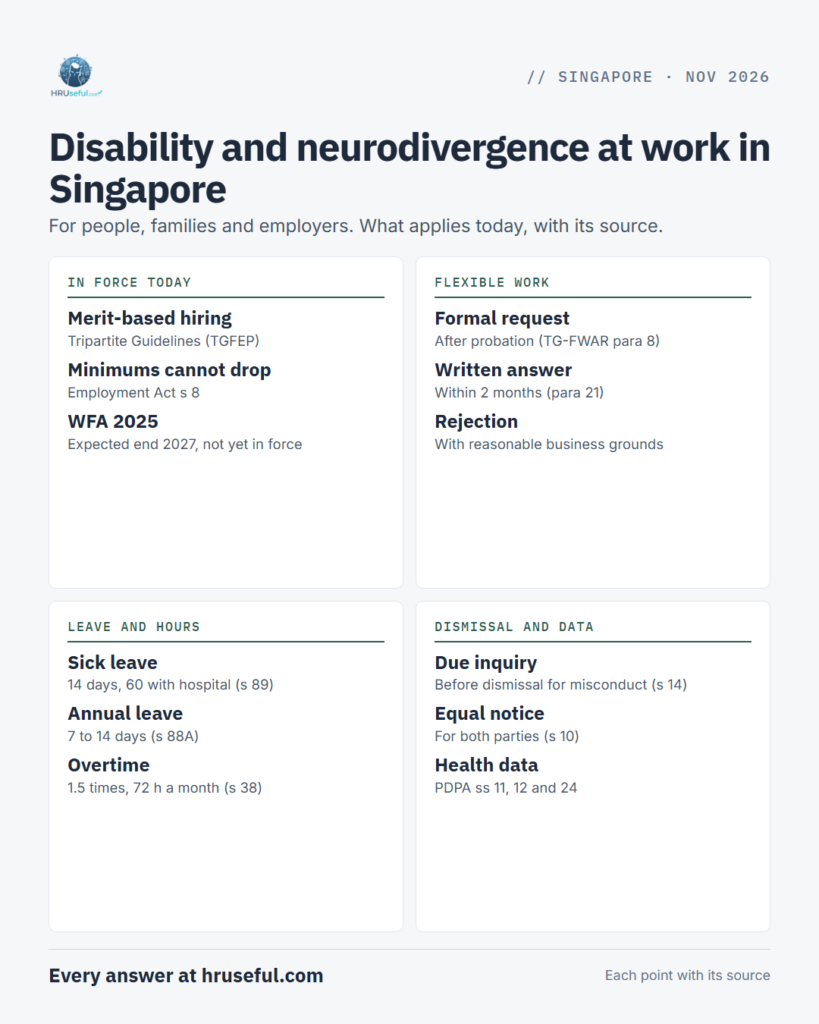
- Merit-based recruitment and fair treatment under the Tripartite Guidelines, a formal process for flexible work requests with a written answer within two months, the Employment Act minimums on sick leave, annual leave, hours and dismissal, and the PDPA rules for handling health information.
- Good to know
- The Workplace Fairness Act 2025 is expected to come into force around the end of 2027; until then its obligations cannot be enforced. Employers who do not follow the Tripartite Guidelines may face MOM scrutiny and work pass restrictions.
| Key point | What the law says |
| Recruitment | Based on merit. Skills, experience and ability to do the job; disability is listed among the factors that should not decide selection. Tripartite Guidelines on Fair Employment Practices (TGFEP), Principle Recruit Based on Merit |
| Flexible work | Written answer within 2 months. After probation, employees can make a formal request; a rejection must give reasonable business grounds. Tripartite Guidelines on Flexible Work Arrangement Requests (TG-FWAR), para 21 |
| Minimum conditions | Cannot be lowered. A term less favourable than the Employment Act minimums is illegal and void, disability or not. Employment Act 1968, s. 8 |
| Sick leave | Up to 14 days, or 60 with hospitalisation. After six months of service and with medical certification. Employment Act 1968, s. 89(1) |
| Dismissal for misconduct | Only after due inquiry. A disability or support need is not in itself misconduct. Employment Act 1968, s. 14(1) |
| Health data | Protected under the PDPA. The organisation remains responsible for the disability data it holds and must protect it with reasonable security arrangements. Personal Data Protection Act 2012, s. 11(2) |
Flexible work requests
Who can make a formal flexible work arrangement request under the Guidelines?
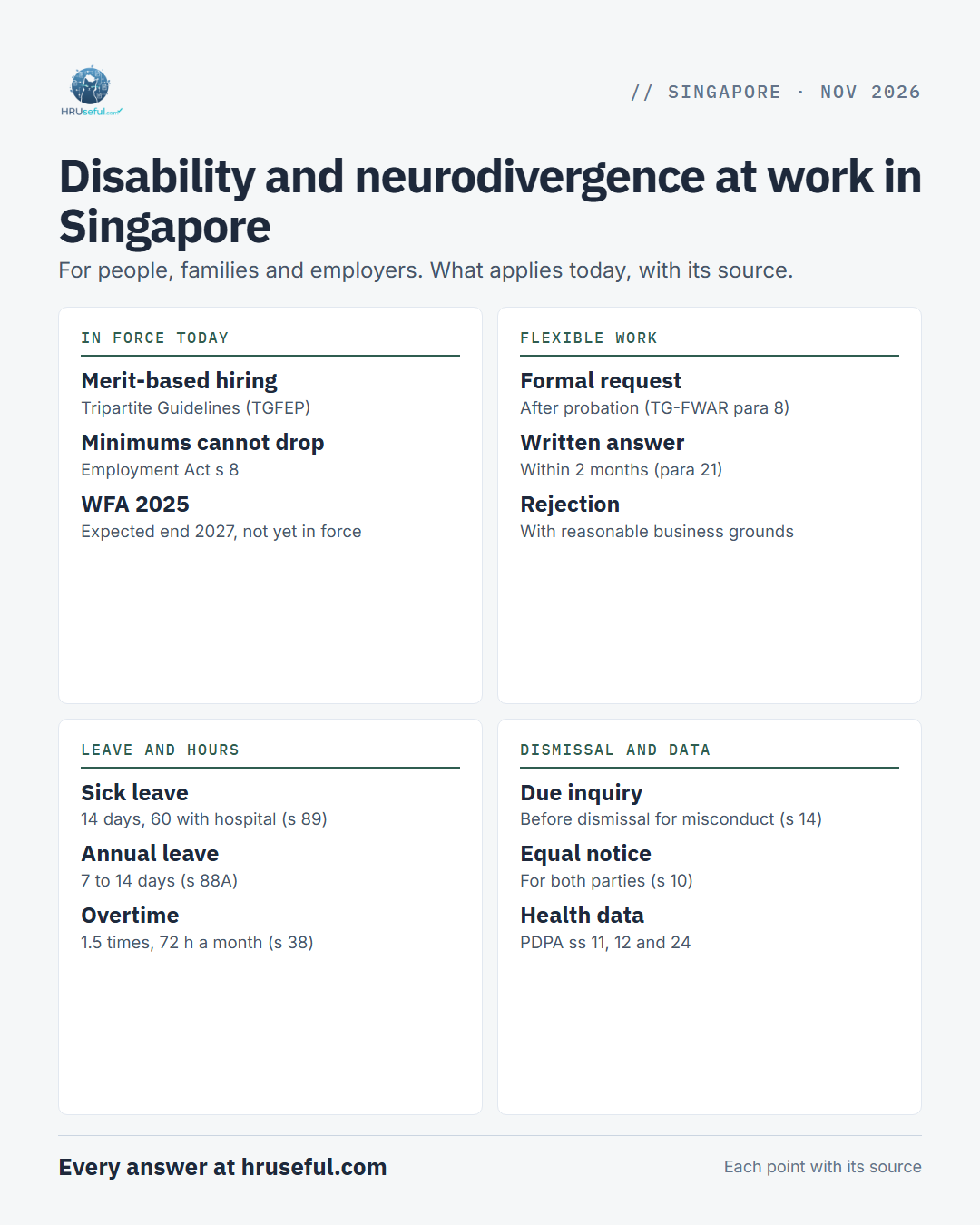
Any employee who has completed the probation period set by their employer. The Guidelines also let the employer consider requests during probation, but do not require it on those terms. It is a procedural guideline, not automatic approval.Law: Tripartite Guidelines on Flexible Work Arrangement Requests (TG-FWAR), para 8
Does making a formal request give a right to the arrangement chosen?
No. The Guidelines recognise that requests may be rejected on reasonable business grounds, not out of personal bias against flexible work. They distinguish the duty to consider the request from an unconditional right to the arrangement requested.Law: Tripartite Guidelines on Flexible Work Arrangement Requests (TG-FWAR), para 18
Can the request be made in writing if the company has no procedure?
Yes. The Guidelines provide for this where the employer has not set any requirements or process. The request must contain the information listed in paragraph 12.Law: Tripartite Guidelines on Flexible Work Arrangement Requests (TG-FWAR), para 12(a)
Must the employer’s form or format be followed?
As a procedural rule, the format and information requirements the employer has set for formal requests should be followed. It is worth checking that the channel lets the person explain their specific need.Law: Tripartite Guidelines on Flexible Work Arrangement Requests (TG-FWAR), para 11
What details does a formal request contain when there are no internal requirements?
Date of the request, the flexible arrangement requested, its expected frequency and duration, the reason, and start and end dates where relevant. The text does not on its own require a medical diagnosis to be attached to every request.Law: Tripartite Guidelines on Flexible Work Arrangement Requests (TG-FWAR), para 12(a)(i) to (iv)
How long does the employer have to reply in writing?
It must communicate its decision within two months of receiving the formal request. Clarifications and discussions should take place within that period, under the Guidelines.Law: Tripartite Guidelines on Flexible Work Arrangement Requests (TG-FWAR), para 21
Can the reply reject the request without giving a reason?
The Guidelines state that a rejection must include its reason in the written decision. This is a requirement of the tripartite procedure; it is not presented as automatic statutory compensation for each failure.Law: Tripartite Guidelines on Flexible Work Arrangement Requests (TG-FWAR), para 22
Is a habit of always working in the office enough as a business reason?
The Guidelines say requests should not be rejected for reasons not directly linked to business outcomes, and give examples of unsuitable reasons. The assessment should consider the role and concrete operational effects.Law: Tripartite Guidelines on Flexible Work Arrangement Requests (TG-FWAR), para 19
Is it recommended to explore another arrangement if the one requested is not possible?
Yes. Employers are encouraged to discuss alternatives with the employee if they reject the request. It is a recommendation; it does not guarantee that both parties must agree on a particular alternative.Law: Tripartite Guidelines on Flexible Work Arrangement Requests (TG-FWAR), para 23
Do the Guidelines require informal arrangements that work to be dropped?
No. They note that existing formal and informal practices can continue where they work for both parties. That arrangement should be distinguished from the formal request procedure in the Guidelines.Law: Tripartite Guidelines on Flexible Work Arrangement Requests (TG-FWAR), para 5
Does flexible work only mean working from home?
No. The Guidelines cover changes to place, time and workload. The arrangement must be agreed and can combine categories; its availability depends on the organisation and the role.Law: Tripartite Guidelines on Flexible Work Arrangement Requests (TG-FWAR), para 4
Does a reduced workload have to keep the same pay under these Guidelines?
The flexi-load category describes changes in workload with commensurate pay, such as job sharing or part-time work. It does not by itself create a right to reduce workload while keeping the same salary; the agreement and applicable rules must be reviewed.Law: Tripartite Guidelines on Flexible Work Arrangement Requests (TG-FWAR), para 4, category Flexi-load
Must the same arrangement be approved for the whole workforce at once?
No. Each request must be assessed individually and be workable for the business. The Guidelines do not require the same arrangement to be approved for everyone at the same time if there are valid business reasons.Law: Tripartite Guidelines on Flexible Work Arrangement Requests (TG-FWAR), para 7(c)
What channel is recommended when there is disagreement over a request?
The Guidelines recommend open dialogue and, where possible, the internal grievance procedure. Union members can also ask their union for help. This channel is not the same as a new court procedure created by a future law.Law: Tripartite Guidelines on Flexible Work Arrangement Requests (TG-FWAR), para 16
Fair employment
Should recruitment assess ability to do the job instead of excluding people because of disability?
The TGFEP require recruitment based on merit, such as skills, experience or ability to perform the job, and list disability among the factors that should not determine selection. They are applicable tripartite guidelines, not the future law already in force.Law: Tripartite Guidelines on Fair Employment Practices (TGFEP), Principle Recruit Based on Merit
What standard of treatment do the fair employment guidelines set?
They require fair and respectful treatment and progressive human resource management systems. It is a standard for reviewing supervisory practices; it does not on its own create a specific court remedy for each behaviour.Law: Tripartite Guidelines on Fair Employment Practices (TGFEP), Principle Respect Employees
Should training opportunities be based on strengths and needs?
Yes. The Guidelines provide for fair consideration for training and development based on strengths and needs. It is a criterion for avoiding blanket exclusion of persons with disabilities or support needs.Law: Tripartite Guidelines on Fair Employment Practices (TGFEP), Principle Provide Fair Opportunities
What criterion do the Guidelines propose for rewarding employees?
Fair reward based on ability, performance, contribution and experience. When reviewing pay or incentives, those criteria should be identified and not replaced by stereotypes about disability.Law: Tripartite Guidelines on Fair Employment Practices (TGFEP), Principle Reward Fairly
Do the Guidelines have no consequences because they are not an Act of Parliament?
No. TAFEP explains that, under the Fair Consideration Framework, employers who do not comply may face MOM scrutiny and restrictions on their work pass privileges. This must be distinguished from the penalties or claims provided for in the law that is not yet in force.Law: Tripartite Guidelines on Fair Employment Practices (TGFEP), Section Being Fair, note Fair Consideration Framework
As of the cut-off date, can the Workplace Fairness Act be presented as law in force?
No. Official information presents it as upcoming and expects it to come into force around the end of 2027. Its obligations, exceptions or remedies should not be presented as enforceable at the cut-off date. Current guidance must rely on the laws and guidelines that apply today.Law: Implementation status of Workplace Fairness Act 2025 — TAFEP information, Section Workplace Fairness — implementation
Who the Employment Act covers
Can a condition below the legal minimum be agreed because the person has a disability?
For a person covered by the Employment Act, a term less favourable than their minimum conditions is illegal and void to that extent. A disability does not make a waiver of those minimums valid.Law: Employment Act 1968, s. 8
What salary threshold applies to manual work for Part 4 to apply?
Part 4 covers manual work within the legal category of workman earning up to SGD 4,500 a month, excluding the items set out in the law. Coverage depends on duties and pay, not only on disability.Law: Employment Act 1968, s. 35(a)
Does Part 4 apply in the same way to non-manual staff and managers?
For non-manual staff, excluding managerial or executive positions, the threshold is SGD 2,600 a month with the legal salary exclusions. Its working-hours rules should not be extended to every managerial role.Law: Employment Act 1968, s. 35(b)
Sick leave
What paid sick leave applies after six months of service?
Subject to the certification and coverage requirements, the law provides up to 14 days a year of outpatient sick leave. For hospitalisation, the limit is the lower of 60 days or 14 plus the qualifying days of hospitalisation. They are not two separate allowances of 14 and 60 days.Law: Employment Act 1968, s. 89(1)
Is there paid sick leave with three to less than four months of service?
Yes. With certification and the other requirements, up to 5 days of outpatient sick leave apply. With hospitalisation, the limit is the lower of 15 days or 5 plus the qualifying days of hospitalisation. This is a general rule, not a special leave for neurodivergence.Law: Employment Act 1968, s. 89(2)(a)
What limit applies with four to less than five months of service?
Subject to the legal requirements, up to 8 days of outpatient sick leave. With hospitalisation, the limit is the lower of 30 days or 8 plus the qualifying days of hospitalisation. The service of the actual employment relationship must be used.Law: Employment Act 1968, s. 89(2)(b)
What limit applies with five to less than six months of service?
Subject to the legal requirements, up to 11 days of outpatient sick leave. With hospitalisation, the limit is the lower of 45 days or 11 plus the qualifying days of hospitalisation. From six months of service, the full rule in subsection 1 applies.Law: Employment Act 1968, s. 89(2)(c)
Can any absence without certification be treated as paid medical leave?
No. The section sets out consequences for sick leave not certified by a medical practitioner. A disability or neurodivergent condition does not automatically replace the certification required for this leave.Law: Employment Act 1968, s. 89(4)
Why does informing the employer within 48 hours matter?
Where the certificate comes from a practitioner not appointed by the employer, the law treats as absence without permission or reasonable excuse an absence the employer was not informed of, and no attempt was made to inform, within 48 hours of its start. Keep a record of attempts to give notice too.Law: Employment Act 1968, s. 89(4)(b)
Must the person stay in hospital for the whole period for it to count as hospitalisation?
Not in every case. The law allows a person to be treated as hospitalised if they hold the required certification of the need for hospitalisation, or of rest or further treatment after discharge in order to recover. Who issues the certificate and the legal case must be checked.Law: Employment Act 1968, s. 89(3)(b)
Can a legal quarantine count as hospitalisation?
Yes. The subsection includes quarantine under any written law, whether or not the person is in a hospital. A personal decision to self-isolate should not be treated as a legal quarantine.Law: Employment Act 1968, s. 89(3)(a)
How is a day of outpatient sick leave paid?
The law requires payment at the gross rate of pay excluding any shift allowance. The calculation must apply the legal definition of that term and the relevant type of leave.Law: Employment Act 1968, s. 89(5)(a)
Does hospitalisation leave pay use the same shift allowance exclusion?
The hospitalisation provision refers to the gross rate of pay, while the outpatient provision excludes shift allowance. The same calculation should not be copied automatically for both cases.Law: Employment Act 1968, s. 89(5)(b)
Does illness create extra leave pay on a rest day or a day of paid annual leave?
The subsection excludes paid sick leave on rest days, covered holidays, paid annual leave, days with no contractual obligation to work and certain unpaid leave. Whether the contract improves on that minimum should also be checked.Law: Employment Act 1968, s. 89(6)
Can paid sick leave overlap with compensation for temporary incapacity from a work accident?
The law excludes paid sick leave for the period in which compensation for temporary incapacity under the work injury compensation law is received or due. The specific benefit and period must be checked.Law: Employment Act 1968, s. 89(7)
Does every medical certificate oblige the employer to reimburse the consultation?
It is not presumed. After at least three months of service, this subsection requires the employer to pay or reimburse the examination if the practitioner is appointed by the employer or is a medical officer and certifies entitlement to paid leave. The medical benefits scheme and related rules must also be reviewed.Law: Employment Act 1968, s. 89(7A)
Does statutory medical leave automatically cover cosmetic procedures?
No. The section excludes treatment the examining practitioner considers cosmetic. A contractual benefit can be broader; this exclusion does not allow HR to label a treatment as cosmetic on its own.Law: Employment Act 1968, s. 89(10)
Annual leave
When does the statutory right to paid annual leave begin?
For a person covered by this law, after at least three months of service. No recognised disability is required to access the general right, and no specific additional disability leave is created here.Law: Employment Act 1968, s. 88A(1)
What is the minimum annual leave in the first year?
Seven days of paid annual leave for the first 12 months of continuous service with the same employer, subject to the legal access and pro-rating rules. The contract can provide better terms.Law: Employment Act 1968, s. 88A(1)(a)
Does the minimum annual leave increase with service?
Yes. One day is added for every further 12 months of continuous service, up to the legal maximum of 14 days under this minimum scheme. It is not a cap on more favourable contractual benefits.Law: Employment Act 1968, s. 88A(1)(b) and (c)
How is annual leave calculated if the year is not completed?
After the minimum three months, the law grants annual leave in proportion to the completed months of service in that year. This can matter when joining, leaving or reorganising an employment relationship.Law: Employment Act 1968, s. 88A(2)
How are fractions of a day rounded when pro-rating?
Fractions of less than half a day are disregarded, and fractions of half a day or more count as one day. HR must use the same criterion when calculating the legal minimum.Law: Employment Act 1968, s. 88A(3)
Does unpaid leave taken at the employee’s request count as service for annual leave?
The subsection requires that period to be disregarded when calculating continuous service for this section. It does not mean any certified sick absence can be reclassified as unpaid leave.Law: Employment Act 1968, s. 88A(4)
On what basis is statutory annual leave paid?
At the gross rate of pay for every day of paid annual leave. The legal definition of that term must be used, not a reduction based only on the person’s disability.Law: Employment Act 1968, s. 88A(7)
What happens to outstanding annual leave on dismissal for a reason other than misconduct?
The employer must pay the outstanding days covered by the rule at the gross rate of pay. The section expressly distinguishes the case of misconduct, which must not be confused with a health condition or disability.Law: Employment Act 1968, s. 88A(8)
Hours, rest and shifts
Does Part 4 provide a weekly rest day?
Yes, for those it covers: one whole rest day a week without specific pay for that day, which can be Sunday or another day set by the employer. Shifts and other exceptions must be reviewed separately.Law: Employment Act 1968, s. 36(1), in Part 4
Must the employer give notice of the rest-day roster it sets?
Yes. When it sets rest days, it must prepare a roster before the start of the month and inform employees of their rest days. Predictability can help with support and personal planning; it does not create an extra disability regime.Law: Employment Act 1968, s. 36(4), in Part 4
What is the general rule on working continuously without a break?
The general rule prevents requiring more than six consecutive hours without a period of leisure. The section contains exceptions, including certain continuous work; it should not be presented as an absolute ban in every role.Law: Employment Act 1968, s. 38(1)(a), in Part 4
What minimum rate applies to overtime covered by Part 4?
Covered overtime is paid at no less than one and a half times the hourly basic rate of pay. Coverage, hours thresholds and special regimes must be checked before calculating it.Law: Employment Act 1968, s. 38(4), in Part 4
Does the law set a monthly overtime limit?
The general rule in Part 4 is no more than 72 hours of overtime a month. Any applicable written exceptions or exemptions must be checked; disability alone does not allow a different uniform limit to be stated.Law: Employment Act 1968, s. 38(5), subject to s. 41A
Can shift work spread hours differently from ordinary working hours?
Yes, under the conditions of the section. The average over any continuous period of three weeks must not exceed 44 hours a week, subject to the express exceptions. Review the regime before proposing a change of shift as a support.Law: Employment Act 1968, s. 40(1), in Part 4
Is a signature without explanation enough to consent to the section 40 arrangement?
No. Valid consent requires explaining sections 40 and 38 and informing the employee of start and finish times, working days and weekly rest day. This is a general obligation; making it easy to understand matters when organising support.Law: Employment Act 1968, s. 40(2), in Part 4
Notice and dismissal
Can a different notice period be set for the employer and the employee?
The notice period must be the same for both parties. What was agreed applies or, if nothing was agreed, the statutory scale. A disability does not allow this contractual check to be skipped.Law: Employment Act 1968, s. 10(2)
Must notice of termination be given in writing?
Yes. The day the notice is given counts towards the period. It is advisable to make sure the communication is accessible to the person receiving it; this practical recommendation does not replace the legal requirements.Law: Employment Act 1968, s. 10(5)
Can the contract be ended by paying for the notice period?
The law allows termination without waiting for the notice period by paying a sum equal to the salary for that period, under the legal basis and calculation. Paying notice does not on its own settle whether the reason for dismissal was legitimate.Law: Employment Act 1968, s. 11(1)
Do two days of absence automatically prove the contract was broken?
The provision refers to more than two continuous days without prior leave, together with no reasonable excuse or no notice, or attempt at notice, of that excuse. It should not be applied without regard to the circumstances, certificates and communications.Law: Employment Act 1968, s. 13(2)
Does dismissal without notice for misconduct require a prior inquiry?
Yes. The law requires due inquiry for dismissal without notice for misconduct inconsistent with the conditions of service. A disability or support need is not in itself misconduct.Law: Employment Act 1968, s. 14(1)
Can an employee be suspended without any pay during a disciplinary inquiry?
The suspension provision requires at least half the salary during the inquiry. The ordinary period does not exceed one week, unless the Commissioner allows a longer period at the employer’s request. It must not be confused with a penalty already imposed.Law: Employment Act 1968, s. 14(8)
What happens to withheld salary if the inquiry does not establish misconduct?
The employer must immediately restore the full amount withheld. HR must distinguish the inquiry from any non-disciplinary matter related to health or ability to perform duties.Law: Employment Act 1968, s. 14(9)
Is there a way to claim against dismissal without just cause or excuse?
Yes. The section provides that a covered employee can make a claim under the Employment Claims Act, subject to its requirements. No time limit or automatic access is stated here for any relationship excluded from the regime.Law: Employment Act 1968, s. 14(2)
Personal data
Is the company still responsible for the disability data it keeps?
Yes. The organisation is responsible for personal data in its possession or under its control. This is a general PDPA rule that applies within its scope; it should not be extended without checking the exclusions in section 4, including public agencies.Law: Personal Data Protection Act 2012, s. 11(2)
Must there be someone responsible for PDPA compliance?
Yes. The organisation must designate one or more individuals to be responsible for ensuring compliance. HR should coordinate the handling of disability or support information with that role.Law: Personal Data Protection Act 2012, s. 11(3)
Must the data protection contact be available to the public?
Yes. The business contact information of at least one designated or delegated person must be made public under the section. Their private details do not have to be published.Law: Personal Data Protection Act 2012, s. 11(5)
Does designating a responsible person relieve the company of its data obligations?
No. The designation does not relieve the organisation of its obligations. Nor does it automatically make that person responsible for every mishandling of personnel files.Law: Personal Data Protection Act 2012, s. 11(6)
Can protection of personnel files be limited to a general statement?
The law requires developing and implementing the policies and practices needed to comply with the PDPA. As an HR action, their actual application to personnel files and support requests should be reviewed.Law: Personal Data Protection Act 2012, s. 12(a)
Must there be a process for receiving complaints about personal data?
Yes. The organisation must develop a process to receive and respond to complaints about how the PDPA is applied. This can be relevant when disclosure or handling of disability data is questioned.Law: Personal Data Protection Act 2012, s. 12(b)
Must data protection policies be communicated to staff?
Yes. The organisation must communicate its policies and practices to its staff. In practice, those who handle certificates or support requests should know them.Law: Personal Data Protection Act 2012, s. 12(c)
Does PDPA compliance require considering what is appropriate in the circumstances?
Yes. The section requires considering what a reasonable person would consider appropriate in the circumstances. It is not unlimited permission to collect health information; the specific applicable rules must also be reviewed.Law: Personal Data Protection Act 2012, s. 11(1)
Must the accuracy of data used to make a decision about a person be checked?
Yes. A reasonable effort must be made to ensure the data is accurate and complete if it will be used to make a decision affecting the person or disclosed to another organisation. HR should not base decisions on unverified inferences about disability.Law: Personal Data Protection Act 2012, s. 23
Does information about support or disability need security measures?
Personal data in the organisation’s possession or under its control must be protected with reasonable security arrangements. The operational review should cover access, use, disclosure and other risks set out in the law, within the scope of the PDPA.Law: Personal Data Protection Act 2012, s. 24
Keep exploring
- Private-sector employment in Singapore
- Unions in Singapore
- Work passes and international mobility
- Public-sector employment in Singapore
- All Singapore topics
- Disability and neurodivergence at work — Australia
- Disability and neurodivergence at work — India
Every answer cites the law in force on 1 November 2026 and was checked against its official text. Current questions: 70.
- En pocas líneas · a quién alcanza
- A las personas con discapacidad y neurodivergentes que buscan trabajo o trabajan en Singapur, a sus familias y a los empleadores y equipos de RR. HH. que las contratan.
- Qué rige hoy
- Selección por mérito y trato justo según las directrices tripartitas, un procedimiento formal para pedir trabajo flexible con respuesta escrita en dos meses, los mínimos de la Employment Act sobre licencia por enfermedad, vacaciones, jornada y despido, y las reglas de la PDPA para la información de salud.
- Lo que conviene saber
- La Workplace Fairness Act 2025 entraría en vigor hacia fines de 2027; hasta entonces sus obligaciones no son exigibles. Quien no cumple las directrices tripartitas puede quedar bajo el escrutinio del MOM y con restricciones en sus permisos de trabajo.
| Dato clave | Qué dice la norma |
| Selección | Por mérito. Habilidades, experiencia y capacidad para el puesto; la discapacidad figura entre los motivos que no deben decidir la selección. Tripartite Guidelines on Fair Employment Practices (TGFEP), Principio Recruit Based on Merit |
| Trabajo flexible | Respuesta escrita en 2 meses. Terminado el período de prueba, se puede presentar un pedido formal; el rechazo exige razones empresariales razonables. Tripartite Guidelines on Flexible Work Arrangement Requests (TG-FWAR), Párr. 21 |
| Condiciones mínimas | No se pueden rebajar. Una cláusula inferior a los mínimos de la Employment Act es ilegal y nula, haya o no discapacidad. Employment Act 1968, s. 8 |
| Licencia por enfermedad | Hasta 14 días, o 60 con internación. Después de seis meses de servicio y con certificado médico. Employment Act 1968, s. 89(1) |
| Despido por mala conducta | Solo con investigación previa. Una discapacidad o una necesidad de apoyo no es, por sí misma, mala conducta. Employment Act 1968, s. 14(1) |
| Datos de salud | Protegidos por la PDPA. La organización responde por los datos de discapacidad que conserva y debe protegerlos con medidas de seguridad razonables. Personal Data Protection Act 2012, s. 11(2) |
Pedidos de trabajo flexible
¿Quién puede presentar una solicitud formal de trabajo flexible bajo las directrices?
Todo empleado que haya completado el período de prueba fijado por su empleador. La guía también permite que el empleador considere pedidos durante la prueba, pero no exige hacerlo en esos términos. Es una directriz de procedimiento, no aprobación automática.Norma: Tripartite Guidelines on Flexible Work Arrangement Requests (TG-FWAR), Párr. 8
¿Presentar una solicitud formal da derecho a que se apruebe la modalidad elegida?
No. Las directrices reconocen la facultad de rechazar por razones empresariales razonables, no por prejuicio personal contra la flexibilidad. Distinguen el deber de considerar el pedido de un derecho incondicional a la modalidad solicitada.Norma: Tripartite Guidelines on Flexible Work Arrangement Requests (TG-FWAR), Párr. 18
¿Se puede presentar el pedido por escrito si la empresa no tiene procedimiento?
Sí. Las directrices prevén esa posibilidad cuando no hay requisitos o proceso fijado por el empleador. El pedido debe contener la información indicada en el párrafo 12.Norma: Tripartite Guidelines on Flexible Work Arrangement Requests (TG-FWAR), Párr. 12(a)
¿Hay que seguir el formulario o formato establecido por el empleador?
Como regla del procedimiento, deben seguirse los requisitos de formato y datos que el empleador haya estipulado para el pedido formal. Conviene verificar que el canal permita expresar la necesidad concreta de organización laboral.Norma: Tripartite Guidelines on Flexible Work Arrangement Requests (TG-FWAR), Párr. 11
¿Qué datos contiene un pedido formal cuando no hay requisitos internos?
Fecha del pedido, modalidad de flexibilidad, frecuencia y duración esperadas, motivo y fechas de inicio y fin si corresponden. El texto no exige por sí solo adjuntar un diagnóstico médico a toda solicitud.Norma: Tripartite Guidelines on Flexible Work Arrangement Requests (TG-FWAR), Párr. 12(a)(i) a (iv)
¿Cuánto tiempo tiene el empleador para responder por escrito?
Debe comunicar la decisión dentro de dos meses desde la recepción del pedido formal. Las aclaraciones y conversaciones deben integrarse dentro de ese período, conforme a las directrices.Norma: Tripartite Guidelines on Flexible Work Arrangement Requests (TG-FWAR), Párr. 21
¿La respuesta puede rechazar sin indicar una razón?
Las directrices indican que el rechazo debe incluir su razón en la decisión escrita. Es una exigencia del procedimiento tripartito; no se presenta como una indemnización legal automática por cada incumplimiento.Norma: Tripartite Guidelines on Flexible Work Arrangement Requests (TG-FWAR), Párr. 22
¿La costumbre de trabajar siempre en oficina basta como razón empresarial?
Las directrices indican que no se rechacen solicitudes por motivos sin vínculo directo con resultados empresariales y dan ejemplos de razones inadecuadas. La evaluación debe considerar el puesto y efectos operativos concretos.Norma: Tripartite Guidelines on Flexible Work Arrangement Requests (TG-FWAR), Párr. 19
¿Se recomienda explorar otra modalidad si la solicitada no es posible?
Sí. Se alienta al empleador a conversar alternativas con la persona si rechaza el pedido. Es una recomendación expresada como encouraged; no garantiza que ambas partes deban acordar una alternativa determinada.Norma: Tripartite Guidelines on Flexible Work Arrangement Requests (TG-FWAR), Párr. 23
¿Las directrices obligan a abandonar acuerdos informales que funcionan?
No. Señalan que las prácticas formales e informales existentes pueden continuar cuando funcionan para ambas partes. Debe distinguirse ese acuerdo del procedimiento de solicitud formal previsto por las directrices.Norma: Tripartite Guidelines on Flexible Work Arrangement Requests (TG-FWAR), Párr. 5
¿El trabajo flexible significa solamente trabajar desde casa?
No. Las directrices contemplan cambios de lugar, de horarios y de carga de trabajo. La modalidad debe acordarse y puede combinar categorías; su disponibilidad depende de la organización y del puesto.Norma: Tripartite Guidelines on Flexible Work Arrangement Requests (TG-FWAR), Párr. 4
¿La reducción de carga de trabajo mantiene obligatoriamente la misma remuneración bajo estas directrices?
La categoría flexi-load describe variaciones de carga con remuneración acorde, como trabajo compartido o parcial. No crea por sí sola un derecho a reducir carga manteniendo el mismo salario; deben revisarse el acuerdo y las normas aplicables.Norma: Tripartite Guidelines on Flexible Work Arrangement Requests (TG-FWAR), Párr. 4, categoría Flexi-load
¿La misma modalidad debe aprobarse simultáneamente para toda la dotación?
No. Cada solicitud debe evaluarse individualmente y ser viable desde el punto de vista empresarial. Las directrices no exigen aprobar la misma modalidad al mismo tiempo para todos si existen razones empresariales válidas.Norma: Tripartite Guidelines on Flexible Work Arrangement Requests (TG-FWAR), Párr. 7(c)
¿Qué canal se recomienda ante desacuerdos por una solicitud?
Las directrices recomiendan diálogo abierto y, en lo posible, el procedimiento interno de reclamos. Quienes están sindicalizados también pueden pedir ayuda al sindicato. No se equipara este canal a un nuevo procedimiento judicial creado por una ley futura.Norma: Tripartite Guidelines on Flexible Work Arrangement Requests (TG-FWAR), Párr. 16
Empleo justo
¿La selección debe evaluar capacidades para el puesto en lugar de excluir por discapacidad?
Las TGFEP requieren selección por mérito, como habilidades, experiencia o capacidad de desempeñar el trabajo, y contemplan discapacidad entre los motivos que no deben determinar la selección. Son directrices tripartitas aplicables, no la ley futura ya en vigor.Norma: Tripartite Guidelines on Fair Employment Practices (TGFEP), Principio Recruit Based on Merit
¿Qué pauta de trato establecen las directrices de empleo justo?
Exigen trato justo y respetuoso y sistemas progresivos de gestión de personas. Es una pauta aplicable para revisar prácticas de supervisión; no constituye por sí sola una reparación judicial específica por cada conducta.Norma: Tripartite Guidelines on Fair Employment Practices (TGFEP), Principio Respect Employees
¿Las oportunidades de capacitación deben basarse en fortalezas y necesidades?
Sí. Las directrices prevén oportunidades justas de consideración para formación y desarrollo según fortalezas y necesidades. Es un criterio para evitar exclusiones generales de personas con discapacidad o necesidades de apoyo.Norma: Tripartite Guidelines on Fair Employment Practices (TGFEP), Principio Provide Fair Opportunities
¿Qué criterio proponen las directrices para recompensar a las personas?
Recompensa justa basada en capacidad, desempeño, contribución y experiencia. Al revisar remuneración o incentivos, corresponde identificar esos criterios y evitar sustituirlos por estereotipos sobre discapacidad.Norma: Tripartite Guidelines on Fair Employment Practices (TGFEP), Principio Reward Fairly
¿Las directrices carecen de consecuencias porque no son una ley parlamentaria?
No. TAFEP explica que, bajo el Fair Consideration Framework, empleadores que no las cumplen pueden quedar sujetos al escrutinio de MOM y a restricciones en sus privilegios de permisos de trabajo. Esto debe distinguirse de sanciones o reclamos previstos para la ley todavía no vigente.Norma: Tripartite Guidelines on Fair Employment Practices (TGFEP), Apartado Being Fair, nota Fair Consideration Framework
¿Al corte solicitado ya puede presentarse la Workplace Fairness Act como ley vigente?
No. La información oficial la presenta como próxima y prevé su entrada en vigor hacia fines de 2027. No corresponde anticipar sus obligaciones, excepciones o remedios como si ya fueran exigibles al corte. El bloque vigente debe apoyarse en las normas y directrices aplicables actuales.Norma: Estado de implementación de Workplace Fairness Act 2025 — información de TAFEP, Apartado Workplace Fairness — implementación
A quién alcanza la Employment Act
¿Puede pactarse una condición inferior al mínimo legal porque la persona tiene discapacidad?
Para una persona cubierta por la Employment Act, una cláusula menos favorable que sus condiciones mínimas es ilegal y nula en esa medida. La discapacidad no convierte en válida una renuncia a esos mínimos.Norma: Employment Act 1968, s. 8
¿Qué umbral corresponde al trabajo manual para aplicar la Parte 4?
La Parte 4 alcanza al trabajo manual incluido en la categoría legal de workman con salario mensual de hasta SGD 4.500, excluidos los conceptos indicados por la ley. El encuadre depende de las funciones y la remuneración, no solamente de la discapacidad.Norma: Employment Act 1968, s. 35(a)
¿La Parte 4 se aplica de la misma forma a personal no manual y a directivos?
Para personal no manual, excluidos puestos gerenciales o ejecutivos, el umbral es SGD 2.600 mensuales con las exclusiones salariales legales. No hay que extrapolar sus reglas de jornada a todo puesto directivo.Norma: Employment Act 1968, s. 35(b)
Licencia por enfermedad
¿Qué licencia paga por enfermedad corresponde después de seis meses?
Con los requisitos de certificación y cobertura, la ley prevé hasta 14 días anuales sin hospitalización. Para hospitalización aplica el menor entre 60 días y la suma de 14 más los días computables de hospitalización. No son dos bolsas independientes de 14 y 60 días.Norma: Employment Act 1968, s. 89(1)
¿Hay licencia paga entre tres y menos de cuatro meses de servicio?
Sí. Con certificación y demás requisitos, corresponden hasta 5 días sin hospitalización. Si hay hospitalización, el límite es el menor entre 15 días y 5 más los días computables de hospitalización. Esta es una regla general, no una licencia especial por neurodivergencia.Norma: Employment Act 1968, s. 89(2)(a)
¿Qué límite corresponde entre cuatro y menos de cinco meses?
Con los requisitos legales, hasta 8 días sin hospitalización. Si hay hospitalización, el límite es el menor entre 30 días y 8 más los días computables de hospitalización. Debe usarse la antigüedad del vínculo concreto.Norma: Employment Act 1968, s. 89(2)(b)
¿Qué límite corresponde entre cinco y menos de seis meses?
Con los requisitos legales, hasta 11 días sin hospitalización. Si hay hospitalización, el límite es el menor entre 45 días y 11 más los días computables de hospitalización. Al cumplir seis meses se aplica la regla completa del apartado 1.Norma: Employment Act 1968, s. 89(2)(c)
¿Puede tratarse como licencia médica paga cualquier ausencia sin certificación?
No. El artículo prevé consecuencias para una ausencia por enfermedad no certificada por un profesional médico. Una condición de discapacidad o neurodivergencia no sustituye automáticamente la certificación requerida para esta licencia.Norma: Employment Act 1968, s. 89(4)
¿Qué importancia tiene avisar al empleador dentro de las 48 horas?
Cuando certifica un profesional no designado por el empleador, la ley contempla como ausencia sin permiso ni excusa razonable aquella respecto de la cual no se informó ni intentó informar dentro de las 48 horas desde su inicio. Documentá también los intentos de aviso.Norma: Employment Act 1968, s. 89(4)(b)
¿Es indispensable permanecer internado todo el período para computarlo como hospitalización?
No en todos los casos. La ley permite tratar como hospitalizado a quien tenga la certificación exigida de necesidad de hospitalización o de reposo o tratamiento posterior al alta para recuperarse. Hay que verificar quién emite la certificación y el supuesto legal.Norma: Employment Act 1968, s. 89(3)(b)
¿Una cuarentena legal puede integrar el concepto de hospitalización?
Sí. El apartado incluye cuarentena bajo una ley escrita, esté o no la persona en un hospital. No debe equipararse cualquier decisión personal de aislamiento a una cuarentena legal.Norma: Employment Act 1968, s. 89(3)(a)
¿Cómo se remunera un día de licencia por enfermedad sin hospitalización?
La ley dispone pagar el gross rate of pay excluyendo el adicional por trabajo en turnos. La liquidación debe aplicar la definición legal del concepto y el supuesto de licencia correspondiente.Norma: Employment Act 1968, s. 89(5)(a)
¿El pago de hospitalización usa la misma exclusión del adicional de turno?
El apartado de hospitalización indica el gross rate of pay, mientras que el de ausencia sin hospitalización excluye el adicional por turno. No corresponde copiar automáticamente la misma liquidación para ambos supuestos.Norma: Employment Act 1968, s. 89(5)(b)
¿La enfermedad genera un pago adicional de licencia en un día de descanso o vacaciones pagas?
El apartado excluye el derecho a licencia médica paga en días de descanso, feriados comprendidos, vacaciones pagas, días sin obligación contractual de trabajar y determinadas licencias sin goce. Debe revisarse además si el contrato mejora ese mínimo.Norma: Employment Act 1968, s. 89(6)
¿Puede superponerse licencia médica paga con compensación por incapacidad temporal laboral?
La ley excluye la licencia médica paga para el período en que se recibe o se tiene derecho a la compensación por incapacidad temporal prevista en el régimen de accidentes de trabajo citado. Debe verificarse el beneficio y período concreto.Norma: Employment Act 1968, s. 89(7)
¿Todo certificado médico obliga al mismo reintegro de consulta?
No se presume. Tras al menos tres meses de servicio, este apartado obliga a cubrir o reintegrar el examen si el profesional es designado por el empleador o es medical officer y certifica derecho a licencia paga. Hay que revisar también el esquema de salud y las reglas complementarias.Norma: Employment Act 1968, s. 89(7A)
¿La licencia médica legal alcanza automáticamente a procedimientos cosméticos?
No. El artículo excluye tratamientos considerados cosméticos por el profesional que realiza el examen. Un beneficio contractual puede ser más amplio; esta exclusión no permite clasificar por cuenta de RR. HH. una atención como cosmética.Norma: Employment Act 1968, s. 89(10)
Vacaciones
¿Cuándo comienza el derecho legal a vacaciones pagas?
Para quien está cubierto por esta ley, después de al menos tres meses de servicio. No se exige una discapacidad reconocida para acceder al derecho general ni se crea aquí una licencia adicional específica por discapacidad.Norma: Employment Act 1968, s. 88A(1)
¿Cuál es el mínimo de vacaciones del primer año?
Siete días de vacaciones pagas en los primeros doce meses continuos con el mismo empleador, sujeto al acceso y al prorrateo legales. El contrato puede otorgar condiciones mejores.Norma: Employment Act 1968, s. 88A(1)(a)
¿El mínimo de vacaciones aumenta con la antigüedad?
Sí. Se agrega un día por cada doce meses posteriores de servicio continuo, hasta el máximo legal de catorce días de este esquema mínimo. No es un límite a beneficios contractuales más favorables.Norma: Employment Act 1968, s. 88A(1)(b) y (c)
¿Cómo se computan vacaciones si no se completa el año?
Tras cumplir el mínimo de tres meses, la ley reconoce vacaciones proporcionales a los meses completos de servicio del año. Esto puede ser relevante al ingresar, salir o reorganizar una relación laboral.Norma: Employment Act 1968, s. 88A(2)
¿Cómo se redondean las fracciones de día en el prorrateo?
Se descartan las inferiores a medio día y las iguales o superiores a medio día se computan como un día. RR. HH. debe usar el mismo criterio para la liquidación del mínimo legal.Norma: Employment Act 1968, s. 88A(3)
¿Una licencia sin goce pedida por la persona integra el servicio para calcular vacaciones?
El apartado dispone excluir ese período al calcular el servicio continuo para esta sección. No significa que toda ausencia por enfermedad certificada pueda reclasificarse como licencia sin goce.Norma: Employment Act 1968, s. 88A(4)
¿Con qué base se pagan las vacaciones legales?
Con el gross rate of pay por cada día de vacaciones pagas. Debe usarse la definición legal del concepto, no una reducción fundada solamente en la discapacidad de la persona.Norma: Employment Act 1968, s. 88A(7)
¿Qué pasa con vacaciones pendientes cuando hay despido por una causa distinta de misconduct?
El empleador debe pagar al gross rate of pay los días pendientes comprendidos por la regla. El artículo distingue expresamente el supuesto de misconduct, que no debe confundirse con una condición de salud o discapacidad.Norma: Employment Act 1968, s. 88A(8)
Jornada, descansos y turnos
¿La Parte 4 reconoce un descanso semanal?
Sí, para quienes están comprendidos en ella: un día completo de descanso semanal sin remuneración específica por ese día, que puede ser domingo u otro determinado por el empleador. Los turnos y demás excepciones deben revisarse por separado.Norma: Employment Act 1968, s. 36(1), dentro de Parte 4
¿El empleador debe informar el calendario de descansos que fija?
Sí. Cuando los determina, debe preparar un calendario antes del inicio del mes e informar los días de descanso. Su previsibilidad puede facilitar apoyos y organización personal; no crea un régimen adicional de discapacidad.Norma: Employment Act 1968, s. 36(4), dentro de Parte 4
¿Cuál es la regla general sobre trabajo continuo sin pausa?
La regla general impide exigir más de seis horas consecutivas sin un período de descanso. El artículo contiene excepciones, incluida determinada actividad continua; no debe presentarse como una prohibición absoluta en cualquier puesto.Norma: Employment Act 1968, s. 38(1)(a), dentro de Parte 4
¿Qué recargo mínimo corresponde a las horas extra alcanzadas por la Parte 4?
El trabajo extra comprendido se paga al menos a una vez y media la tarifa básica horaria. Hay que verificar cobertura, umbrales de jornada y regímenes especiales antes de calcularlo.Norma: Employment Act 1968, s. 38(4), dentro de Parte 4
¿La ley fija un límite mensual de horas extra?
La regla general de la Parte 4 es no más de 72 horas extra mensuales. Deben verificarse las excepciones o exenciones escritas aplicables; la discapacidad por sí sola no permite afirmar otro límite uniforme.Norma: Employment Act 1968, s. 38(5), sujeto a s. 41A
¿Los turnos pueden tener una distribución distinta de la jornada ordinaria?
Sí, bajo las condiciones del artículo. El promedio en cualquier período continuo de tres semanas no debe superar 44 horas semanales, sin perjuicio de las excepciones expresas. Revisá el régimen antes de proponer un cambio de turno como apoyo.Norma: Employment Act 1968, s. 40(1), dentro de Parte 4
¿Basta una firma sin explicación para consentir el esquema del artículo 40?
No. La validez del consentimiento exige explicar las secciones 40 y 38 e informar horarios de inicio y fin, días de trabajo y descanso semanal. Esto es una obligación general; facilitar su comprensión es relevante al organizar apoyos.Norma: Employment Act 1968, s. 40(2), dentro de Parte 4
Preaviso y despido
¿Puede establecerse un preaviso distinto para el empleador y la persona empleada?
La duración del preaviso debe ser igual para ambas partes. Se aplica lo pactado o, si no hay previsión, la escala legal. Una situación de discapacidad no permite omitir esta revisión contractual.Norma: Employment Act 1968, s. 10(2)
¿El aviso de terminación debe darse por escrito?
Sí. El día en que se entrega integra el plazo. Conviene asegurar que la comunicación sea accesible para quien la recibe; esta recomendación operativa no sustituye los requisitos legales.Norma: Employment Act 1968, s. 10(5)
¿Puede terminarse el contrato pagando el período de preaviso?
La ley permite terminar sin esperar el preaviso mediante una suma equivalente al salario que habría correspondido durante ese período, conforme a la base y cálculo legales. Cumplir el preaviso no resuelve por sí solo si el motivo del despido fue legítimo.Norma: Employment Act 1968, s. 11(1)
¿Dos días de ausencia prueban automáticamente que se rompió el contrato?
La disposición se refiere a más de dos días continuos sin permiso previo, junto con falta de excusa razonable o falta de aviso o intento de avisar esa excusa. No debe aplicarse prescindiendo de las circunstancias, certificaciones y comunicaciones.Norma: Employment Act 1968, s. 13(2)
¿El despido sin preaviso por misconduct requiere una investigación previa?
Sí. La ley exige due inquiry para el despido sin aviso por misconduct incompatible con las condiciones del servicio. Una discapacidad o necesidad de apoyo no constituye por sí misma una conducta disciplinaria.Norma: Employment Act 1968, s. 14(1)
¿Se puede suspender sin ningún pago durante la investigación disciplinaria?
El apartado de suspensión durante la investigación exige al menos la mitad del salario. El plazo ordinario no supera una semana, salvo el período mayor que determine el Commissioner a solicitud del empleador. No debe confundirse con una sanción ya impuesta.Norma: Employment Act 1968, s. 14(8)
¿Qué pasa con el salario retenido si la investigación no acredita misconduct?
El empleador debe restituir inmediatamente la totalidad de lo retenido. RR. HH. debe diferenciar la investigación de cualquier supuesto no disciplinario vinculado a salud o capacidad de desempeñar tareas.Norma: Employment Act 1968, s. 14(9)
¿Hay una vía para reclamar un despido sin causa o excusa justificada?
Sí. La sección contempla que el trabajador comprendido formule un reclamo conforme a la Employment Claims Act, sujeto a sus requisitos. No se afirma aquí un plazo ni acceso automático para cualquier relación excluida del régimen.Norma: Employment Act 1968, s. 14(2)
Datos personales
¿La empresa sigue siendo responsable de los datos de discapacidad que conserva?
Sí. La organización responde por los datos personales en su posesión o bajo su control. Esta es una regla general de la PDPA aplicable según su ámbito; no debe extrapolarse sin revisar las exclusiones de la sección 4, incluidas agencias públicas.Norma: Personal Data Protection Act 2012, s. 11(2)
¿Debe existir una persona responsable del cumplimiento de la PDPA?
Sí. La organización debe designar una o más personas responsables de asegurar su cumplimiento. RR. HH. debe coordinar el manejo de información sobre discapacidad o apoyos con esa función.Norma: Personal Data Protection Act 2012, s. 11(3)
¿El contacto del responsable de datos debe estar disponible para el público?
Sí. Debe hacerse pública la información de contacto profesional de al menos una persona designada o delegada según el artículo. No exige publicar sus datos privados.Norma: Personal Data Protection Act 2012, s. 11(5)
¿Designar a un responsable libera a la empresa de las obligaciones de datos?
No. La designación no releva a la organización de sus obligaciones. Tampoco permite atribuir automáticamente a esa persona toda responsabilidad por un manejo inadecuado de legajos.Norma: Personal Data Protection Act 2012, s. 11(6)
¿La protección de legajos puede limitarse a una declaración genérica?
La ley exige desarrollar e implementar políticas y prácticas necesarias para cumplir la PDPA. Como acción de RR. HH., corresponde revisar su aplicación real al legajo y a solicitudes de apoyo.Norma: Personal Data Protection Act 2012, s. 12(a)
¿Debe existir un proceso para recibir reclamos sobre datos personales?
Sí. La organización debe desarrollar un proceso para recibir y responder quejas sobre la aplicación de la PDPA. Puede ser relevante ante divulgación o tratamiento cuestionado de datos sobre discapacidad.Norma: Personal Data Protection Act 2012, s. 12(b)
¿Deben comunicarse al personal las políticas de protección de datos?
Sí. La organización debe informar a su personal sobre las políticas y prácticas correspondientes. Como aplicación operativa, quienes gestionan certificados o pedidos de apoyo deben conocerlas.Norma: Personal Data Protection Act 2012, s. 12(c)
¿El cumplimiento de la PDPA exige considerar qué resulta apropiado en el contexto?
Sí. La sección exige considerar lo que una persona razonable juzgaría apropiado dadas las circunstancias. No constituye una autorización ilimitada para recolectar información de salud; deben revisarse también las reglas específicas aplicables.Norma: Personal Data Protection Act 2012, s. 11(1)
¿Hay que revisar la exactitud de datos usados para decidir sobre una persona?
Sí. Debe hacerse un esfuerzo razonable para que sean exactos y completos si se usarán para una decisión que la afecta o se divulgarán a otra organización. RR. HH. no debería basar decisiones en inferencias no comprobadas sobre discapacidad.Norma: Personal Data Protection Act 2012, s. 23
¿La información sobre apoyos o discapacidad necesita medidas de seguridad?
Los datos personales bajo posesión o control de la organización deben protegerse con medidas de seguridad razonables. La revisión operativa debe abarcar accesos, usos, divulgación y otros riesgos previstos por la norma, conforme al ámbito de la PDPA.Norma: Personal Data Protection Act 2012, s. 24
Seguí recorriendo
- Trabajo en el sector privado en Singapur
- Sindicatos en Singapur
- Permisos de trabajo y movilidad internacional
- Empleo público en Singapur
- Todos los temas de Singapur
- Discapacidad y neurodivergencia en el trabajo — España
- Discapacidad y neurodivergencia en el trabajo — Argentina
Cada respuesta cita la norma vigente al 1/11/2026 y fue cotejada con su texto oficial. Preguntas actuales: 70.
2026 HRUseful.com — Contenido de elaboración propia basado en fuentes oficiales actualizadas a noviembre 2026. Se permite la reproducción parcial o total con mención expresa de la fuente: hruseful.com. Para consultas y asesoramiento especializado visitá nuestro centro de contacto.