
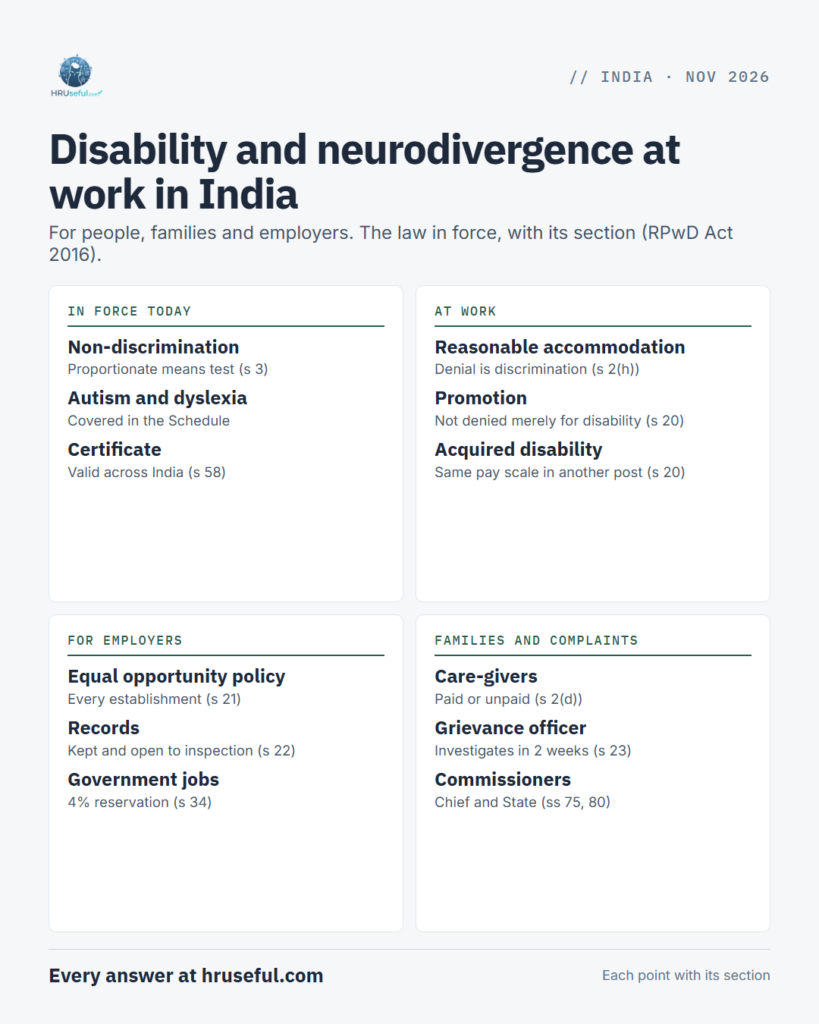
- In short · who it covers
- Persons with disabilities, including autism and specific learning disabilities such as dyslexia, their families and care-givers, and government and private establishments across India.
- What it sets out
- A ban on disability discrimination, reasonable accommodation, a 4% reservation in government posts, protection for employees who acquire a disability in government service, and an equal opportunity policy for every establishment, public or private.
- Good to know
- There is no general hiring quota for private employers: the 5% in section 35 refers to government incentives. Many benefits require a disability certificate issued by the certifying authority, which is valid across the country.
| Key point | What the law says |
| Government jobs | 4% reservation. Of vacancies in government establishments for persons with benchmark disabilities; autism and specific learning disabilities share 1%. Rights of Persons with Disabilities Act, 2016, section 34(1) |
| Discrimination | Prohibited. Unless the act is a proportionate means of achieving a legitimate aim; denying reasonable accommodation is discrimination. Rights of Persons with Disabilities Act, 2016, section 3(3) |
| Acquired disability | No dismissal or demotion. In government service, the employee is shifted to another post with the same pay scale and service benefits. Rights of Persons with Disabilities Act, 2016, first proviso to section 20(4) |
| Private employers | Equal opportunity policy. Every establishment must have one and register it with the Chief or State Commissioner. Rights of Persons with Disabilities Act, 2016, sections 2(i) and 21(1) |
| Certificate | Valid across India. Issued by the certifying authority; an internal HR assessment does not replace it. Rights of Persons with Disabilities Act, 2016, section 58(3) |
| Complaints | Investigated within 2 weeks. Complaints to the Grievance Redressal Officer of a government establishment must be investigated within two weeks. Rights of Persons with Disabilities Act, 2016, section 23(3) |
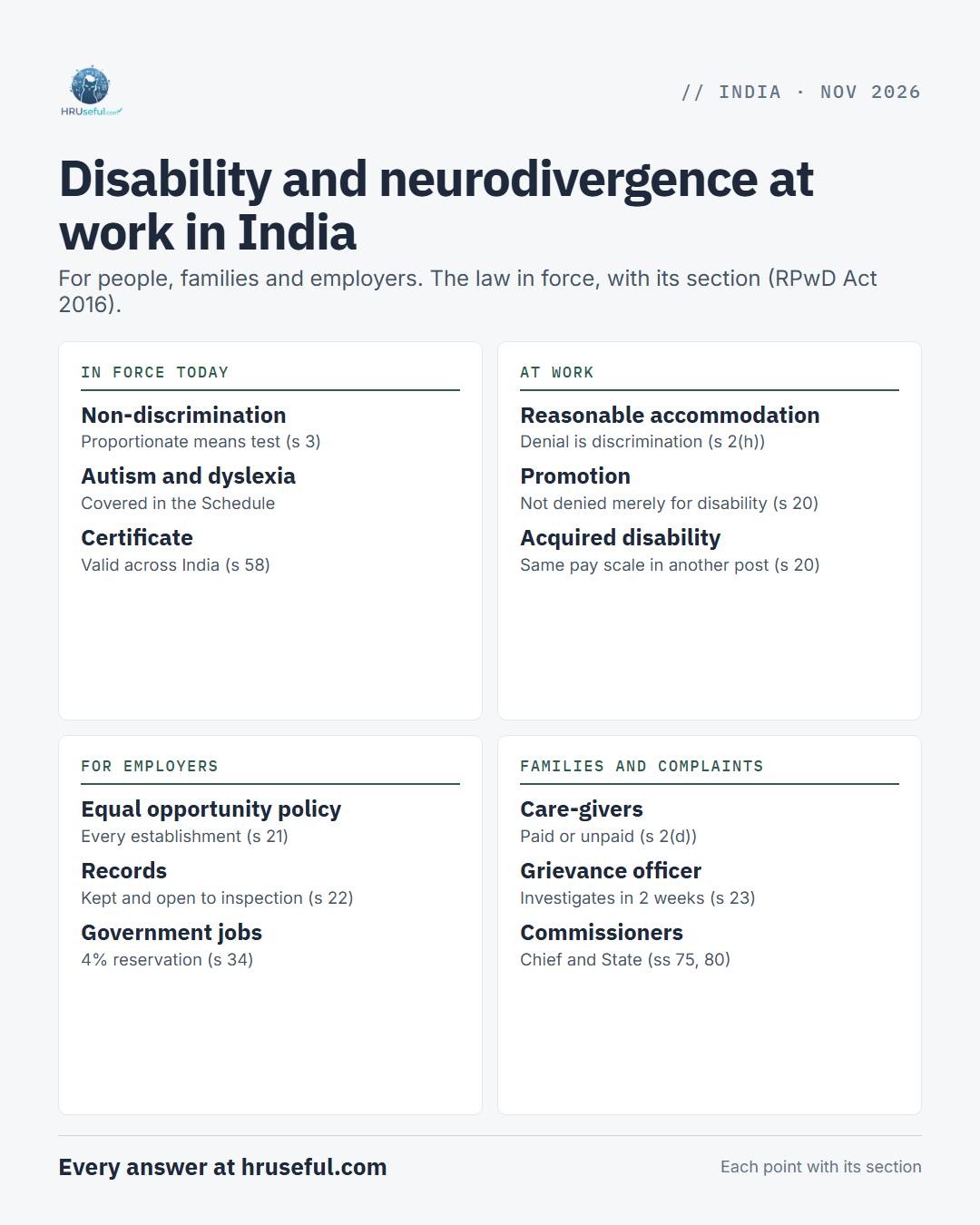
Public employment and reservation
What public employment reservation is there for persons with disabilities in India?
Section 34 sets a minimum reservation of 4% of the vacancies in government establishments for persons with benchmark disabilities. It is calculated for each group of posts and distributed among categories. For a particular recruitment, the identified posts, their requirements and any notified exemptions must be checked.Law: Rights of Persons with Disabilities Act, 2016, section 34(1)
Who decides which public posts are reserved for persons with disabilities?
The appropriate Government must identify the posts that can be held by the different categories of persons with benchmark disabilities. To do so it must set up an expert committee with representation of persons with those disabilities. Identifying posts is part of the employment reservation system.Law: Rights of Persons with Disabilities Act, 2016, section 33(i) and (ii)
Is the upper age limit relaxed when applying for public jobs with a disability?
The law allows the appropriate Government to relax, by notification, the upper age limit for persons with benchmark disability. This section does not set a single relaxation for all recruitments. The notification that applies to the selection process must be consulted.Law: Rights of Persons with Disabilities Act, 2016, section 34(3)
Can I be denied a promotion in public employment because of my disability?
Section 20 provides that promotion shall not be denied merely on the ground of disability. This protection is in the section on employment in government establishments. The professional requirements of the post must be distinguished from an exclusion based only on disability.Law: Rights of Persons with Disabilities Act, 2016, section 20(3)
Can a government body dismiss me if I acquire a disability?
Section 20 prohibits a government establishment from dispensing with or reducing in rank an employee who acquires a disability during service. It also provides alternatives when the person can no longer do their previous job. For a specific case, the exemptions notified under that section must be checked.Law: Rights of Persons with Disabilities Act, 2016, section 20(1), proviso, and 20(4)
What happens to my pay if I have to change posts because of an acquired disability?
In the case covered by section 20(4), if the employee is no longer suitable for the previous post, they must be shifted to another post with the same pay scale and service benefits. This rule applies to government establishments. It should not be presented as an identical guarantee for any private job.Law: Rights of Persons with Disabilities Act, 2016, first proviso to section 20(4)
What happens if a vacancy reserved for persons with disabilities is not filled?
Section 34 provides for carrying the vacancy forward to the next recruitment year when it cannot be filled for want of a suitable person or other sufficient reason. If it still cannot be filled, it sets an interchange procedure between categories before appointing a person without a disability. The conditions of that section must be followed.Law: Rights of Persons with Disabilities Act, 2016, section 34(2)
What happens if a government body has no other post for someone who acquired a disability?
Section 20 provides for keeping the employee on a supernumerary post if they cannot be placed in another post. This can continue until a suitable post is available or they reach the age of superannuation, whichever is earlier. The provision applies to government establishments covered by that section.Law: Rights of Persons with Disabilities Act, 2016, second proviso to section 20(4)
Can disability be taken into account for a transfer in public employment?
The law allows the appropriate Government to frame policies for the posting and transfer of employees with disabilities. The section does not on its own grant the posting chosen by the person. The policy that applies to the service and the body must be reviewed.Law: Rights of Persons with Disabilities Act, 2016, section 20(5)
Is there a separate reservation for autism and another for specific learning disabilities?
Section 34 does not assign a separate percentage to each of those conditions. It sets 1% shared between the categories in clauses (d) and (e). Those categories include autism, intellectual disability, specific learning disability, mental illness and the multiple disabilities described there.Law: Rights of Persons with Disabilities Act, 2016, section 34(1)(d) and (e)
How often must the posts identified for public employment reservation be reviewed?
Section 33 requires periodic review of the identified posts, at intervals not exceeding three years. This means reviewing the identification of posts, not just keeping a historical list.Law: Rights of Persons with Disabilities Act, 2016, section 33(iii)
Does the law provide specific insurance for government employees with disabilities?
Section 26 requires the appropriate Government to set up, by notification, insurance schemes for its employees with disabilities. The specific cover is found in the notified scheme; the section does not set a uniform amount or extend it automatically to private employment.Law: Rights of Persons with Disabilities Act, 2016, section 26
Equality, accommodation and accessibility
What does asking for reasonable accommodation at work mean?
It means requesting necessary and appropriate modifications to exercise rights equally with others. The definition requires each case to be assessed and provides that the accommodation must not impose a disproportionate or undue burden. That definition must be read together with the obligation that applies to the establishment.Law: Rights of Persons with Disabilities Act, 2016, section 2(y)
Must a government body adapt the working conditions of a person with disability?
Yes. Section 20 requires government establishments to provide reasonable accommodation and an appropriate barrier-free and conducive environment. When looking at a particular body, any exemptions notified under that section must also be checked.Law: Rights of Persons with Disabilities Act, 2016, section 20(1), proviso, and 20(2)
Can accommodations include accessible forms of communication?
The law recognises a broad definition of communication. It includes text, Braille, sign language, plain language and alternative or augmentative modes. These formats can be considered when assessing a communication barrier and the right accommodation for the case.Law: Rights of Persons with Disabilities Act, 2016, sections 2(f) and 2(y)
Does Indian law prohibit discrimination on the ground of disability?
Yes. Section 3 prohibits discrimination on the ground of disability, unless it is shown that the act or omission is a proportionate means of achieving a legitimate aim. The exception requires that justification. It does not allow a person to be excluded because of an employer’s general preference.Law: Rights of Persons with Disabilities Act, 2016, section 3(3)
Do barriers at work include attitudes and internal rules?
Yes. The definition of barrier includes institutional, social, communicational and attitudinal factors, as well as structural ones. So the assessment is not limited to stairs or physical access. It can also cover practices that hinder equal participation.Law: Rights of Persons with Disabilities Act, 2016, section 2(c)
Can denying reasonable accommodation be discrimination?
Yes. The legal definition of discrimination includes the denial of reasonable accommodation. To analyse a specific situation, the definition of accommodation and the obligation that applies to the establishment must also be considered.Law: Rights of Persons with Disabilities Act, 2016, sections 2(h) and 2(y)
Must accessibility be checked before a workplace building is built or occupied?
Section 44 links building permission to the accessibility rules made under section 40. It also makes the completion certificate and occupation of the building subject to compliance with the applicable rules. For a specific project, the standards in force must be identified.Law: Rights of Persons with Disabilities Act, 2016, section 44(1) and (2)
Do universal design and reasonable accommodation mean the same thing?
The law defines them separately. Universal design aims for products, environments, programmes and services usable by all people to the greatest extent possible. Reasonable accommodation responds to the needs of a particular case.Law: Rights of Persons with Disabilities Act, 2016, sections 2(ze) and 2(y)
Does accessibility also cover digital systems and tools?
Yes. Section 40 includes information, communications and technologies among the areas for which accessibility standards must be set. To require a specific technical feature, the applicable rule in force must be identified. This section does not on its own set the specifications of each tool.Law: Rights of Persons with Disabilities Act, 2016, section 40
What employers must do
Must a private company have an equal opportunity policy?
Yes. Section 21 requires every establishment to have one, and the legal definition includes both government and private establishments. The policy must set out the measures proposed to implement the chapter on employment. Its detailed regulatory requirements must be checked separately.Law: Rights of Persons with Disabilities Act, 2016, sections 2(i) and 21(1)
Where must the equal opportunity policy be registered?
A copy must be registered with the Chief Commissioner or the State Commissioner, as the case may be. The law distinguishes central and state powers, so the competent authority must be identified before filing.Law: Rights of Persons with Disabilities Act, 2016, section 21(2)
Must the company keep records on the employment of persons with disabilities?
Section 22 requires records to be kept of the employment, the facilities provided and other necessary information. Their form and content must follow the applicable rules. The section also provides for inspection by persons authorised by the appropriate Government.Law: Rights of Persons with Disabilities Act, 2016, section 22(1) and (3)
Is the 5% mentioned in the law a mandatory quota for private companies?
Section 35 deals with incentives for private employers to reach a workforce with at least 5% persons with benchmark disability. It is addressed to the appropriate Governments and local authorities, within the limits of their economic capacity and development. It does not create a general private obligation equivalent to the government employment reservation in section 34.Law: Rights of Persons with Disabilities Act, 2016, section 35
Who can inspect the records on the employment of persons with disabilities?
Section 22 allows inspection by persons authorised by the appropriate Government, at reasonable hours. The provision does not make those records freely available to anyone.Law: Rights of Persons with Disabilities Act, 2016, section 22(3)
Where must the equal opportunity policy be made available?
Rule 8 provides that it should preferably be displayed on the establishment’s website. If not, it must be displayed at conspicuous places in its premises. The Office of the Chief Commissioner officially reproduces this provision.Law: RPwD Rules, rule 8(2), reproduced by the Office of Chief Commissioner for Persons with Disabilities
Must the policy provide for training after joining and before a promotion?
Yes. This content is required for government and private establishments with 20 or more employees. It includes training after recruitment and before promotion.Law: RPwD Rules, rule 8(3), reproduced by the Office of Chief Commissioner
Must the policy provide for assistive devices and accessibility?
Yes. Rule 8 lists them among the contents of the policy for government and private establishments with 20 or more employees. They must be provided for along with the other facilities.Law: RPwD Rules, rule 8(3)(d), reproduced by the Office of Chief Commissioner
Can a director be liable for a company’s breach of the disability law?
Section 90 provides for liability when the offence is committed with the consent, connivance or negligence of a director, manager or other officer mentioned there. Their position alone does not prove those elements. Liability must be assessed according to their involvement and the circumstances of the case.Law: Rights of Persons with Disabilities Act, 2016, section 90(2)
Can employers be required to report vacancies to a special employment exchange?
Yes. Section 36 allows the appropriate Government to require, by notification, that information on vacancies for persons with benchmark disability be furnished to a special employment exchange. The specific obligation depends on the notification and the information required by the rules.Law: Rights of Persons with Disabilities Act, 2016, section 36
Certification and who is covered
Is dyslexia recognised in India’s disability law?
Yes. The Schedule expressly mentions dyslexia among specific learning disabilities. That inclusion identifies the legal category. For a specific reservation or benefit, its own requirements and certification must also be met.Law: Rights of Persons with Disabilities Act, 2016, Schedule, para 2(a)
Does the law provide specific job training for autistic persons?
Yes. Section 19 provides for specific training programmes with active links to the labour market. It expressly mentions persons with autism, along with other categories. Availability and enrolment depend on the programmes in place.Law: Rights of Persons with Disabilities Act, 2016, section 19(2)(c)
Do dysgraphia, dyscalculia and dyspraxia appear in the law?
Yes. The Schedule mentions them among specific learning disabilities. That specific reference should be used to describe them legally. Their inclusion does not mean the same access requirement applies to every work support or benefit.Law: Rights of Persons with Disabilities Act, 2016, Schedule, para 2(a)
Is a disability certificate valid for applying in another Indian state?
A certificate issued under section 58 is valid across the country. That validity allows the disability to be proven outside the state where it was issued. The other requirements of the recruitment must be checked separately.Law: Rights of Persons with Disabilities Act, 2016, section 58(3)
Can a company decide a candidate’s percentage of disability?
Certification belongs to the certifying authorities designated by the appropriate Government. They must have the required qualifications and experience. An internal HR assessment does not replace that legal certification.Law: Rights of Persons with Disabilities Act, 2016, section 57(1)
Does needing high support mean it cannot be used to work?
The definition of high support expressly includes participation in employment. It also covers support for daily living and for making independent and informed decisions. Needing support should not be read as a general exclusion from work.Law: Rights of Persons with Disabilities Act, 2016, section 2(l)
Do the specific learning disabilities recognised by law include difficulties with writing and arithmetic?
The legal definition includes difficulties that can show in writing, spelling and mathematical calculation, among other areas. It is a legal description of specific learning disabilities. It does not allow the conclusion, from one isolated difficulty, that a person meets the certification requirements.Law: Rights of Persons with Disabilities Act, 2016, Schedule, para 2(a)
Is the word neurodivergent enough to prove a disability to an employer?
The certification provided for in the law requires a competent authority and an assessment under the official guidelines. A general label does not replace that procedure when a recruitment or benefit requires a certificate. This does not mean that every right requires the same certification.Law: Rights of Persons with Disabilities Act, 2016, section 58(2)
Can a person have more than one disability certified?
Yes. The Schedule covers multiple disabilities as a combination of more than one specified disability. Their coexistence must be assessed under the certification procedure. Percentages should not be added up independently.Law: Rights of Persons with Disabilities Act, 2016, Schedule, para 5; RPwD Rules, rule 18 and Form VI
Does the legal definition of disability take into account the barriers the person faces?
Yes. Section 2(s) links long-term impairments with their interaction with barriers that hinder equal participation. The analysis is not reduced to a label or diagnosis. The requirements of a specific benefit must be checked as well.Law: Rights of Persons with Disabilities Act, 2016, section 2(s)
Must the authority state in writing if it concludes there is no specified disability?
Yes. Section 58(2)(b) provides for informing that conclusion in writing after the assessment. Attributing the decision to the employer or to an informal view is not enough.Law: Rights of Persons with Disabilities Act, 2016, section 58(2)(b)
Who do I apply to for a disability certificate to use work benefits?
Section 58(1) allows the application to be made to the certifying authority with jurisdiction, in the manner set by the Central Government. The employer does not replace that administrative assessment.Law: Rights of Persons with Disabilities Act, 2016, section 58(1)
Can the certifying authority’s decision be appealed?
Section 59 provides for an appeal to the authority designated by the State Government. The time limit and form depend on the state’s rules: that section does not set a single time limit for all of India.Law: Rights of Persons with Disabilities Act, 2016, section 59(1)
Training, education and self-employment
Does the law provide training to find work or start a business?
Yes. It directs the appropriate Government to formulate schemes to facilitate employment, vocational training and self-employment of persons with disabilities. It also provides for loans at concessional rates. To apply for specific support, the available scheme and its requirements must be checked.Law: Rights of Persons with Disabilities Act, 2016, section 19(1)
Can persons with disabilities join general vocational training programmes?
The law requires employment schemes to provide for their inclusion in mainstream formal and non-formal vocational and skill training. It also requires support and facilities to make use of the training. It does not limit participation to separate courses for persons with disabilities.Law: Rights of Persons with Disabilities Act, 2016, section 19(2)(a) and (b)
Does the law provide for raising awareness among managers and co-workers?
Yes. The awareness programmes that governments must promote include employers, administrators and co-workers. They must address barriers linked to disability and the rights of persons with disabilities. This provision sets a public responsibility for awareness.Law: Rights of Persons with Disabilities Act, 2016, section 39(1) and (2)(e)
Are higher education seats reserved for persons with benchmark disabilities?
Yes. Government higher education institutions and those receiving government aid must reserve at least 5% of seats. The reservation is for persons with benchmark disabilities and is not the same as the public employment quota.Law: Rights of Persons with Disabilities Act, 2016, section 32(1)
Is the age limit relaxed for admission to higher education with a benchmark disability?
Section 32(2) grants a five-year relaxation of the upper age limit for admission to higher education. It is an education admission rule, separate from age relaxations in job recruitment.Law: Rights of Persons with Disabilities Act, 2016, section 32(2)
Does the law provide land on favourable terms to start a business with a benchmark disability?
Section 37(c) provides for notified schemes with a 5% reservation in the allotment of land at concessional rates for the purposes it lists, including business and enterprises. It does not mean anyone can demand land without meeting the applicable scheme.Law: Rights of Persons with Disabilities Act, 2016, section 37(c)
Up to what age does this law grant free education to children with benchmark disability?
Section 31 grants free education from six to eighteen years of age to children with benchmark disability, in a neighbourhood school or a special school of their choice. It is an education right, not a benefit that depends on the family having a job.Law: Rights of Persons with Disabilities Act, 2016, section 31
Complaints and enforcement
Where can I complain if a government body fails to provide workplace accommodations?
The person affected can file a complaint with the Grievance Redressal Officer for non-compliance with section 20. That officer must investigate it and take up the matter with the establishment for corrective action. If the action is not satisfactory, the law allows the person to approach the District-level Committee on disability.Law: Rights of Persons with Disabilities Act, 2016, section 23(2) and (4)
How quickly must a workplace complaint to a government body’s grievance officer be investigated?
Section 23 sets two weeks from registration to investigate each complaint. That time limit refers to the investigation by the Grievance Redressal Officer. It must not be confused with a guarantee of a final court decision within the same period.Law: Rights of Persons with Disabilities Act, 2016, section 23(3)
Can I go to court without my disability being an obstacle?
The law requires access without discrimination to courts and other bodies with judicial, investigative or similar powers. It also provides for support and accessible means to exercise rights. This matters when a workplace dispute needs action before those authorities.Law: Rights of Persons with Disabilities Act, 2016, section 12(1), (2) and (4)
Can I give evidence in a complaint using my own form of communication?
The law requires measures to help persons with disabilities give evidence and present arguments or opinions in their preferred language and means of communication. This matters when a workplace complaint reaches a judicial or similar authority. The necessary facilities should be requested from the body involved.Law: Rights of Persons with Disabilities Act, 2016, section 12(4)(c)
Can publicly humiliating a person because of their disability be an offence?
Section 92 covers intentional insult or intimidation aimed at humiliating a person with disability in any place within public view. The elements of the offence must be proven. Not every workplace disagreement can be treated as that offence.Law: Rights of Persons with Disabilities Act, 2016, section 92(a)
Who can step in if a Central Government body violates disability rights?
The Chief Commissioner can inquire into deprivation of rights in matters where the Central Government is the appropriate Government. It can act on its own motion or on information received. It can then take up the matter with the relevant authorities for corrective action.Law: Rights of Persons with Disabilities Act, 2016, section 75(1)(b)
Who acts when a disability complaint falls within a state’s powers?
The law gives the State Commissioner the power to inquire into deprivation of rights in matters within state competence. The competent authority depends on the matter and the establishment involved. Not every complaint must go to the central Chief Commissioner.Law: Rights of Persons with Disabilities Act, 2016, section 80(b)
Can a person or organisation report exploitation or violence against a person with disability?
Section 7(2) allows the Executive Magistrate with jurisdiction to be informed when there is reason to believe abuse, violence or exploitation has occurred, is occurring or is likely to occur. Any person or registered organisation can do so; it is not limited to the victim.Law: Rights of Persons with Disabilities Act, 2016, section 7(2)
How long does an authority have to report what it did with a disability commissioner’s recommendation?
Sections 76 and 81 provide for reporting the action taken within three months of receiving the recommendation, depending on whether the Chief Commissioner or the State Commissioner is involved. If it is not accepted, the reasons must be given and the person affected must also be informed.Law: Rights of Persons with Disabilities Act, 2016, sections 76 and 81
Families, carers and supported decisions
Can I be considered the care-giver of a family member even if I am not paid for it?
Yes. The definition of care-giver includes parents and other family members who provide care, support or assistance, with or without payment. That status does not on its own grant work leave or financial support. Each benefit needs its own legal basis.Law: Rights of Persons with Disabilities Act, 2016, section 2(d)
How should the family support the decisions of a person with disability?
Whoever provides support must respect their autonomy, dignity and privacy. The law prohibits undue influence. Support with a work decision must keep that respect for the person’s will.Law: Rights of Persons with Disabilities Act, 2016, section 13(5)
Can the person change who helps them make decisions?
Yes. The law allows a support arrangement to be altered or revoked and support to be sought from another person. The change takes effect from then on. It does not by itself undo earlier transactions made with third parties under that arrangement.Law: Rights of Persons with Disabilities Act, 2016, section 13(4) and proviso
Does the law provide training for families and care-givers?
Yes. It includes programmes to build the capacity of families, community members and care-givers in care and support. It also covers training for independent living and community relationships. The provision does not on its own identify a course available in each locality.Law: Rights of Persons with Disabilities Act, 2016, section 47(1)(c)
Does having a disability prevent a person from managing their own money?
The law recognises the right to control one’s own financial affairs on an equal basis. It also provides for access to loans and other forms of credit. Disability alone does not allow a relative to take control of the person’s salary or property.Law: Rights of Persons with Disabilities Act, 2016, section 13(1) and (2)
Can the family request high support for a person with disability?
Section 38 allows a person with benchmark disability who considers they need high support to apply for it. It also allows another person or organisation to apply on their behalf. The need and the type of support must be assessed, and its provision depends on the applicable schemes and orders.Law: Rights of Persons with Disabilities Act, 2016, section 38(1) to (4)
What does limited guardianship mean for an adult with disability?
The law defines it as a system of joint decision-making based on mutual understanding and trust. It must be limited to a specific period, decision and situation. It must operate in accordance with the will of the person with disability.Law: Rights of Persons with Disabilities Act, 2016, explanation to section 14(1)
What should a supporter do if they have a financial interest in the decision?
If there is a conflict of interest in a particular financial transaction, they must refrain from providing support in that transaction. The law clarifies that kinship alone does not create a presumption of conflict. The specific situation must be analysed.Law: Rights of Persons with Disabilities Act, 2016, section 13(3) and proviso
Does the law provide financial help for care when high support is needed?
Section 24 includes a care-giver allowance among the measures social security schemes must provide. It refers to persons with disabilities with high support needs. The section does not set an amount or show that any relative is entitled to a specific benefit.Law: Rights of Persons with Disabilities Act, 2016, section 24(1) and (3)(i)
Can the appointment of a limited guardian be appealed?
A person with disability aggrieved by the decision of the designated authority can appeal it. The appeal goes to the authority notified by the State Government for that purpose. The procedure must be checked in the relevant state.Law: Rights of Persons with Disabilities Act, 2016, section 14(3)
Keep exploring
- Private-sector employment in India
- Public-sector employment in India
- Self-employment in India
- Workplace harassment and the POSH Act
- All India topics
- Disability and neurodivergence at work — Australia
- Disability and neurodivergence at work — Singapore
Every answer cites the law in force on 1 November 2026 and was checked against its official text. Current questions: 70.
- En pocas líneas · a quién alcanza
- A las personas con discapacidad, incluidos el autismo y las dificultades específicas del aprendizaje como la dislexia, a sus familias y cuidadores, y a los establecimientos públicos y privados de toda India.
- Qué establece
- La prohibición de discriminar por discapacidad, los ajustes razonables, una reserva del 4 % en puestos del Estado, protección para quien adquiere una discapacidad en el servicio público y una política de igualdad de oportunidades en todo establecimiento, público o privado.
- Lo que conviene saber
- No hay una cuota general de contratación para empresas privadas: el 5 % de la sección 35 se refiere a incentivos de los gobiernos. Muchos beneficios exigen el certificado de discapacidad de la autoridad certificadora, válido en todo el país.
| Dato clave | Qué dice la norma |
| Empleo público | Reserva del 4 %. De las vacantes de establecimientos gubernamentales para personas con benchmark disabilities; autismo y dificultades específicas del aprendizaje comparten el 1 %. Rights of Persons with Disabilities Act, 2016, sección 34(1); porcentaje del texto consultado al 1/11/2026 |
| Discriminación | Prohibida. Salvo que sea un medio proporcionado para una finalidad legítima; negar un ajuste razonable es discriminación. Rights of Persons with Disabilities Act, 2016, sección 3(3) |
| Discapacidad adquirida | Sin despido ni descenso. En el servicio público, la persona pasa a otro puesto con la misma escala salarial y beneficios. Rights of Persons with Disabilities Act, 2016, primer proviso de la sección 20(4) |
| Empresas privadas | Política de igualdad de oportunidades. Todo establecimiento debe tenerla y registrarla ante el Chief Commissioner o el State Commissioner. Rights of Persons with Disabilities Act, 2016, secciones 2(i) y 21(1) |
| Certificado | Válido en todo el país. Lo emite la autoridad certificadora; una evaluación interna de RR. HH. no lo reemplaza. Rights of Persons with Disabilities Act, 2016, sección 58(3) |
| Reclamos | Investigación en 2 semanas. Las quejas ante el Grievance Redressal Officer de un establecimiento gubernamental se investigan en dos semanas. Rights of Persons with Disabilities Act, 2016, sección 23(3); plazo del texto consultado al 1/11/2026 |
Empleo público y reserva
¿Qué reserva de empleo público hay para personas con discapacidad en India?
La sección 34 establece una reserva mínima del 4 % de las vacantes computables en establecimientos gubernamentales para personas con benchmark disabilities. El cálculo corresponde a cada grupo de puestos y tiene una distribución por categorías. Para una convocatoria concreta deben revisarse los puestos identificados, sus requisitos y las posibles exenciones notificadas.Norma: Rights of Persons with Disabilities Act, 2016, sección 34(1); porcentaje del texto consultado al 1/11/2026
¿Quién decide qué puestos públicos se reservan para personas con discapacidad?
El gobierno competente debe identificar los puestos que pueden desempeñar las distintas categorías de personas con benchmark disabilities. Para hacerlo debe constituir un comité de expertos con representación de personas con esas discapacidades. La identificación de puestos forma parte del sistema de reserva de empleo.Norma: Rights of Persons with Disabilities Act, 2016, sección 33(i) y (ii)
¿Hay una ampliación del límite de edad para postularse a empleos públicos con discapacidad?
La ley permite que el gobierno competente amplíe mediante notificación el límite máximo de edad para personas con benchmark disability. Este artículo no fija una ampliación única para todas las convocatorias. Debe consultarse la notificación aplicable al proceso de selección.Norma: Rights of Persons with Disabilities Act, 2016, sección 34(3)
¿Pueden negarme un ascenso en el empleo público por mi discapacidad?
La sección 20 establece que no se puede negar una promoción únicamente por discapacidad. Esta protección se encuentra en el artículo sobre empleo en establecimientos gubernamentales. Deben distinguirse los requisitos profesionales del puesto de una exclusión basada solamente en la discapacidad.Norma: Rights of Persons with Disabilities Act, 2016, sección 20(3)
¿Pueden despedirme de un organismo público si adquiero una discapacidad?
La sección 20 prohíbe que un establecimiento gubernamental despida o rebaje de categoría a una persona que adquiere una discapacidad durante el servicio. También prevé alternativas cuando ya no puede desempeñar su puesto anterior. Para el caso concreto deben comprobarse las exenciones notificadas bajo ese artículo.Norma: Rights of Persons with Disabilities Act, 2016, sección 20(1), proviso, y 20(4)
¿Qué pasa con mi salario si deben cambiarme de puesto por una discapacidad adquirida?
En el supuesto regulado por la sección 20(4), si la persona deja de ser apta para su puesto anterior, debe trasladarse a otro conservando la misma escala salarial y los beneficios del servicio. Esta regla corresponde a establecimientos gubernamentales. No debe presentarse como una garantía idéntica para cualquier empleo privado.Norma: Rights of Persons with Disabilities Act, 2016, primer proviso de la sección 20(4)
¿Qué pasa si no se cubre una vacante reservada para personas con discapacidad?
La sección 34 prevé trasladar la vacante al siguiente año de contratación cuando no pueda cubrirse por falta de una persona adecuada u otra razón suficiente. Si tampoco se consigue cubrirla entonces, establece un procedimiento de intercambio entre categorías antes de recurrir a una persona sin discapacidad. Deben respetarse las condiciones de ese artículo.Norma: Rights of Persons with Disabilities Act, 2016, sección 34(2); secuencia temporal del texto consultado al 1/11/2026
¿Qué pasa si un organismo público no tiene otro puesto disponible para quien adquirió una discapacidad?
La sección 20 contempla mantener a la persona en un puesto supernumerario si no es posible ubicarla en otro puesto. Esa situación puede continuar hasta que haya un puesto adecuado o llegue a la edad de retiro, lo que ocurra primero. La disposición corresponde a establecimientos gubernamentales sujetos a ese artículo.Norma: Rights of Persons with Disabilities Act, 2016, segundo proviso de la sección 20(4)
¿La discapacidad puede tenerse en cuenta para un traslado dentro del empleo público?
La ley permite al gobierno competente establecer políticas sobre destinos y traslados de empleados con discapacidad. El artículo no concede por sí solo el destino elegido por la persona. Debe revisarse la política aplicable al servicio y al organismo.Norma: Rights of Persons with Disabilities Act, 2016, sección 20(5)
¿Hay una reserva separada para autismo y otra para dificultades específicas del aprendizaje?
La sección 34 no asigna un porcentaje independiente a cada una de esas condiciones. Establece un 1 % compartido entre las categorías de sus incisos (d) y (e). Esas categorías incluyen autismo, discapacidad intelectual, dificultades específicas del aprendizaje, enfermedad mental y las discapacidades múltiples allí descritas.Norma: Rights of Persons with Disabilities Act, 2016, sección 34(1)(d) y (e); porcentaje del texto consultado al 1/11/2026
¿Cada cuánto deben revisarse los puestos identificados para la reserva de empleo público?
La sección 33 exige revisar periódicamente los puestos identificados. El intervalo no puede superar tres años. Esto obliga a revisar la identificación de puestos y no solamente a conservar una lista histórica.Norma: Rights of Persons with Disabilities Act, 2016, sección 33(iii); plazo del texto consultado al 1/11/2026
¿La ley prevé seguros específicos para personas empleadas públicas con discapacidad?
La sección 26 exige al Gobierno competente establecer mediante notificación esquemas de seguro para sus empleados con discapacidad. Para identificar la cobertura concreta hay que revisar el esquema notificado; la sección no fija un monto uniforme ni lo extiende automáticamente a todo empleo privado.Norma: Rights of Persons with Disabilities Act, 2016, sección 26
Igualdad, ajustes y accesibilidad
¿Qué significa pedir ajustes razonables en el trabajo?
Significa solicitar modificaciones necesarias y adecuadas para ejercer derechos en igualdad de condiciones. La definición exige evaluar el caso concreto y contempla que el ajuste no imponga una carga desproporcionada o indebida. Esa definición debe leerse junto con la obligación aplicable al establecimiento.Norma: Rights of Persons with Disabilities Act, 2016, sección 2(y)
¿Un organismo público debe adaptar las condiciones de trabajo de una persona con discapacidad?
Sí. La sección 20 exige a los establecimientos gubernamentales ajustes razonables y un entorno adecuado, sin barreras y favorable al trabajo. Al analizar un organismo concreto también deben comprobarse las exenciones que pudieran haberse notificado conforme a ese artículo.Norma: Rights of Persons with Disabilities Act, 2016, sección 20(1), proviso, y 20(2)
¿Los ajustes pueden incluir formas accesibles de comunicación?
La ley reconoce una definición amplia de comunicación. Incluye texto, braille, lengua de señas, lenguaje claro y medios alternativos o aumentativos. Estos formatos pueden considerarse al evaluar una barrera de comunicación y el ajuste adecuado para el caso.Norma: Rights of Persons with Disabilities Act, 2016, secciones 2(f) y 2(y)
¿La ley de India prohíbe discriminar por discapacidad?
Sí. La sección 3 prohíbe discriminar por discapacidad, salvo que se demuestre que la actuación u omisión es un medio proporcionado para alcanzar una finalidad legítima. La excepción exige esa justificación. No permite excluir a una persona por una preferencia general del empleador.Norma: Rights of Persons with Disabilities Act, 2016, sección 3(3)
¿Las barreras en el trabajo incluyen las actitudes y las reglas internas?
Sí. La definición de barrera incluye factores institucionales, sociales, de comunicación y de actitud, además de los estructurales. Por eso, la evaluación no se limita a escaleras o accesos físicos. También puede abarcar prácticas que dificulten la participación en igualdad.Norma: Rights of Persons with Disabilities Act, 2016, sección 2(c)
¿Negar un ajuste razonable puede ser discriminación?
Sí. La definición legal de discriminación incluye la denegación de ajustes razonables. Para analizar una situación concreta también deben considerarse la definición de ajuste y la obligación aplicable al establecimiento.Norma: Rights of Persons with Disabilities Act, 2016, secciones 2(h) y 2(y)
¿La accesibilidad debe revisarse antes de construir o habilitar un edificio de trabajo?
La sección 44 vincula la autorización de construcción con las reglas de accesibilidad dictadas bajo la sección 40. También condiciona la certificación de finalización y la ocupación del edificio al cumplimiento de las reglas aplicables. Para un proyecto concreto deben identificarse los estándares vigentes que correspondan.Norma: Rights of Persons with Disabilities Act, 2016, sección 44(1) y (2)
¿El diseño universal y los ajustes razonables significan lo mismo?
La ley los define por separado. El diseño universal busca que productos, entornos, programas y servicios puedan utilizarse por todas las personas en la mayor medida posible. El ajuste razonable responde a las necesidades de un caso particular.Norma: Rights of Persons with Disabilities Act, 2016, secciones 2(ze) y 2(y)
¿La accesibilidad también comprende los sistemas y las herramientas digitales?
Sí. La sección 40 incluye información, comunicaciones y tecnologías dentro de los ámbitos para los que deben establecerse estándares de accesibilidad. Para exigir una característica técnica concreta debe identificarse la regla vigente aplicable. Este artículo no fija por sí solo las especificaciones de cada herramienta.Norma: Rights of Persons with Disabilities Act, 2016, sección 40
Qué deben hacer los empleadores
¿Una empresa privada debe tener una política de igualdad de oportunidades?
Sí. La sección 21 exige esa política a cada establishment, y la definición legal incluye establecimientos gubernamentales y privados. La política debe detallar las medidas propuestas para aplicar el capítulo sobre empleo. Sus requisitos reglamentarios de detalle deben verificarse por separado.Norma: Rights of Persons with Disabilities Act, 2016, secciones 2(i) y 21(1)
¿Dónde debe registrarse la política de igualdad de oportunidades?
Debe registrarse una copia ante el Chief Commissioner o el State Commissioner, según corresponda. La ley distingue las competencias centrales y estatales. Por eso, debe identificarse la autoridad competente antes de realizar el trámite.Norma: Rights of Persons with Disabilities Act, 2016, sección 21(2)
¿La empresa debe llevar registros sobre el empleo de personas con discapacidad?
La sección 22 exige mantener registros relativos al empleo, las facilidades proporcionadas y otra información necesaria. La forma y el contenido deben ajustarse a la reglamentación aplicable. El artículo también contempla su inspección por personas autorizadas por el gobierno competente.Norma: Rights of Persons with Disabilities Act, 2016, sección 22(1) y (3)
¿El 5 % que menciona la ley es una cuota obligatoria para las empresas privadas?
La sección 35 regula incentivos a empleadores privados para alcanzar una plantilla con al menos un 5 % de personas con benchmark disability. Está dirigida a los gobiernos competentes y autoridades locales, dentro de sus posibilidades económicas y de desarrollo. No establece una obligación privada general equivalente a la reserva de empleo gubernamental de la sección 34.Norma: Rights of Persons with Disabilities Act, 2016, sección 35; porcentaje del texto consultado al 1/11/2026
¿Quién puede inspeccionar los registros de empleo de personas con discapacidad?
La sección 22 permite la inspección por personas autorizadas por el gobierno competente. La consulta debe realizarse en horarios razonables. La disposición no convierte esos registros en información de libre acceso para cualquier persona.Norma: Rights of Persons with Disabilities Act, 2016, sección 22(3)
¿Dónde debe estar disponible la política de igualdad de oportunidades?
La regla 8 establece que se muestre preferentemente en el sitio web del establecimiento. Si eso no se hace, debe exhibirse en lugares visibles de sus instalaciones. El Office of Chief Commissioner reproduce oficialmente esta disposición.Norma: RPwD Rules, regla 8(2), reproducida por el Office of Chief Commissioner for Persons with Disabilities
¿La política debe contemplar capacitación después del ingreso y antes de un ascenso?
Sí. Ese contenido está previsto para establecimientos gubernamentales y privados con veinte o más empleados. Incluye formación posterior a la contratación y previa a la promoción.Norma: RPwD Rules, regla 8(3), reproducida por el Office of Chief Commissioner; umbral consultado al 1/11/2026
¿La política debe prever dispositivos de apoyo y accesibilidad?
Sí. La regla 8 los incluye entre los contenidos de la política para establecimientos gubernamentales y privados con veinte o más empleados. Deben contemplarse junto con las demás facilidades.Norma: RPwD Rules, regla 8(3)(d), reproducida por el Office of Chief Commissioner; umbral consultado al 1/11/2026
¿Un directivo puede responder por una infracción de la empresa a la ley de discapacidad?
La sección 90 contempla responsabilidad cuando la infracción se comete con consentimiento, complicidad o negligencia de un director, gerente u otro responsable allí mencionado. Su cargo, por sí solo, no demuestra esos elementos. La responsabilidad debe analizarse según la intervención y las circunstancias del caso.Norma: Rights of Persons with Disabilities Act, 2016, sección 90(2)
¿Puede exigirse al empleador que informe vacantes a un servicio especializado de empleo?
Sí. La sección 36 permite al Gobierno competente imponer por notificación la presentación de información sobre vacantes para personas con benchmark disability a un special employment exchange. La obligación concreta depende de la notificación y de la información reglamentariamente exigida.Norma: Rights of Persons with Disabilities Act, 2016, sección 36
Certificación y a quién alcanza
¿La dislexia está reconocida en la ley de discapacidad de India?
Sí. El Schedule menciona expresamente la dislexia dentro de specific learning disabilities. Esa inclusión identifica la categoría legal. Para una reserva o prestación concreta también deben cumplirse sus requisitos específicos y de certificación.Norma: Rights of Persons with Disabilities Act, 2016, Schedule, apartado 2(a)
¿La ley prevé formación laboral específica para personas autistas?
Sí. La sección 19 contempla programas específicos de capacitación con vínculos activos con el mercado laboral. Menciona expresamente a las personas autistas, junto con otras categorías. La disponibilidad y la inscripción dependen de los programas implementados.Norma: Rights of Persons with Disabilities Act, 2016, sección 19(2)(c)
¿La disgrafía, la discalculia y la dispraxia aparecen en la ley?
Sí. El Schedule las menciona dentro de specific learning disabilities. Para describirlas jurídicamente debe utilizarse esa referencia concreta. Su inclusión no permite atribuir el mismo requisito de acceso a todos los apoyos o beneficios laborales.Norma: Rights of Persons with Disabilities Act, 2016, Schedule, apartado 2(a)
¿El certificado de discapacidad sirve para postularse en otro estado de India?
El certificado emitido conforme a la sección 58 tiene validez en todo el país. Esa validez permite acreditar la discapacidad fuera del estado donde se emitió. Los demás requisitos de la convocatoria deben comprobarse por separado.Norma: Rights of Persons with Disabilities Act, 2016, sección 58(3)
¿Una empresa puede decidir el porcentaje de discapacidad de una persona candidata?
La certificación corresponde a las autoridades designadas por el gobierno competente. Deben contar con las calificaciones y experiencia requeridas. Una evaluación interna de RR. HH. no sustituye esa certificación legal.Norma: Rights of Persons with Disabilities Act, 2016, sección 57(1)
¿Necesitar mucho apoyo impide que ese apoyo se utilice para trabajar?
La definición de high support contempla expresamente la participación en el empleo. También abarca apoyo para la vida diaria y para tomar decisiones independientes e informadas. La necesidad de apoyo no debe interpretarse como una exclusión general del trabajo.Norma: Rights of Persons with Disabilities Act, 2016, sección 2(l)
¿Las dificultades específicas del aprendizaje reconocidas por la ley incluyen problemas para escribir y calcular?
La definición legal incluye dificultades que pueden manifestarse en la escritura, la ortografía y los cálculos matemáticos, entre otras áreas. Se trata de una descripción normativa de specific learning disabilities. No permite concluir, a partir de una dificultad aislada, que una persona cumple los requisitos de certificación.Norma: Rights of Persons with Disabilities Act, 2016, Schedule, apartado 2(a)
¿La palabra neurodivergente alcanza para acreditar una discapacidad ante un empleador?
La certificación prevista en la ley requiere la intervención de una autoridad competente y una evaluación conforme a las directrices oficiales. Una denominación general no reemplaza ese procedimiento cuando una convocatoria o prestación exige certificado. Esto no significa que todos los derechos requieran la misma certificación.Norma: Rights of Persons with Disabilities Act, 2016, sección 58(2)
¿Una persona puede tener certificadas varias discapacidades?
Sí. El Schedule contempla las discapacidades múltiples como la combinación de más de una de las discapacidades especificadas. La coexistencia debe evaluarse conforme al procedimiento de certificación. No corresponde sumar porcentajes por cuenta propia.Norma: Rights of Persons with Disabilities Act, 2016, Schedule, apartado 5; RPwD Rules, regla 18 y formulario VI
¿La definición legal de discapacidad considera las barreras que enfrenta la persona?
Sí. La sección 2(s) relaciona las limitaciones de largo plazo con su interacción con barreras que dificultan la participación en igualdad. El análisis no se reduce a una etiqueta o diagnóstico. Los requisitos de un beneficio concreto deben revisarse adicionalmente.Norma: Rights of Persons with Disabilities Act, 2016, sección 2(s)
¿La autoridad debe comunicar por escrito si concluye que no existe una specified disability?
Sí. La sección 58(2).b prevé informar esa conclusión por escrito después de la evaluación. No basta con atribuir la decisión al empleador o a una apreciación informal.Norma: Rights of Persons with Disabilities Act, 2016, sección 58(2)(b)
¿Ante quién se solicita un certificado de discapacidad para utilizar beneficios laborales?
La sección 58(1) permite solicitarlo a la autoridad certificadora con jurisdicción, según la forma prevista por el Gobierno central. El empleador no reemplaza esa evaluación administrativa.Norma: Rights of Persons with Disabilities Act, 2016, sección 58(1)
¿Se puede apelar la decisión de la autoridad certificadora?
La sección 59 reconoce la apelación ante la autoridad designada por el Gobierno estatal. El plazo y la forma dependen de las reglas del estado: no existe en esa sección un plazo único para toda India.Norma: Rights of Persons with Disabilities Act, 2016, sección 59(1)
Formación, estudios y trabajo por cuenta propia
¿La ley contempla capacitación para conseguir trabajo o iniciar un emprendimiento?
Sí. Ordena al gobierno competente formular programas para facilitar el empleo, la formación profesional y el trabajo por cuenta propia de personas con discapacidad. También contempla préstamos en condiciones favorables. Para solicitar una ayuda concreta deben comprobarse el programa disponible y sus requisitos.Norma: Rights of Persons with Disabilities Act, 2016, sección 19(1)
¿Las personas con discapacidad pueden acceder a los programas generales de formación laboral?
La ley exige que los programas de empleo contemplen su inclusión en la formación profesional y de habilidades, tanto formal como no formal. También exige prever apoyo y facilidades para aprovechar la capacitación. No limita esta participación a cursos separados para personas con discapacidad.Norma: Rights of Persons with Disabilities Act, 2016, sección 19(2)(a) y (b)
¿La ley contempla sensibilizar a jefes y compañeros sobre discapacidad?
Sí. Los programas de sensibilización que deben promover los gobiernos incluyen a empleadores, administradores y compañeros de trabajo. Deben tratar las barreras vinculadas con la discapacidad y los derechos de las personas. Esta disposición establece una responsabilidad pública de sensibilización.Norma: Rights of Persons with Disabilities Act, 2016, sección 39(1) y (2)(e)
¿Existe reserva de plazas de educación superior para personas con benchmark disabilities?
Sí. Las instituciones gubernamentales de educación superior y las que reciben ayuda del Gobierno deben reservar al menos el 5% de las plazas. La reserva corresponde a personas con benchmark disabilities y no equivale a la cuota de empleo público.Norma: Rights of Persons with Disabilities Act, 2016, sección 32(1)
¿Se amplía el límite de edad para ingresar a educación superior con benchmark disability?
La sección 32(2) reconoce una ampliación de cinco años del límite superior de edad para la admisión en educación superior. Es una regla de admisión educativa, distinta de las ampliaciones de edad en convocatorias de empleo.Norma: Rights of Persons with Disabilities Act, 2016, sección 32(2)
¿La ley contempla terrenos en condiciones favorables para desarrollar un negocio con benchmark disability?
La sección 37.c prevé esquemas notificados con una reserva del 5% en la adjudicación de terrenos a precio concesional para los usos que enumera, incluidos negocios y empresas. No significa que cualquier persona pueda exigir un terreno sin cumplir el esquema aplicable.Norma: Rights of Persons with Disabilities Act, 2016, sección 37(c)
¿Hasta qué edad reconoce esta ley educación gratuita a niños con benchmark disability?
La sección 31 reconoce educación gratuita entre los seis y los dieciocho años para niños con benchmark disability, en una escuela del entorno o especial de su elección. Es un derecho educativo y no un beneficio condicionado a que la familia tenga un empleo.Norma: Rights of Persons with Disabilities Act, 2016, sección 31
Reclamos y control
¿Dónde reclamar si un organismo público no cumple con los ajustes laborales?
La persona afectada puede presentar una queja ante el Grievance Redressal Officer por incumplimiento de la sección 20. Ese responsable debe investigarla y tratar el asunto con el establecimiento para adoptar medidas correctivas. Si la actuación no resulta satisfactoria, la ley permite acudir al comité distrital de discapacidad.Norma: Rights of Persons with Disabilities Act, 2016, sección 23(2) y (4)
¿En cuánto tiempo debe investigarse una queja laboral presentada ante el responsable de reclamaciones del organismo público?
La sección 23 fija dos semanas desde el registro para investigar cada queja. Ese plazo se refiere a la investigación por el Grievance Redressal Officer. No debe confundirse con una garantía de resolución judicial definitiva dentro del mismo período.Norma: Rights of Persons with Disabilities Act, 2016, sección 23(3); plazo del texto consultado al 1/11/2026
¿Puedo reclamar ante un tribunal sin que la discapacidad sea un obstáculo?
La ley exige garantizar el acceso sin discriminación a tribunales y otros organismos con facultades judiciales, de investigación o similares. También contempla apoyos y medios accesibles para ejercer derechos. Esto es relevante cuando una controversia laboral requiere una actuación ante esas autoridades.Norma: Rights of Persons with Disabilities Act, 2016, sección 12(1), (2) y (4)
¿Puedo declarar en un reclamo utilizando mi forma de comunicación?
La ley exige medidas para facilitar que las personas con discapacidad presten testimonio y presenten argumentos u opiniones mediante su idioma y forma de comunicación preferidos. Esto es relevante cuando un reclamo laboral llega a una autoridad judicial o similar. Deben solicitarse las facilidades necesarias ante el organismo que interviene.Norma: Rights of Persons with Disabilities Act, 2016, sección 12(4)(c)
¿Humillar públicamente a una persona por su discapacidad puede ser delito?
La sección 92 contempla el insulto o la intimidación intencionales dirigidos a humillar a una persona con discapacidad en un lugar a la vista del público. Deben acreditarse los elementos del supuesto legal. No corresponde calificar cualquier desacuerdo laboral como ese delito.Norma: Rights of Persons with Disabilities Act, 2016, sección 92(a)
¿Quién puede intervenir si un organismo del Gobierno central vulnera derechos por discapacidad?
El Chief Commissioner puede investigar privaciones de derechos dentro de las materias en las que el Gobierno central es el gobierno competente. Puede actuar de oficio o a partir de información recibida. Luego puede plantear el asunto ante las autoridades correspondientes para que adopten medidas correctivas.Norma: Rights of Persons with Disabilities Act, 2016, sección 75(1)(b)
¿Quién interviene cuando el reclamo por discapacidad corresponde a un estado de India?
La ley asigna al State Commissioner la investigación de privaciones de derechos en materias de competencia estatal. La autoridad competente depende del asunto y del establecimiento involucrado. No todos los reclamos deben dirigirse al Chief Commissioner central.Norma: Rights of Persons with Disabilities Act, 2016, sección 80(b)
¿Puede una persona u organización avisar de explotación o violencia contra una persona con discapacidad?
La sección 7(2) permite informar al Executive Magistrate con jurisdicción cuando haya razones para creer que ocurrió, ocurre o puede ocurrir abuso, violencia o explotación. Puede hacerlo cualquier persona u organización registrada; no se limita a la víctima.Norma: Rights of Persons with Disabilities Act, 2016, sección 7(2)
¿Qué plazo tiene una autoridad para informar qué hizo con una recomendación del comisionado de discapacidad?
Las secciones 76 y 81 prevén informar las medidas adoptadas dentro de tres meses de recibida la recomendación, según intervenga el Chief Commissioner o el State Commissioner. Si no se acepta, deben comunicarse las razones y también informarse a la persona afectada.Norma: Rights of Persons with Disabilities Act, 2016, secciones 76 y 81
Familias, cuidadores y apoyo en las decisiones
¿Puedo ser considerado cuidador de un familiar aunque no cobre por acompañarlo?
Sí. La definición de care-giver incluye a madres, padres y otros familiares que brindan cuidado, apoyo o asistencia con o sin remuneración. Esa condición no concede por sí sola una licencia laboral o una ayuda económica. Cada prestación requiere su propia base normativa.Norma: Rights of Persons with Disabilities Act, 2016, sección 2(d)
¿Cómo debe acompañar la familia las decisiones de una persona con discapacidad?
Quien presta apoyo debe respetar su autonomía, dignidad y privacidad. La ley prohíbe ejercer influencia indebida. El acompañamiento de una decisión laboral debe conservar ese respeto por la voluntad de la persona.Norma: Rights of Persons with Disabilities Act, 2016, sección 13(5)
¿La persona puede cambiar a quien la ayuda a tomar decisiones?
Sí. La ley permite modificar o dejar sin efecto un arreglo de apoyo y buscar el apoyo de otra persona. El cambio tiene efectos hacia adelante. No anula por sí mismo las operaciones anteriores realizadas con terceros bajo ese arreglo.Norma: Rights of Persons with Disabilities Act, 2016, sección 13(4) y su proviso
¿La ley contempla capacitación para familias y personas cuidadoras?
Sí. Incluye programas para fortalecer las capacidades de familias, integrantes de la comunidad y personas cuidadoras en materia de cuidado y apoyo. También contempla formación para la vida independiente y las relaciones comunitarias. La disposición no identifica por sí sola un curso disponible en cada localidad.Norma: Rights of Persons with Disabilities Act, 2016, sección 47(1)(c)
¿Tener una discapacidad impide administrar el dinero propio?
La ley reconoce el derecho a controlar los asuntos financieros en igualdad de condiciones. También contempla acceso a préstamos y otras formas de crédito. La discapacidad, por sí sola, no permite atribuir a un familiar el control del salario o del patrimonio de la persona.Norma: Rights of Persons with Disabilities Act, 2016, sección 13(1) y (2)
¿La familia puede pedir apoyos intensivos para una persona con discapacidad?
La sección 38 permite solicitar high support a una persona con benchmark disability que considere necesitarlo. También permite que otra persona u organización presente la solicitud en su nombre. La necesidad y la naturaleza del apoyo deben evaluarse, y su provisión queda sujeta a los programas y órdenes aplicables.Norma: Rights of Persons with Disabilities Act, 2016, sección 38(1) a (4)
¿Qué significa la tutela limitada para una persona adulta con discapacidad?
La ley la define como un sistema de decisión conjunta basado en comprensión y confianza mutuas. Debe limitarse a un período, una decisión y una situación determinados. Debe funcionar de acuerdo con la voluntad de la persona con discapacidad.Norma: Rights of Persons with Disabilities Act, 2016, explicación de la sección 14(1)
¿Qué debe hacer quien presta apoyo si tiene un interés económico en la decisión?
Si existe un conflicto de intereses en una operación económica concreta, debe abstenerse de prestar apoyo en esa operación. La ley aclara que el parentesco, por sí solo, no permite presumir ese conflicto. Debe analizarse la situación concreta.Norma: Rights of Persons with Disabilities Act, 2016, sección 13(3) y su proviso
¿La ley contempla ayuda económica para los cuidados cuando se necesita mucho apoyo?
La sección 24 incluye una care-giver allowance entre las medidas que deben contemplar los programas de protección social. La refiere a personas con discapacidad con necesidades intensivas de apoyo. El artículo no fija un monto ni demuestra que cualquier familiar tenga derecho a cobrar una prestación concreta.Norma: Rights of Persons with Disabilities Act, 2016, sección 24(1) y (3)(i)
¿Se puede apelar la designación de un representante legal?
La persona con discapacidad que resulte afectada por la decisión de la autoridad designada puede recurrirla. La apelación corresponde a la autoridad que haya notificado el gobierno estatal para ese fin. El procedimiento debe verificarse en el estado correspondiente.Norma: Rights of Persons with Disabilities Act, 2016, sección 14(3)
Seguí recorriendo
- Trabajo en el sector privado en India
- Empleo público en India
- Trabajo independiente en India
- Todos los temas de India
- Discapacidad y neurodivergencia en el trabajo — España
- Discapacidad y neurodivergencia en el trabajo — Argentina
Cada respuesta cita la norma vigente al 1/11/2026 y fue cotejada con su texto oficial. Preguntas actuales: 70.
2026 HRUseful.com — Contenido de elaboración propia basado en fuentes oficiales actualizadas a noviembre 2026. Se permite la reproducción parcial o total con mención expresa de la fuente: hruseful.com. Para consultas y asesoramiento especializado visitá nuestro centro de contacto.