
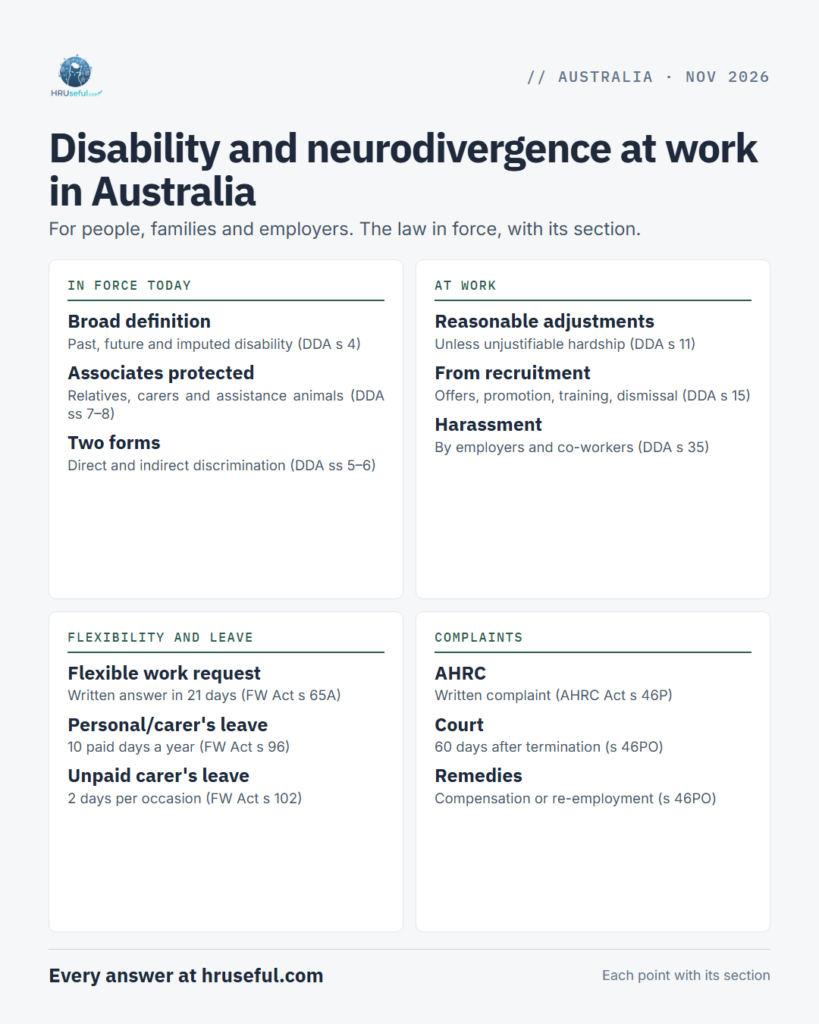
- In short · who it covers
- People with disability, including disability that is temporary, past, future or imputed; neurodivergent people; associates and carers; and employers, agencies and host businesses across Australia.
- What it sets out
- A ban on direct and indirect disability discrimination at every stage of employment, a duty to make reasonable adjustments unless they cause unjustifiable hardship, protection from harassment and victimisation, flexible working requests and carer’s leave under the Fair Work Act, and a complaints pathway through the Australian Human Rights Commission.
- Good to know
- Whoever claims unjustifiable hardship has to prove it, and whoever imposes a condition has to prove it is reasonable. State and territory laws apply alongside the federal law.
| Key point | What the law says |
| Who is protected | A broad definition. It covers physical, mental and learning differences, and disability that existed in the past, may exist in the future or is imputed. Disability Discrimination Act 1992, 4(1), definition of disability, (a) |
| Reasonable adjustments | Required unless unjustifiable hardship. Not making one can be direct discrimination; whoever claims unjustifiable hardship has to prove it. Disability Discrimination Act 1992, 11(2) |
| Recruitment | Covered from the job ad. Protection applies to recruitment arrangements, the decision on who is offered a job and the terms of the offer. Disability Discrimination Act 1992, 15(1)(a)–(b) |
| Flexible working | Written answer within 21 days. Employees with disability and carers can request changes in writing; a refusal needs reasonable business grounds. Fair Work Act 2009, 65A(1) |
| Carer’s leave | 10 days of paid personal/carer’s leave. Per year of service for non-casual employees, plus 2 days of unpaid carer’s leave per occasion. Fair Work Act 2009, 96(1)–(2) |
| Complaints | Australian Human Rights Commission. A written complaint is inquired into and conciliated; after termination there are 60 days to apply to court. Australian Human Rights Commission Act 1986, 46PO(2) and (3A) |
Who is protected
Is federal protection limited to physical disability?
No. The legal definition covers total or partial loss of bodily or mental functions and other situations expressly listed. An assessment should not be limited to what is visible.Law: Disability Discrimination Act 1992, 4(1), definition of disability, (a)
Can differences in the way a person learns be covered?
They can be, if the specific situation falls within the legal definition. The word neurodivergence does not decide the outcome on its own, nor does it allow HR to make a diagnosis.Law: Disability Discrimination Act 1992, 4(1), definition of disability, (f)
Is a person whose disability no longer exists also protected?
Yes. The definition includes a disability that presently exists and one that existed in the past, even if it no longer exists. Protection cannot be excluded for that reason alone.Law: Disability Discrimination Act 1992, 4(1), definition of disability, (h)–(i)
Does the law cover a disability that may exist in the future?
Yes. The definition covers that possibility, including a genetic predisposition. This does not allow candidates to be excluded on assumptions about their future health.Law: Disability Discrimination Act 1992, 4(1), definition of disability, (j)
What happens if the employer attributes a disability the person does not have?
The definition also includes a disability imputed to a person. A detrimental decision based on that imputation may be covered.Law: Disability Discrimination Act 1992, 4(1), definition of disability, (k)
Are the effects of a disability taken into account when assessing behaviour?
Yes. The definition includes behaviour that is a symptom or manifestation of a covered disability. Each case and the relevant adjustments must be analysed, without assuming that all behaviour has that origin.Law: Disability Discrimination Act 1992, 4(1), final paragraph of the definition of disability
Can there be discrimination for having a relative or associate with disability?
Yes. The law extends protection to a person who has an associate with disability. The relationship covered by the definition and the reason for the treatment must be established.Law: Disability Discrimination Act 1992, 7(1)
Does the protection also cover needing a carer or support?
Yes. The law extends the analysis to having a carer or assistant, an assistance animal or a disability aid. The relevant definitions and exceptions must be checked.Law: Disability Discrimination Act 1992, 8(1)
Is any pet an assistance animal under this law?
No. One of the legal pathways requires training to alleviate the effect of the disability and appropriate standards of hygiene and behaviour. There are also accreditation pathways; it is not presumed that any pet meets the requirements.Law: Disability Discrimination Act 1992, 9(2)(c)
What is a disability aid?
It can be equipment, including a palliative or therapeutic device, that the person uses and that helps to alleviate the effect of their disability. Its actual function must be assessed.Law: Disability Discrimination Act 1992, 9(3)
Discrimination and reasonable adjustments
What is direct disability discrimination?
It is less favourable treatment because of the disability than a person without that disability would receive in circumstances that are not materially different. The analysis requires comparing the relevant situations.Law: Disability Discrimination Act 1992, 5(1)
Does the discriminatory treatment have to have already happened?
Not necessarily. The definition also covers proposing less favourable treatment. The other legal elements of the case must still be established.Law: Disability Discrimination Act 1992, 5(1)
Can failing to make a reasonable adjustment be direct discrimination?
Yes, when not making the adjustment has, or would have, the effect of less favourable treatment required by the provision. Recording the request is not enough: its effects and the response must be assessed.Law: Disability Discrimination Act 1992, 5(2)(a)–(b)
Must every adjustment requested be accepted automatically?
No. The law defines a reasonable adjustment by reference to unjustifiable hardship. The circumstances and alternatives of the case must be analysed; the label given to the request does not settle on its own whether it must be made.Law: Disability Discrimination Act 1992, 4(1), definition of reasonable adjustment
Can a general rule result in indirect discrimination?
Yes. A seemingly general requirement can disadvantage people with disability if, because of that disability, they cannot or do not comply with it. The reasonableness defence provided by the law must also be considered.Law: Disability Discrimination Act 1992, 6(1)(a)–(c)
Can a uniform assessment require adjustments?
Yes. The provision covers a person who could only comply with a requirement if reasonable adjustments were made, and is disadvantaged when they are not made. Barriers and alternatives should be assessed before excluding the person.Law: Disability Discrimination Act 1992, 6(2)(b)–(c)
Is every requirement that causes disadvantage necessarily indirect discrimination?
No. The law provides a defence if the requirement or condition is reasonable having regard to the circumstances. That reasonableness must be proven, not assumed.Law: Disability Discrimination Act 1992, 6(3)
Who has to prove that a challenged condition is reasonable?
The person who requires, or proposes to require, compliance with it. HR should keep the reasons and evidence for the requirement and for the alternatives considered.Law: Disability Discrimination Act 1992, 6(4)
Must disability be the only reason for a decision for the law to apply?
No. It can be one of several reasons, even if it is not the dominant or substantial one. Adding another explanation does not automatically remove the discrimination analysis.Law: Disability Discrimination Act 1992, 10
Is the cost of an adjustment considered on its own?
No. It must be considered together with the circumstances of the case, including the financial position of whoever must make it. Saying that the adjustment has a cost is not enough.Law: Disability Discrimination Act 1992, 11(1)(c)
Does available financial assistance matter when assessing unjustifiable hardship?
Yes. The availability of financial and other assistance is a legal factor. Whether assistance exists must be checked for the case, without promising a specific subsidy.Law: Disability Discrimination Act 1992, 11(1)(d)
Who has to prove unjustifiable hardship?
The person claiming it. It is advisable to document the circumstances, costs, benefits and support considered, instead of giving a general refusal.Law: Disability Discrimination Act 1992, 11(2)
Recruitment, work and promotion
Does protection only begin once the contract is signed?
No. It also covers the arrangements made for recruitment and the decision about who should be offered employment, within the scope and exceptions of the law.Law: Disability Discrimination Act 1992, 15(1)(a)–(b)
Can the terms of a job offer be discriminatory?
Yes. The prohibition also covers the terms on which employment is offered. The offer must be reviewed, not only the decision to hire.Law: Disability Discrimination Act 1992, 15(1)(c)
Can a person be excluded from a promotion because of their disability?
The law prohibits denying or limiting opportunities for promotion because of disability. The assessment must look at the specific role and at the relevant exceptions and adjustments.Law: Disability Discrimination Act 1992, 15(2)(b)
Does protection cover access to the organisation’s training?
Yes. Training is one of the employment benefits expressly covered. The conditions of access and any barriers to taking part must be reviewed.Law: Disability Discrimination Act 1992, 15(2)(b)
Is dismissal also covered by the prohibition of discrimination?
Yes. The prohibition includes dismissal because of disability and other detriment at work. The real reasons and the legal exceptions must be analysed, without concluding that any termination of a person with disability is automatically unlawful.Law: Disability Discrimination Act 1992, 15(2)(c)–(d)
Can a host business discriminate against workers supplied by another employer?
The law prohibits a principal from discriminating against a contract worker because of disability, both in the terms on which the work is allowed and by not allowing them to work or continue working. That legal relationship must be established.Law: Disability Discrimination Act 1992, 17(a)–(b)
Are employment agencies covered?
Yes. They cannot discriminate because of disability by refusing their services, in the terms on which they offer them or in the way they provide them. The obligation is not limited to the business that will hire.Law: Disability Discrimination Act 1992, 21(1)(a)–(c)
Does protection extend to a licence needed to practise a profession?
Yes. It covers authorities that grant or renew authorisations or professional qualifications. The inherent requirements and applicable exceptions must be checked.Law: Disability Discrimination Act 1992, 19(a)
Can a registered organisation refuse membership because of disability?
The provision prohibits that discrimination by the organisations within its definition, both in admitting members and in the terms of admission.Law: Disability Discrimination Act 1992, 20(1)(a)–(b)
Can an inherent requirement be relied on without considering reasonable adjustments?
The exception requires that the person could not carry out the inherent requirements of the work even with the relevant reasonable adjustments. The essential functions should be identified and supports assessed before deciding.Law: Disability Discrimination Act 1992, 21A(1)(b)
Must the person’s experience and training be considered when assessing the role?
Yes. The law requires taking into account their training, qualifications and experience relevant to the particular work. That assessment cannot be replaced by a stereotype.Law: Disability Discrimination Act 1992, 21A(2)(a)
Does past performance matter when assessing someone who already works for the organisation?
Yes. The provision includes their work performance when they already work for the decision-maker. It must be assessed together with the other relevant factors.Law: Disability Discrimination Act 1992, 21A(2)(b)
Does the inherent requirements exception allow any employment benefit to be denied?
No. It has express limits for certain opportunities and detriments. Deciding who gets a promotion or transfer must be distinguished from denying other protected benefits.Law: Disability Discrimination Act 1992, 21A(4)(a)
Harassment, victimisation and liability
Is disability-related harassment by the employer prohibited?
Yes. The section prohibits an employer from harassing an employee in relation to their disability. The specific facts must be recorded and reviewed, not treated as part of the job.Law: Disability Discrimination Act 1992, 35(1)
Does the harassment prohibition cover co-workers?
Yes. It covers harassment of a person employed by the same employer in relation to their disability. It is not limited to a reporting relationship.Law: Disability Discrimination Act 1992, 35(2)
Can disability harassment happen while looking for work?
Yes. The section also protects people seeking employment from harassment in relation to their disability by the persons it covers.Law: Disability Discrimination Act 1992, 35(3)
Can someone be disadvantaged for making or announcing a complaint?
The law prohibits victimisation, which covers detriment or threats linked to having made, or proposing to make, a complaint under the relevant provisions. Indirect retaliation must also be reviewed.Law: Disability Discrimination Act 1992, 58A(1)–(2)(a)
Are people who give evidence as witnesses also protected?
Yes. Protection against victimisation covers having appeared, or proposing to appear, as a witness in the relevant proceedings.Law: Disability Discrimination Act 1992, 58A(2)(e)
Can the business ask for any medical information during recruitment?
Not indiscriminately. The provision restricts disability-related requests and provides exceptions for non-discriminatory purposes, such as assessing inherent requirements or adjustments. The need for the information and its use must be justified.Law: Disability Discrimination Act 1992, 30(2)–(3), example
Can physical access matter in addition to workplace adjustments?
Yes. The law also covers the means of access to premises that the public or a section of the public may enter or use. The features of the premises, the technical standards and applicable exceptions must be checked.Law: Disability Discrimination Act 1992, 23(c)
Does the federal law override state and territory anti-discrimination laws?
No. It allows them to operate concurrently where applicable. Before making a complaint or designing a policy, the local law and the rules on simultaneous proceedings must also be identified.Law: Disability Discrimination Act 1992, 13(3)
Can causing or helping an act of discrimination create liability?
Yes. The provision reaches anyone who causes, instructs, induces, aids or permits the unlawful act covered. Liability is not necessarily limited to whoever carries out the final decision.Law: Disability Discrimination Act 1992, 122
Can the business be liable for acts of its employees or agents?
Yes, for conduct within the scope of their actual or apparent authority, with the defence available to whoever proves reasonable precautions and due diligence. A written policy alone does not prove that it was applied.Law: Disability Discrimination Act 1992, 123(2)
Flexibility and caring
Can a person with disability request changes to their working arrangements?
Under the national system, and if they meet the requirements of the section, yes. They can request changes relating to their disability. This pathway must be distinguished from the duty to make adjustments under anti-discrimination law.Law: Fair Work Act 2009, 65(1), (1A)(c)
Can a carer request flexibility?
They can if they are a carer in the legal sense and meet the other requirements. Not every family relationship establishes that status on its own.Law: Fair Work Act 2009, 65(1A)(b)
How much service does this flexibility pathway require for non-casual employees?
At least 12 months of continuous service immediately before the request. That requirement belongs to this legal pathway and does not automatically apply to adjustments under anti-discrimination law.Law: Fair Work Act 2009, 65(2)(a)
Can casual employees use the legal request for flexibility?
Yes, if they have worked on a regular basis during the legal period and have a reasonable expectation of continuing employment on a regular and systematic basis. Not every casual engagement meets those requirements.Law: Fair Work Act 2009, 65(2)(b)
How must a flexibility request be made?
In writing, setting out the change requested and the reasons for it. It is advisable to keep a copy with the date it was received.Law: Fair Work Act 2009, 65(3)
How long does the employer have to respond to the request?
21 days, with a written response, for a request covered by section 65. That time limit must not be confused with the assessment of other adjustment requests.Law: Fair Work Act 2009, 65A(1)
Can the parties agree on a change different from the one first requested?
Yes. If it arises from the discussion and both parties agree, the response must set out that change. Its implementation should be made clear.Law: Fair Work Act 2009, 65A(2)(b)
Can the employer refuse the request without discussing it?
A refusal requires discussing the request, genuinely trying to reach agreement, considering the consequences for the employee and relying on reasonable business grounds. An automatic refusal is not enough.Law: Fair Work Act 2009, 65A(3)
What must a refusal explain?
It must set out the particular business grounds and explain how they apply to the request. It must also include the other matters and alternatives required by the section.Law: Fair Work Act 2009, 65A(6)(b)
Where can a refusal or a failure to respond be disputed?
The pathway first requires trying to resolve the dispute through discussions at the workplace. If it is not resolved, a party can refer it to the Fair Work Commission, under the requirements of the section.Law: Fair Work Act 2009, 65B(2)–(3)
Can a state law give more beneficial flexibility?
Yes. This part of the federal law is not intended to exclude more beneficial state or territory entitlements. The law that actually applies to the employment must be identified.Law: Fair Work Act 2009, 66
Is there paid personal or carer’s leave in the national system?
For covered employees who are not casuals, the law provides 10 days for each year of service. It accrues according to ordinary hours and carries over from year to year; the equivalent for the actual work pattern must be calculated.Law: Fair Work Act 2009, 96(1)–(2)
Does having a disability automatically allow sick leave to be used?
Not because of the condition alone. Personal leave is used when the person is not fit for work because of a personal illness or injury, meeting the notice and evidence requirements.Law: Fair Work Act 2009, 97(a)
Is there unpaid leave to care for a family or household member?
The law provides two days for each permissible occasion of illness, injury or unexpected emergency affecting an immediate family or household member. It cannot be taken during a period in which paid carer’s leave is available.Law: Fair Work Act 2009, 102 and 103(3)
Must personal or carer’s leave be notified and supported by evidence?
Yes. Notice must be given as soon as practicable and state the period, or expected period, of leave. If the employer requires it, evidence that would satisfy a reasonable person must be given.Law: Fair Work Act 2009, 107(1)–(3)
Complaints and protection
How is a complaint made to the Australian Human Rights Commission?
By a written complaint alleging acts, omissions or practices of unlawful discrimination. What happened must be specified; mentioning a workplace disagreement without explaining its link with discrimination is not enough.Law: Australian Human Rights Commission Act 1986, 46P(1)
What information must the complaint include?
Details of the alleged acts, omissions or practices, as fully as practicable. It helps to set out the facts in order and keep the documents that support them.Law: Australian Human Rights Commission Act 1986, 46P(1B)
Can another person or a union make the complaint on behalf of the person affected?
Yes. The law allows a person or trade union to lodge a complaint on behalf of one or more people affected. The representation and the scope of the case must be established.Law: Australian Human Rights Commission Act 1986, 46P(2)(c)
Must the Commission help if the person needs support to make the complaint?
It must take reasonable steps to provide appropriate assistance when the conditions of that section are met. The request for help can explain the barrier to framing or writing the complaint.Law: Australian Human Rights Commission Act 1986, 46P(4)
Does every complaint go straight to court?
No. Unless it is terminated earlier on the legal grounds, the pathway involves inquiring into the complaint and attempting to conciliate it. Termination and any access to the courts have their own requirements.Law: Australian Human Rights Commission Act 1986, 46PF(1)(c)
Does lodging a complaint after 24 months always prevent it from being dealt with?
It is not an automatic bar in that clause, but it is a ground on which the President may terminate the complaint. Time limits should be checked without delaying the complaint.Law: Australian Human Rights Commission Act 1986, 46PH(1)(b)
Must the termination of a complaint be notified with reasons?
Yes. The President must notify the complainants in writing of the termination and the reasons for it. That notice matters when assessing the next step.Law: Australian Human Rights Commission Act 1986, 46PH(2)
What general time limit applies to a court application after termination?
The provision sets 60 days from the date the notice was issued, or any further time the court allows. Leave of the court and any applicable legal exceptions must also be checked.Law: Australian Human Rights Commission Act 1986, 46PO(2) and (3A)
Can the court order financial compensation?
If it finds unlawful discrimination, it can order compensation for loss or damage caused by the conduct. It is not an automatic payment for making a complaint.Law: Australian Human Rights Commission Act 1986, 46PO(4)(d)
Can a court decision include employment or re-employment?
Yes. Among the possible orders is requiring the respondent to employ or re-employ the applicant. The remedy depends on the court’s decision and the case.Law: Australian Human Rights Commission Act 1986, 46PO(4)(c)
Keep exploring
- Private-sector employment in Australia
- Minimum wage and pay in Australia
- Unions in Australia
- Public-sector employment in Australia
- Independent contractors in Australia
- All Australia topics
- Disability and neurodivergence at work — Singapore
- Disability and neurodivergence at work — India
Every answer cites the law in force on 1 November 2026 and was checked against its official text. Current questions: 70.
- En pocas líneas · a quién alcanza
- A las personas con discapacidad, incluida la temporal, pasada, futura o atribuida; a las personas neurodivergentes; a familiares y personas cuidadoras, y a empleadores, agencias y empresas usuarias en toda Australia.
- Qué establece
- La prohibición de la discriminación directa e indirecta en todas las etapas del empleo, el deber de hacer ajustes razonables salvo carga injustificable, protección frente al acoso y las represalias, pedidos de flexibilidad y licencias por cuidado en la Fair Work Act, y una vía de reclamo ante la Australian Human Rights Commission.
- Lo que conviene saber
- Quien invoca una carga injustificable debe probarla, y quien impone una condición debe probar que es razonable. Las leyes de los estados y territorios se aplican junto con la ley federal.
| Dato clave | Qué dice la norma |
| A quién protege | Una definición amplia. Comprende diferencias físicas, mentales y de aprendizaje, y la discapacidad pasada, futura o atribuida. Disability Discrimination Act 1992, 4(1), definición de disability, (a) |
| Ajustes razonables | Obligatorios salvo carga injustificable. No hacerlos puede ser discriminación directa; quien invoca la carga injustificable debe probarla. Disability Discrimination Act 1992, 11(2) |
| Selección | Protegida desde el aviso. Alcanza la organización de la selección, la decisión de a quién ofrecer el empleo y las condiciones de la oferta. Disability Discrimination Act 1992, 15(1)(a)–(b) |
| Flexibilidad | Respuesta escrita en 21 días. Personas con discapacidad y cuidadoras pueden pedir cambios por escrito; el rechazo exige razones empresariales razonables. Fair Work Act 2009, 65A(1) |
| Licencia por cuidado | 10 días pagos por año. Licencia personal o por cuidado para empleados no casuales, más 2 días sin goce por cada ocasión de cuidado. Fair Work Act 2009, 96(1)–(2) |
| Reclamos | Australian Human Rights Commission. La denuncia escrita se investiga y concilia; terminada, hay 60 días para presentarse ante el tribunal. Australian Human Rights Commission Act 1986, 46PO(2) y (3A) |
A quién protege
¿La protección federal se limita a las discapacidades físicas?
No. La definición legal comprende la pérdida total o parcial de funciones corporales o mentales y otras situaciones expresamente enumeradas. No debe limitarse la evaluación a lo visible.Norma: Disability Discrimination Act 1992, 4(1), definición de disability, (a)
¿Las diferencias en la forma de aprender pueden estar comprendidas?
Pueden estarlo si la situación concreta encuadra en la definición legal. La palabra neurodivergencia no determina por sí sola el resultado ni habilita a RR. HH. a realizar un diagnóstico.Norma: Disability Discrimination Act 1992, 4(1), definición de disability, (f)
¿También está protegida una persona cuya discapacidad ya no existe?
Sí. La definición incluye una discapacidad presente y una que existió anteriormente, aunque ya no exista. No corresponde excluir la protección por ese solo motivo.Norma: Disability Discrimination Act 1992, 4(1), definición de disability, (h)–(i)
¿La ley contempla una discapacidad que podría existir en el futuro?
Sí. La definición comprende esa posibilidad, incluida la predisposición genética. Eso no autoriza a excluir candidatos por suposiciones sobre su salud futura.Norma: Disability Discrimination Act 1992, 4(1), definición de disability, (j)
¿Qué ocurre si el empleador atribuye una discapacidad que la persona no tiene?
La definición también incluye una discapacidad atribuida a la persona. Una decisión perjudicial basada en esa atribución puede quedar alcanzada.Norma: Disability Discrimination Act 1992, 4(1), definición de disability, (k)
¿Se consideran las manifestaciones de la discapacidad al evaluar una conducta?
Sí. La definición incluye conductas que sean síntoma o manifestación de una discapacidad comprendida. Hay que analizar el caso y los ajustes pertinentes, sin presumir que toda conducta tiene ese origen.Norma: Disability Discrimination Act 1992, 4(1), párrafo final de la definición de disability
¿Puede haber discriminación por tener un familiar o persona cercana con discapacidad?
Sí. La ley extiende su protección a quien tiene una persona asociada con discapacidad. Debe comprobarse la relación comprendida en la definición y el motivo del trato.Norma: Disability Discrimination Act 1992, 7(1)
¿La protección también contempla necesitar un asistente o apoyo?
Sí. La ley extiende el análisis a tener una persona cuidadora o asistente, un animal de asistencia o una ayuda por discapacidad. Deben verificarse las definiciones y excepciones correspondientes.Norma: Disability Discrimination Act 1992, 8(1)
¿Cualquier mascota es un animal de asistencia para esta ley?
No. Una de las vías legales exige entrenamiento para aliviar el efecto de la discapacidad y estándares adecuados de higiene y conducta. También existen vías de acreditación; no se presume que cualquier mascota reúna los requisitos.Norma: Disability Discrimination Act 1992, 9(2)(c)
¿Qué comprende una ayuda por discapacidad?
Puede ser un equipo, incluido un dispositivo paliativo o terapéutico, que la persona utiliza y que ayuda a aliviar el efecto de su discapacidad. Debe analizarse su función concreta.Norma: Disability Discrimination Act 1992, 9(3)
Discriminación y ajustes razonables
¿Qué es la discriminación directa por discapacidad?
Es el trato menos favorable por la discapacidad frente al que recibiría una persona sin esa discapacidad en circunstancias que no sean materialmente diferentes. El análisis requiere comparar situaciones pertinentes.Norma: Disability Discrimination Act 1992, 5(1)
¿Hace falta que el trato discriminatorio ya se haya ejecutado?
No necesariamente. La definición también contempla proponer un trato menos favorable. Deben verificarse los demás elementos legales del caso.Norma: Disability Discrimination Act 1992, 5(1)
¿No hacer un ajuste razonable puede constituir discriminación directa?
Sí, cuando la falta del ajuste produzca o pueda producir el trato menos favorable que exige la norma. No basta con registrar el pedido: corresponde evaluar sus efectos y la respuesta.Norma: Disability Discrimination Act 1992, 5(2)(a)–(b)
¿Debe aceptarse automáticamente cualquier ajuste solicitado?
No. La ley define el ajuste razonable con referencia a la carga injustificable. Deben analizarse las circunstancias y alternativas del caso; el nombre dado al pedido no resuelve por sí solo su procedencia.Norma: Disability Discrimination Act 1992, 4(1), definición de reasonable adjustment
¿Una regla general puede producir discriminación indirecta?
Sí. Un requisito aparentemente general puede perjudicar a personas con discapacidad si estas no pueden o no llegan a cumplirlo por esa discapacidad. También debe revisarse la defensa de razonabilidad prevista por la ley.Norma: Disability Discrimination Act 1992, 6(1)(a)–(c)
¿Una evaluación uniforme puede requerir ajustes?
Sí. La norma contempla que una persona solo pueda cumplir un requisito si se realizan ajustes razonables y que no hacerlos la coloque en desventaja. Conviene evaluar barreras y alternativas antes de excluirla.Norma: Disability Discrimination Act 1992, 6(2)(b)–(c)
¿Todo requisito que genera desventaja es necesariamente discriminación indirecta?
No. La ley contempla una defensa si el requisito o condición es razonable atendiendo a las circunstancias. Esa razonabilidad debe demostrarse, no presumirse.Norma: Disability Discrimination Act 1992, 6(3)
¿Quién debe probar la razonabilidad de una condición cuestionada?
La persona que exige o propone exigir su cumplimiento. RR. HH. debería conservar las razones y evidencias del requisito y de las alternativas evaluadas.Norma: Disability Discrimination Act 1992, 6(4)
¿La discapacidad debe ser el único motivo de una decisión para que la ley se aplique?
No. Puede ser uno de varios motivos, aunque no sea el dominante ni sustancial. Agregar otra explicación no elimina automáticamente el análisis de discriminación.Norma: Disability Discrimination Act 1992, 10
¿El costo de un ajuste se analiza de manera aislada?
No. Debe analizarse junto con las circunstancias del caso, incluida la situación financiera de quien debe realizarlo. No alcanza con afirmar que el ajuste tiene un costo.Norma: Disability Discrimination Act 1992, 11(1)(c)
¿La ayuda financiera disponible importa para evaluar una carga injustificable?
Sí. La disponibilidad de asistencia financiera y de otro tipo es un factor legal. La existencia o inexistencia de ayuda debe verificarse para el caso, sin prometer un subsidio concreto.Norma: Disability Discrimination Act 1992, 11(1)(d)
¿Quién debe acreditar que existe una carga injustificable?
Quien la invoca. Es conveniente documentar las circunstancias, los costos, beneficios y apoyos considerados, en lugar de limitarse a una negativa general.Norma: Disability Discrimination Act 1992, 11(2)
Selección, trabajo y ascensos
¿La protección comienza recién cuando se firma el contrato?
No. También comprende la organización de la selección y la determinación de a quién ofrecer empleo, dentro del ámbito y excepciones de la ley.Norma: Disability Discrimination Act 1992, 15(1)(a)–(b)
¿Las condiciones de una oferta laboral pueden ser discriminatorias?
Sí. La prohibición también alcanza las condiciones en que se ofrece el empleo. Debe revisarse la oferta y no solamente la decisión de contratar.Norma: Disability Discrimination Act 1992, 15(1)(c)
¿Puede excluirse de un ascenso a una persona por su discapacidad?
La ley prohíbe negar o limitar oportunidades de promoción por discapacidad. La evaluación debe atender al puesto concreto y a las excepciones y ajustes que correspondan.Norma: Disability Discrimination Act 1992, 15(2)(b)
¿La protección comprende el acceso a capacitación de la empresa?
Sí. La capacitación es uno de los beneficios laborales expresamente contemplados. Deben revisarse las condiciones de acceso y las barreras que impidan participar.Norma: Disability Discrimination Act 1992, 15(2)(b)
¿El despido también está comprendido en la prohibición de discriminación?
Sí. La prohibición incluye despedir por discapacidad y otros perjuicios laborales. Deben analizarse los motivos reales y las excepciones legales, sin concluir que cualquier desvinculación de una persona con discapacidad sea automáticamente ilícita.Norma: Disability Discrimination Act 1992, 15(2)(c)–(d)
¿Una empresa usuaria puede discriminar al personal provisto por otro empleador?
La ley prohíbe al principal discriminar al contract worker por discapacidad, tanto en las condiciones permitidas como al impedir que trabaje o continúe trabajando. Debe comprobarse esa relación jurídica.Norma: Disability Discrimination Act 1992, 17(a)–(b)
¿Las agencias de empleo están alcanzadas?
Sí. No pueden discriminar por discapacidad al negar sus servicios, fijar sus condiciones o prestarlos. La obligación no se limita a la empresa que contratará.Norma: Disability Discrimination Act 1992, 21(1)(a)–(c)
¿La protección alcanza a una habilitación necesaria para ejercer una profesión?
Sí. Comprende organismos que conceden o renuevan autorizaciones o calificaciones profesionales. Deben verificarse las exigencias inherentes y las excepciones aplicables.Norma: Disability Discrimination Act 1992, 19(a)
¿Una organización registrada puede rechazar una afiliación por discapacidad?
La norma prohíbe esa discriminación en las organizaciones comprendidas en su definición, tanto al aceptar miembros como en las condiciones de ingreso.Norma: Disability Discrimination Act 1992, 20(1)(a)–(b)
¿Puede invocarse una exigencia inherente sin considerar ajustes razonables?
La excepción exige que la persona no pueda cumplir los requisitos inherentes del trabajo aun realizando los ajustes razonables pertinentes. Conviene identificar las funciones esenciales y evaluar apoyos antes de decidir.Norma: Disability Discrimination Act 1992, 21A(1)(b)
¿La experiencia y formación de la persona deben considerarse al evaluar el puesto?
Sí. La ley exige tomar en cuenta su formación, calificaciones y experiencia relevantes para el trabajo concreto. No corresponde reemplazar esa evaluación por un estereotipo.Norma: Disability Discrimination Act 1992, 21A(2)(a)
¿El desempeño previo importa al evaluar a quien ya trabaja en la organización?
Sí. La norma incluye su desempeño laboral cuando ya trabaja para quien toma la decisión. Debe evaluarse junto con los demás factores pertinentes.Norma: Disability Discrimination Act 1992, 21A(2)(b)
¿La excepción de requisitos inherentes permite negar cualquier beneficio laboral?
No. Tiene límites expresos para determinadas oportunidades y perjuicios. Debe distinguirse decidir quién accede a un ascenso o traslado de negar otros beneficios protegidos.Norma: Disability Discrimination Act 1992, 21A(4)(a)
Acoso, represalias y responsabilidad
¿Está prohibido el acoso del empleador relacionado con la discapacidad?
Sí. El artículo prohíbe acosar a su empleado en relación con la discapacidad. Corresponde registrar y revisar los hechos concretos, no normalizarlos como parte del trabajo.Norma: Disability Discrimination Act 1992, 35(1)
¿La prohibición de acoso alcanza a compañeros de trabajo?
Sí. Comprende el acoso a una persona empleada por el mismo empleador, en relación con su discapacidad. No se limita a una relación jerárquica.Norma: Disability Discrimination Act 1992, 35(2)
¿Puede haber acoso por discapacidad durante la búsqueda de empleo?
Sí. El artículo también protege a quienes buscan empleo frente al acoso relacionado con su discapacidad por las personas comprendidas en la norma.Norma: Disability Discrimination Act 1992, 35(3)
¿Puede perjudicarse a alguien por presentar o anunciar un reclamo?
La ley prohíbe la victimización, que comprende perjuicios o amenazas vinculados con haber presentado o proponerse presentar una denuncia bajo las normas indicadas. Deben revisarse también las represalias indirectas.Norma: Disability Discrimination Act 1992, 58A(1)–(2)(a)
¿También están protegidos quienes declaran como testigos?
Sí. La protección contra victimización comprende haber comparecido o proponerse comparecer como testigo en los procedimientos indicados.Norma: Disability Discrimination Act 1992, 58A(2)(e)
¿La empresa puede pedir cualquier información médica durante la selección?
No de manera indiscriminada. La norma restringe solicitudes vinculadas con discapacidad y contempla excepciones por finalidades no discriminatorias, como evaluar requisitos inherentes o ajustes. Hay que justificar la necesidad y el uso del dato.Norma: Disability Discrimination Act 1992, 30(2)–(3), ejemplo
¿La accesibilidad física puede ser relevante además de los ajustes del puesto?
Sí. La ley también contempla los medios de acceso a lugares a los que el público o un sector del público puede ingresar o usar. Deben verificarse las características del lugar, las normas técnicas y excepciones aplicables.Norma: Disability Discrimination Act 1992, 23(c)
¿La ley federal elimina las leyes antidiscriminatorias de estados y territorios?
No. Permite su funcionamiento concurrente cuando corresponda. Antes de reclamar o diseñar una política debe identificarse también la norma local y las reglas sobre procedimientos simultáneos.Norma: Disability Discrimination Act 1992, 13(3)
¿Ordenar o facilitar un acto discriminatorio puede generar responsabilidad?
Sí. La norma alcanza a quien causa, ordena, induce, ayuda o permite el acto ilícito comprendido. La responsabilidad no se limita necesariamente a quien ejecuta la decisión final.Norma: Disability Discrimination Act 1992, 122
¿La empresa puede responder por actos de sus empleados o agentes?
Sí, por conductas dentro del alcance de su autoridad real o aparente, con la defensa prevista para quien acredite precauciones razonables y diligencia debida. Una política escrita por sí sola no acredita que se haya aplicado.Norma: Disability Discrimination Act 1992, 123(2)
Flexibilidad y cuidados
¿Una persona con discapacidad puede pedir cambios en su organización del trabajo?
En el sistema nacional y si cumple los requisitos de la sección, sí. Puede solicitar cambios relacionados con su discapacidad. Es una vía que debe distinguirse del deber de ajustes de la ley antidiscriminatoria.Norma: Fair Work Act 2009, 65(1), (1A)(c)
¿Quien cuida a otra persona puede pedir flexibilidad?
Puede hacerlo si es carer en el sentido legal y cumple los demás requisitos. No cualquier vínculo familiar acredita por sí solo esa condición.Norma: Fair Work Act 2009, 65(1A)(b)
¿Qué antigüedad exige esta vía de flexibilidad para quien no es casual?
Al menos doce meses de servicio continuo inmediatamente anteriores al pedido. Ese requisito es de esta vía legal y no se traslada automáticamente a los ajustes antidiscriminatorios.Norma: Fair Work Act 2009, 65(2)(a)
¿El personal casual puede utilizar la solicitud legal de flexibilidad?
Sí, si reúne las condiciones de regularidad durante el período legal y una expectativa razonable de continuidad regular y sistemática. No todo vínculo casual cumple esos requisitos.Norma: Fair Work Act 2009, 65(2)(b)
¿Cómo debe presentarse el pedido de flexibilidad?
Por escrito, detallando el cambio solicitado y sus razones. Conviene conservar una copia con fecha de recepción.Norma: Fair Work Act 2009, 65(3)
¿Qué plazo tiene el empleador para responder esa solicitud?
Veintiún días, mediante respuesta escrita, cuando se trata de una solicitud comprendida en la sección 65. No debe confundirse ese plazo con el análisis de otros pedidos de ajustes.Norma: Fair Work Act 2009, 65A(1)
¿Las partes pueden acordar un cambio diferente del solicitado inicialmente?
Sí. Si surge de la discusión y ambas partes lo acuerdan, la respuesta debe identificar ese cambio. Conviene precisar su implementación.Norma: Fair Work Act 2009, 65A(2)(b)
¿El empleador puede rechazar el pedido sin conversarlo?
La negativa está condicionada a discutirlo, intentar genuinamente un acuerdo, considerar las consecuencias para el trabajador y fundarse en razones empresariales razonables. No basta con una negativa automática.Norma: Fair Work Act 2009, 65A(3)
¿Qué debe explicar una respuesta negativa?
Debe identificar los motivos empresariales concretos y explicar cómo se aplican al pedido. También debe incluir los demás elementos y alternativas que exige la sección.Norma: Fair Work Act 2009, 65A(6)(b)
¿Dónde puede discutirse un rechazo o la falta de respuesta?
La vía prevé intentar primero resolver la disputa mediante conversaciones en el lugar de trabajo. Si no se resuelve, una parte puede llevarla a la Fair Work Commission, bajo los requisitos de la sección.Norma: Fair Work Act 2009, 65B(2)–(3)
¿Una ley estatal puede reconocer una flexibilidad más beneficiosa?
Sí. Esta parte de la ley federal no pretende excluir derechos estatales o territoriales más beneficiosos. Debe identificarse la norma que realmente se aplica al vínculo.Norma: Fair Work Act 2009, 66
¿Existe licencia paga personal o por cuidado en el sistema nacional?
Para los empleados comprendidos que no son casuals, la ley establece diez días por año de servicio. Se acumulan según las horas ordinarias y pasan de un año a otro; debe calcularse la equivalencia del horario concreto.Norma: Fair Work Act 2009, 96(1)–(2)
¿Tener una discapacidad permite usar automáticamente licencia por enfermedad?
No por la sola condición. La licencia personal se utiliza cuando la persona no está apta para trabajar debido a una enfermedad o lesión personal, cumpliendo los requisitos de aviso y evidencia.Norma: Fair Work Act 2009, 97(a)
¿Existe una licencia sin sueldo para atender a un familiar o conviviente?
La ley prevé dos días por cada ocasión admisible de enfermedad, lesión o emergencia inesperada de un familiar inmediato o miembro del hogar. No puede utilizarse en un período en que corresponda la licencia paga de cuidado.Norma: Fair Work Act 2009, 102 y 103(3)
¿Debe avisarse y acreditarse la licencia personal o de cuidado?
Sí. El aviso debe darse tan pronto sea practicable e indicar la duración o duración esperada. Si el empleador lo requiere, debe aportarse evidencia que satisfaga a una persona razonable.Norma: Fair Work Act 2009, 107(1)–(3)
Reclamos y protección
¿Cómo se inicia un reclamo ante la Australian Human Rights Commission?
Mediante una denuncia escrita que alegue actos, omisiones o prácticas de discriminación ilícita. Debe individualizarse lo ocurrido; no basta mencionar un desacuerdo laboral sin explicar el vínculo con la discriminación.Norma: Australian Human Rights Commission Act 1986, 46P(1)
¿Qué información debe incluir la denuncia?
Los detalles de los actos, omisiones o prácticas alegadas, tan completos como sea practicable. Es útil ordenar los hechos y conservar la documentación que los respalde.Norma: Australian Human Rights Commission Act 1986, 46P(1B)
¿Otra persona o un sindicato puede presentar el reclamo en nombre de la persona afectada?
Sí. La ley permite que una persona o sindicato presente una denuncia por una o más personas afectadas. Debe comprobarse la representación y el alcance del caso.Norma: Australian Human Rights Commission Act 1986, 46P(2)(c)
¿La Comisión debe ayudar si la persona necesita apoyo para formular la denuncia?
Debe tomar medidas razonables para ofrecer asistencia apropiada cuando se dan las condiciones de esa sección. La solicitud de ayuda puede explicar la barrera para formular o escribir el reclamo.Norma: Australian Human Rights Commission Act 1986, 46P(4)
¿Todo reclamo pasa directamente a juicio?
No. Si no se termina antes por las causas legales, la vía prevé investigar e intentar conciliar. La terminación y el eventual acceso judicial tienen requisitos propios.Norma: Australian Human Rights Commission Act 1986, 46PF(1)(c)
¿Presentar el reclamo después de veinticuatro meses impide siempre que sea tratado?
No es una prohibición automática en esa cláusula, pero constituye una causa por la que la Presidencia puede terminar el reclamo. Conviene revisar los plazos sin demorar la presentación.Norma: Australian Human Rights Commission Act 1986, 46PH(1)(b)
¿La terminación del reclamo debe comunicarse con sus motivos?
Sí. La Presidencia debe notificar por escrito a los denunciantes la terminación y sus razones. Esa notificación importa para evaluar la siguiente vía.Norma: Australian Human Rights Commission Act 1986, 46PH(2)
¿Qué plazo general prevé la solicitud judicial después de la terminación?
La norma establece sesenta días desde la emisión de la notificación, o el tiempo adicional que admita el tribunal. Deben verificarse también el permiso judicial y las excepciones legales que correspondan.Norma: Australian Human Rights Commission Act 1986, 46PO(2) y (3A)
¿El tribunal puede ordenar una compensación económica?
Si determina discriminación ilícita, puede ordenar indemnización por pérdidas o daños causados por la conducta. No es un pago automático por presentar una denuncia.Norma: Australian Human Rights Commission Act 1986, 46PO(4)(d)
¿Una decisión judicial puede incluir empleo o reincorporación?
Sí. Entre las órdenes posibles está exigir que el demandado emplee o vuelva a emplear a la persona solicitante. La medida depende de la decisión del tribunal y del caso.Norma: Australian Human Rights Commission Act 1986, 46PO(4)(c)
Seguí recorriendo
- Trabajo en el sector privado en Australia
- Sindicatos en Australia
- Trabajo independiente en Australia
- Salario mínimo en Australia
- Todos los temas de Australia
- Discapacidad y neurodivergencia en el trabajo — España
- Discapacidad y neurodivergencia en el trabajo — Argentina
Cada respuesta cita la norma vigente al 1/11/2026 y fue cotejada con su texto oficial. Preguntas actuales: 70.
2026 HRUseful.com — Contenido de elaboración propia basado en fuentes oficiales actualizadas a noviembre 2026. Se permite la reproducción parcial o total con mención expresa de la fuente: hruseful.com. Para consultas y asesoramiento especializado visitá nuestro centro de contacto.